Review of the Canadian Security Intelligence Service-Royal Canadian Mounted Police relationship in a region of Canada through the lens of an ongoing investigation: Backgrounder
Review of the Canadian Security Intelligence Service-Royal Canadian Mounted Police relationship in a region of Canada through the lens of an ongoing investigation
Backgrounder
Backgrounder
On February 10, 2021, the National Security and Intelligence Review Agency (NSIRA) presented the Minister of Public Safety and Emergency Preparedness with a classified report on its review of the CSIS-RCMP relationship in a region of Canada through the lens of an ongoing investigation.
NSIRA’s review found that in the specific region, the agencies have developed a strong relationship that has fostered effective tactical de-confliction of operational activities. Nonetheless, technological constraints are making CSIS-RCMP de-confliction excessively burdensome and time-consuming. Furthermore, NSIRA observed a general reluctance on the part of both agencies to connect CSIS information to an RCMP investigation.
NSIRA found that the current framework guiding the CSIS-RCMP relationship sets out principals and guidelines to manage the risks of interaction and information sharing between the two agencies; however, it left fundamental issues related to the “intelligence-to-evidence” problem unresolved.
On the whole, NSIRA found that CSIS and the RCMP have made little progress in addressing the threat under investigation. Moreover, CSIS and the RCMP do not have a shared vision or complementary strategy to address the threat.
Publishing this summary aligns with NSIRA’s efforts at increasing transparency and being more accessible to Canadians through its work. Going forward, NSIRA will review CSIS and the RCMP’s implementation of the Operational Improvement Review which set out ambitious recommendations to improve the way in which CSIS and the RCMP jointly manage threats.
Review of the Canadian Security Intelligence Service-Royal Canadian Mounted Police relationship in a region of Canada through the lens of an ongoing investigation
Review of the Canadian Security Intelligence Service-Royal Canadian Mounted Police relationship in a region of Canada through the lens of an ongoing investigation
Review of the Canadian Security Intelligence Service’s (CSIS) Internal Security Branch: CSIS Responses
Review of the Canadian Security Intelligence Service’s (CSIS) Internal Security Branch
Responses
CSIS Internal Security (SIRC 2018-15)
NSIRA Recommendation: CSIS develop an internal policy, in consultation with Treasury Board Secretariat (TBS), outlining parameters on reporting information obtained during the course of IS screening, inquiries, and investigations to law enforcement in a timely manner.
CSIS Response: CSIS has established an internal set of procedures for disclosing information obtained during the course of Internal Security screening to law enforcement, as required. CSIS will continue to review these procedures and will continue to seek legal advice from the Department of Justice regarding these disclosures, as required. CSIS and the Department of Justice have a collaborative relationship that fosters discussion and allows for robust engagement in these matters.
NSIRA Recommendation: CSIS strengthen internal governance over polygraph activities, including modifying the methodology for conducting polygraph assessments, as appropriate.
CSIS Response: CSIS considers the findings and observations in this review as an opportunity to enhance its internal processes. As such, CSIS is working to address this recommendation by strengthening internal governance. New policy and procedures will provide clarity, accountability and transparency to its polygraph program by outlining roles and the ethical and procedural responsibilities of polygraph examiners.
NSIRA Recommendation: CSIS update applicable policy and procedures on the use of the polygraph to address security and procedural fairness implications stemming from failed polygraph results.
CSIS Response: CSIS values the important work done by the National Security and Intelligence Review Agency (NSIRA). To address gaps identified by NSIRA, CSIS is currently updating the polygraph policy and procedures to ensure an enhanced degree of transparency and procedural fairness.
NSIRA Recommendation: IS further align its overarching policy suite with the assessment criteria for adverse information outlined in the Standard on Security Screening, as well as update the its Questionnaire Guidebook with clear definitions and risk indicators.
CSIS Response: CSIS continually engages in the process of updating its guides, procedures and policies. CSIS will ensure that procedures are well aligned with the Treasury Board Secretariat’s Standard on Security Screening. Providing consistency in assessments between cases remains a priority.
Review of the Canadian Security Intelligence Service’s (CSIS) Internal Security Branch: Backgrounder
Review of the Canadian Security Intelligence Service’s (CSIS) Internal Security Branch
Backgrounder
Review Backgrounder
On August 14, 2019, the National Security and Intelligence Review Agency (NSIRA) presented the Minister of Public Safety and Emergency Preparedness with a classified report on its review of the Canadian Security Intelligence Service’s (CSIS) Internal Security Branch. This review is a follow-up to the 2013 study conducted by NSIRA’s predecessor, the Security Intelligence Review Committee (SIRC) of CSIS’s Internal Security (IS) Branch. SIRC found a number of serious shortcomings related to CSIS’s handling of sensitive case files, access lists and their practices and management of internal investigations.
NSIRA’s latest review found that while significant improvements have been made with respect to internal security at CSIS since the 2013 review (The “Insider Threat” and Its Effect on Information Management — Section 54 Report (TOP SECRET) (PDF of Review) (SIRC 2013-06)), further improvements to internal security policies could strengthen the consistency of decision-making on personnel security files and investigations. It could also improve the procedural fairness of these processes writ large.
NSIRA’s review also examined the use of the polygraph, and sought justification for its use and the extent to which such determinations are reasonable and necessary. Several key observations were derived from this analysis. It also raised a much broader consideration: namely, the extent to which the government’s overarching policy document, the Standard on Security Screening, provides adequate guidance for departments and agencies when they implement this safeguarding measure.
Going forward, NSIRA will continue to examine the Government’s use of the polygraph as a security screening tool.
This review began under the authority of the Security Intelligence Review Committee (SIRC) articulated in subsection 38(1 ) of the Canadian Security Intelligence Service’s (CSIS Act), which provided SIRC the mandate to review CSIS’s operations in the performance of its duties and functions.
During the course of the review. Bill C-59 -An Act Respecting National Security Matters received Royal Assent on June 21, 2019. Part 1 of Bill C-59 enacted the National Security and Intelligence Review Agency Act (NSIRA Act), which came into force by order of the Governor in Council on July 12, 2019. The NSIRA Act repeals the provisions of the CSIS Act that established and governed SIRC and establishes in its place the National Security and Intelligence Review Agency (NSIRA). The NSIRA Act sets out the composition, mandate and powers of NSIRA and amends the CSIS Act, and other Acts, in order to transfer certain powers, duties and functions to NSIRA.
This review continued under the authority described in subsections 8(1 )(a) and 8(3) of the NSIRA Act to review any activity carried out by CSIS and to make any finding and recommendation that NSIRA considers appropriate.
2. Introduction
In its review function, NSIRA expects CSIS’s activities to be lawful and comply with ministerial direction. This review focused on CSIS’ s non-warranted collection of geolocation information and is part of NSIRA’s ongoing interest in CSIS’s collection and exploitation of both warranted and unwarranted data. Past reviews have assessed CSIS’s warranted collection and retention of metadata and CSIS’s unwarranted collection and exploitation of bulk personal datasets. This is NSIRA’s first dedicated look at CSIS’s collection of geolocation data.
The review takes place in the context of Federal Court decisions, most particularly the IMSI decision of September 27. 2017, that impact on CSIS’s collection, use and retention of data, including geolocation data. The IMSI decision found that, though CSIS’s authority under section 12 does authorize it to obtain geolocation information for which there is a low expectation of privacy, anything beyond that, such as geolocating an individual, would require a warrant.
It is worth noting that the scope of the review was broader at the outset and was intended to include a more comprehensive examination of the collection of different types of geolocation information, both warranted and unwarranted. Although the scope was reduced in the course of the review, NSIRA will be mindful of this for future reviews.
3. Objectives
The objective of this review is to assess whether CSIS’s collection of unwarranted geolocation information used by CSIS in support of its operations is compliant with applicable sources of law, including the Canadian Charter of Rights and Freedoms (Charter) and the CSIS Act, as well as ministerial direction and operational policy. A related objective is to determine whether CSIS has sufficient safeguards in the form of formal procedures and policies to ensure that it is able to comply with its legal obligations amid a period of rapid change in technology and a correspondingly fluid legal environment.
4. Scope and Methodology
The scope and direction of the review was identified through a preliminary investigation of available documentation and a briefing with the ████████████████████████████████████████████████████████ Further, NSIRA requested that CSIS identify all activities undertaken by the █████ that may result in geographic information collected against non-warranted targets within the review period. This information was used as a foundation to request specific documents from CSIS.
NSIRA examined all documents provided by CSIS and sought, retrieved and reviewed documents through CSIS’s various computer and email systems to ensure a clear record of activity. Documents reviewed included: ██████████████ taskings from the regions, responses to these taskings, briefing notes, planning documents, legal assessments and internal correspondence.
To conduct a compliance assessment of CSIS’ s use of geolocation information, NSIRA chose to conduct an in-depth case study of ██████████████████████████████████████████ geolocation information. NSIRA reviewed all instances when ██████████ was used by CSIS during the period under review. As this review consists of a single case study. NSIRA is mindful of generalizing the findings and conclusions to other types of geolocation data.
The core review period for this study was from January 1, 2017 to June 30, 2018, although NSIRA examined documentation that fell outside this period in order to provide a complete assessment of relevant issues.
5. Criteria
Legal and Ministerial Requirements
NSIRA expects CSIS to conduct its activities in accordance with relevant sources of law. including the CSIS Act. the Charter. the Privacy Act. and case law. NSIRA also expects CSIS to conduct its activities in accordance with ministerial direction. Most relevant in this review given the subject matter was an analysis of the Charter, which, in section 8, provides everyone with the right to be secure against unreasonable search and seizure. In this case, at issue was whether the use of ███████ to collect information about an individual’s location information constitutes a search for the purposes of section 8 such that a warrant would be required.
Policies and Procedures
NSIRA’s expectation was that there would be policies and procedures in place to guide the collection, use and retention of data from ███████ despite its uniqueness, and that those policies and procedures would support compliance with CSIS’s legal obligations, including the Charter, as well as its obligations stemming from ministerial direction.
For reference, the relevant policies that pertain to the collection of information ███████
███████████████████████████████████████████████████████████████████████████████████████████████████████████████████████████████████████████████████████████████████████████████████████████████████████████████████████████████████████ In principle, this allows collection of this nature on a very broad cross-section of individuals;
The collection of █████████ policies, including the DDO Memorandum of 2015 that request the establishment of █████████ as the National Policy Centre for █████████. Additionally there is the procedure on █████████ that allows █████ to conduct █████████ defined as a non-warranted collection tool or technique, against a ██████████████████████████████████████████████████████████████.
6. Background
The Investigative Technique – █████████
████████████████████████████████████████████████████████████████████████████████████████████████████████████████████████████████████████████████████████████████████████████████████████████████████████████████████████████████████████████████████████████████████████████████████████████████████████████████████████████████████████████████████████████████████████████████████████████████████████████████████████████████████ from users across the world.
█████████ contains three months of data. The information is not available in real-time; however, there is a delay of only 24-48 hours between the collection of the ████ and it becoming available in ████████.
█████ echoed those same governance-related issues; specifically, it questioned whether there were legal issues associated with █████ that needed to be addressed prior to the trial period. █████ asked for “the rules of engagement so that we can plan accordingly and get the most of this evaluation.”█████ further noted that, although the data seemed “wonderful….there must be some legal/governance rules that apply to this when in the hands of a government agency. These questions were raised in an email to both █████ and the ██████████
███████████████████████████████████████████████████████████████████████████████████████████████████████████████████ Nevertheless, by September 2017 █████ was anticipating an evaluation of █████ that would involve using █████ for a trial period of two months with a limited ██████████.
█████convened a meeting in October with █████████████████████████████████████████████████████████████████████████████████████████████████████████ The objective of the meeting was to prepare for a █████ evaluation and, for that purpose, “to make decisions on a few details to ensure compliance with legal and policy.
The questions to be covered in the agenda were:
1 ) Does existing █████ policy cover the use of █████ or does the policy need to be adapted?
2) Is the information contained in ███████ subject to a reasonable expectation of privacy?
3) Is there anything else that needs to be considered before CSIS can use █████? For example, additional █████ procedures or tests?
According to a written summary of discussions circulated by █████ following the meeting, it was agreed that ███████ would be compliant with collection under the ████████████ which allows ████ to “research and use open information” in support of investigations, it was further decided that the use of ██████ would align with ████ policies as it would constitute threat related queries ██████████████ and would be used only with the ██████████ authorities in place. Finally, it was assessed that the ██████ data invested would meet the “strictly necessary” threshold for collection and retention as set out in the CSIS Act as it would be based on a specific threat.
Following the meeting, approval was granted for the trial use of ██████ by Deputy Chief █████████. Documentation of the approval consists of an email from the Deputy Chief to ███ and ███ with the understanding that, ██████████████████████████████████████████████████████████████████.
b. CSIS’s trial period – March 2018 – July 2018
CSIS began its pilot of ████ on January 14. 2018. It was initially to be for two months; but because of technical issues at the beginning that delayed its full use, and due to ████████████████████████████████████████████████████████████████████████████████████████████████████████████████████████████████████████████████████████████████████████████████████████████████████████████████████████████
During that time, ████████ was tasked a total of approximately ████ times, resulting in ████ operational messages. As noted, efforts were made by ███ to ensure that its use of ████████ was compliant with CSIS’s ████ policies on collection ████████████████████ as well as the CSIS Act provision that collection and retention be done only to the extent that is “strictly necessary.”
████ completed its evaluation of ████ by the end of April 2018. ████████████████████████████████████████████████████████████████████████████████████████████████████████████████████████████████████████████████████████████████████████████████████████████████████████████████████████████████████████████████████████████████████████.
The first version of a briefing note to gain approval for the ████████████ was drafted jointly by ████ and ███ in April 2018. The briefing note stated that the pilot for ████ was “conducted operational policies.” The briefing note also ████████████████████ one was a restricted amount of information that would meet the strictly necessary threshold; and the other was a situation in which ████████████████████ in which case it would be ████████████████████████████.
A subsequent version of the briefing note was prepared, also jointly by ████████████. This one was dated May 15, 2018 and was sent to the Director General of ████. In contrast to the first version of the briefing note, this one was the dual purpose of obtaining a legal opinion and ████████████████. This version was ultimately sent to the DG ████████ and also included that ████████ had been assessed as compliant with ████ authorities, following discussion with CSIS’s External Review and Compliance (ERC). ████ as well as informally with a representatives of the DLS. The briefing note stated that ████████████████████████ fall within existing authorities and directives” and, further that “although ████ has assessed that ████████████████ a formal legal opinion has not yet been conducted and suggest this briefing note be used as a mechanism to obtain one.”
NSIRA inquired as to the substance of the ERC and DLS discussion, as well as documentation of those meetings. NSIRA was advised that the ERC compliance officer embedded within ████ was aware of ████ which was presented at a town hall, but that it was not discussed with her beyond that. NSIRA asked for documentation to substantiate the DLS discussions but non was provided.
c. Legal advice: July 2018 – February 2019
Following the May briefing note, on July 20th, the DG ██████████████████████████████████████████████████████████████████████████████████████████████████████████████████████████████████████████████████████████████████████████████████████████████████████████████████
By July 31, preliminary legal advice was received:
A formal legal opinion was provided on December 7, 2018, that called into question CSIS’s use of ████████ without a warrant except in very narrow circumstances, ████████████████████████████████████████████████████████████████████.
A further legal opinion was requested by CSIS to determine whether ████████████████████████████████████████. The resulting legal opinion, dated February 19 2019, ████████████████████████████████████████████████████████████████████████████████████████████████████████████████████████████████████████████████████████████. Accordingly, section 8 of the CHarter would not be engaed in this narrow circumstance.
based in part on the February 2019 legal opinion, CSIS subsequently took the decision to ████████████████████████████████████████████████████████████████████████████████████████████████████████. It is NSIRA’s understanding that, presently, ████████████ being used only in very specific circumstances and according to the guidelines set out in the legal opinions.
7. Findings
Finding no. 1 Compliance with the CSIS Act and the Charter NSIRA finds that there was a risk that CSIS breached section 8 of the Charter during the trial period in which it used █████ without a warrant.
DLS was asked to provide a legal opinion to CSIS on this investigative technique; in particular, to address the question of the “legal risk of using ██████████ (i) with respect to Canadians or persons in Canada; and (ii) human sources and employees, with their informed consent”. CSIS was advised in a Legal Memorandum dated December 7,2018 that:
NSIRA’s own review of the file, which is meant to provide the Committee with independent legal advice, supports DLS’s opinion in that regard. In particular, NSIRA believes that the use of ████████████████████████████████████████████████████████████████████████████████████████████████████████████████████████████████████. NSIRA observes that it is very unlikely that a court would find that section 12 of CSIS Act was sufficient legal authority to render warrantless use of ██████ reasonable” for the purposes of section 8 of the Charter. Accordingly, CSIS would be required to obtain a warrant pursuant to section 21 of the CSIS Act for such searches. Of note, NSIRA’s legal analysis was based on the same set of facts as DLS used for its opinion.
In reaching this conclusion. NSIRA interprets section 12 of the CSIS Act as only providing authority for collection activities of minimal intrusiveness. In that regard, NSIRA concurs with the DLS opinion that, ██████████████████████████████████████████████████████████████████████████████████████████████████████████████████████████████████████████████████████████████████████████████████████████████████████████████████████████████████████████████████████████████████████████████
At the time of writing, CSIS is pursuing options for how █████████ may be used under the authority of a warrant in the future.
NSIRA recommends that CSIS review its use of █████████ to date and make a determination as to which of the operational reports generated through the use of ███████ were in breach of section 8 of the Charter. These operational reports and/or any documents related to those results should be purged from its systems.
Findings no. 2 Governance related to piloting █████████
NSIRA finds that there was no policy centre clearly responsible for the use of the data contained in ████████.
NSIRA asked about the policies and procedures that guided the decision to authorize the trial period, as well as which unit within the ██████████████████ branch would have been responsible for assessing and authorizing the use of ███████ As described above, the record suggests there were three discrete units involved in the ████████████████████████ for the trial period.
█████████████ was involved in the ██████████████████ As the policy centre with respect to the ███████████████████████████████ the role and mandate of ████ is to coordinate, manage and █████████████████████████████████. In this capacity, ████ would have been responsible for assessing ████████ for privacy impacts, among other things, had ████████ been assessed as a ████████. However, ████████ was not ████████████████ but rather, as ████████████████████████████████████████████████████████████████. Therefore, █████ did not officially assess ███████████████████████████████████████. That said, the briefing note of May 15 2018, clearly indicates that ██████ assessed that the use of ████████████ fall within existing authorities and directives.” Given the lack of a formal record, NSIRA was unable to assess the content of, or the rationale for, this assessment.
██████ is the unit responsible for providing operational support for ████████████████████████ intelligence through the use of covert ████████████████████████████████████████████████████████████████████████████████████ and it was to ████ that the first demonstration of ██████ was given, ███ authorities were eventually identified as those under which ██████ would operate. However ██████ was not the primary user of ██████. Neither did it participate in the formal evaluation of the data contained in ████████████.
Responsibility for developing a means of formally evaluating ██████ fell to the ██████ given its expertise in geolocation information. However, ████ does not generally collect data, but is merely the user of data provided to it. As such, █████ thorough preliminary evaluation to determine whether there were legal or other issues that needed to be addressed, even at the pilot stage. Nevertheless, ████ prepared, on its own initiative, a formal document to guide its evaluation of ██████ during the trial period. NSIRA also notes that ████ followed existing policy in using ███████ only in instances when a valid targeting authority was in place.
NSIRA was not provided any formal documentation on the decision to authorize the pilot period. The record of decision to pilot ██████ consisted of an email, which contained the following:
I don’t see any reason not to start an evaluation – ████████████████████████████████████████████████ In addition, ████████████████████████ are not provided until after we can determine that they are “strictly necessary” and of relevance to the investigation -just until we find something of relevance.
Ultimately, NSIRA was unable to identify which of the three policy areas within ██████ should have had, according to existing policies and procedures, responsibility for the assessment of ████████████████████████████████████████████████████████████████████████████████████.
Finding no. 3 Record of decision
NSIRA finds that the record of approval to pilot ██████ consisted of an email and that this email was not “put-away” as part of the official record, as it should have been.
As noted, the closest thing to a record of decision to pilot ██████ was an email from a Deputy Chief of ██████ the full text of which is cited above.
NSIRA notes that this email was not “put-away” as is should have been given that it represents, de facto, the approval for acquiring ██████ for the purposes of evaluation and is required for robust records management and for accountability purposes. Instead, it was saved on a “personal” drive and only produced as part of the review process.
Findings no. 4-5 Assessment of risk in the case of ██████
NSIRA finds that there are no developed policies or procedures around the assessment and handling of new and emerging collection technologies, such that a formal evaluation of the legal risks of using ██████ would have been required.
NSIRA finds that CSIS overlooked multiple indicators that using ██████ might raise legal issues.
Ministerial Direction requires that the risk of operational activities be assessed across four pillars (operational, political, foreign policy and legal ). In particular, the Direction states that CSIS should “consider its ow n level of experience and novelty of the operational activity in assessing risk”.
NSIRA was told that there is no formal process for the evaluation of risk in cases like ████████████ given that it was assessed as ████████████████████████. This is consistent with NSIRA’s reading of the relevant policies, cited earlier, pertaining to ██████████████████████████████████████████ of which require an assessment of legal risk prior to the use of ████████████ for collection purposes.
It was suggested to NSIRA that it would not have been possible to conduct a thorough assessment of ████████ before the pilot based on the reasoning that a risk assessment is only possible with full ████████. NSIRA accepts in principle that there are situations when it would be difficult to appreciate the legal risks until such time ████████████████ and fully evaluated. Notwithstanding the difficulties, it is the responsibility of CSIS to mitigate these risks to the extent possible.
In this case, moreover. NSIRA notes that there were indications of a need for caution with respect to the ████████ in the period before the trial was even begun, including the IMSI decision of the Federal Court, which found that geolocating an individual would require a warrant.
Internally, there were multiple indications to the effect that there may be reason for particular attention, including:
two emails sent prior to the pilot, one by █████ on June 28. 2017. and the other by █████ September 27. 2017, both containing legal and governance questions;
the meeting convened by █████ for the purpose of discussing whether there existed a reasonable expectation of privacy in the █████ data;
the examples provided by ███████████████████████████████████████████████████████████████████████████████████████████████ and the evaluation of █████ in April 2018. which indicated that there were privacy concerns with this tool given its ability to generate ███████████████ and to ██████████████████████████████████████████████████████████████████████
There were other indications of a need for caution, ████████████████████████████████████████████████████████████████████████████████████████████████████████████████████████████████████████████████████████████████████████████████████████████████████████████████████████████████████████████████████████████████████████████████████████████████████████████████████████████████████████████████████████████████████████████████████████████████████████████████████████████████████████████████████████████████████████████████████████████████████████████████████████████████████████████████████████████████████████████████
Despite these signs, no formal action was taken to assess the question of legal risk until the briefing note in May 2018 requested a formal legal opinion.
NSIRA recommends that policy be developed or amended as appropriate that would require a documented risk assessment, including legal risks, in situations like ██████████ when information collected through new and emerging technologies may contain information in respect of which there may be a reasonable expectation of privacy. If not █████ NSIRA further recommends that a policy centre for this type of █████ collection be clearlv identified.
Conclusion
At the outset █████ was characterized as making use of ██████████. This is made clear from the approval email, ████████████████████████████████████████████████████████████████████████████████████████████████████████████████████████ would consider, it is not clear that the data exploited through ██████████ represents genuinely ██████████ at least as defined in plain language, as was asserted.
Assessing █████ in this way was not without its consequences in that it appears to have justified the lack of a more thorough legal assessment. This assumption proved to be problematic; the consequence was that CSIS placed itself at risk of having violated the Charter. Throughout this review. NSIRA has been mindful of the length of time it took for CSIS to obtain the final legal opinion, which was requested in July but finalized only in December, a full five months later.
NSIRA is aware that there have been discussions within ██████████ on the need to have ongoing legal support. In particular █████ has requested the establishment of a policy and legal operating envelope to ensure that policy and legal questions related to data exploitation are properly covered, including a resource from DLS who would provide ongoing, even weekly, legal assistance. NSIRA understands that this request was made in part due to the difficulties associated with obtaining legal advice on an as needed basis. NSIRA has been advised that █████ request to have weekly legal support has not yet been actioned.
The combination of an expanding scope in the type, volume and sources of data collected by CSIS and a fluid legal situation makes this an area of persistent high legal risk. CSIS has publicly affirmed that the concept of a reasonable expectation of privacy is evolving over time and committed to ensuring that CSIS’s approach to a reasonable expectation of privacy “is kept consistent”.
NSIRA is of the view that, in this environment, legal support to █████ is essential to operate at an acceptable level of risk. NSIRA expects CSIS and the Department of Justice ( DOJ) to demonstrate institutional leadership that would allow responsible decision-making in an environment of uncertainty by making available legal support to █████ as required on a priority basis.
This quarterly report has been prepared by management as required by section 65.1 of the Financial Administration Act and in the form and manner prescribed by the Directive on Accounting Standards, GC 4400 Departmental Quarterly Financial Report. This quarterly financial report should be read in conjunction with the 2021-22 Main Estimates.
A summary description of the National Security and Intelligence Review Agency Secretariat (NSIRA) program activities can be found in Part II of the Main Estimates. For information on the mandate of NSIRA, please visit its website at https://nsira-ossnr.gc.ca.
This quarterly report has not been subject to an external audit or review.
Mandate
The NSIRA is an independent external review body, which reports to Parliament. NSIRA was established in July of 2019 and is responsible to conduct reviews of the Government of Canada national security and intelligence activities to ensure that they are lawful, reasonable and necessary. NSIRA also hears public complaints regarding key national security agencies and activities. NSIRA replaces the Security Intelligence Review Committee (SIRC), which reviewed CSIS (Canadian Security Intelligence Service) activities as well as those related to the revocation or denial of security clearances. It also hears complaints regarding the Communication Security Establishment (CSE), as well as national security-related complaints regarding the RCMP.
Basis of presentation
This quarterly report has been prepared by management using an expenditure basis of accounting. The accompanying Statement of Authorities includes the department’s spending authorities granted by Parliament and those used by the department, consistent with the 2021-22 Main Estimates. This quarterly report has been prepared using a special purpose financial reporting framework (cash basis) designed to meet financial information needs with respect to the use of spending authorities.
The authority of Parliament is required before moneys can be spent by the Government. Approvals are given in the form of annually approved limits through appropriation acts or through legislation in the form of statutory spending authority for specific purposes.
Highlights of the fiscal quarter and fiscal year-to-date results
This section highlights the significant items that contributed to the net increase or decrease in authorities available for the year and actual expenditures for the quarter ended June 30, 2021.
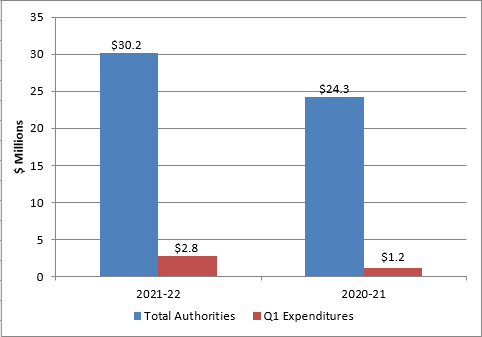
NSIRA spent approximately 9% of its authorities by the end of the first quarter, compared to 5% in the same quarter of 2020-21 (see graph 1 below).
Graph 1: Comparison of total authorities and total net budgetary expenditures, Q1 2021–22 and Q1 2020–21
Text version of Figure 1
Comparison of total authorities and total net budgetary expenditures, Q1 2021–22 and Q1 2020–21
2021-22
2020-21
Total Authorities
$30.2
$24.3
Q1 Expenditures
$2.8
$1.2
Significant changes to authorities
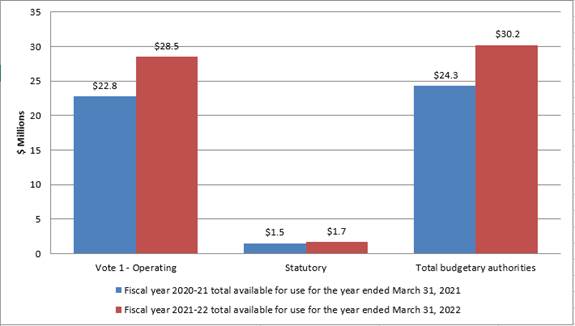
As per graph 2 below as at June 30, 2021, NSIRA had authorities available for use of $30.2 million in 2021-22 compared to $24.3 million as of June 30, 2020, for a net increase of $5.9 million or 24.3%.
Graph 2: Variance in authorities as at June 30, 2021
Text version of Figure 2
Variance in authorities as at June 30, 2021 (in millions)
Fiscal year 2020-21 total available for use for the year ended March 31, 2021
Fiscal year 2021-22 total available for use for the year ended March 31, 2022
Vote 1 – Operating
$22.8
$28.5
Statutory
$1.5
$1.7
Total budgetary authorities
$24.3
$30.2
The authorities’ increase of $5.9 million is mostly explained by the ramp-up of approved funding for the mandate of NSIRA and the approval of a funding reprofile into fiscal year 2021-22 for accommodation and infrastructure projects.
Significant changes to quarter expenditures
The first quarter expenditures totaled $2.7M for an increase of $1.5M when compared to $1.2M spent during the same period in 2020-21. Table 1 below presents budgetary expenditures by standard object.
Table 1
(in thousands of dollars)
Material Variances to Expenditures by Standard Object
YTD Expenditures as of June 30, 2021
YTD Expenditures as of June 30, 2020
Variance $
Variance %
Personnel
2,312
1,111
1,201
108%
Transportation and communications
13
7
6
86%
Information
2
50
(48)
(96%)
Professional and special services
196
68
128
188%
Repair and maintenance
8
0
8
100%
Utilities, materials and supplies
3
9
(6)
(67%)
Acquisition of machinery and equipment
216
0
216
100%
Other subsidies and payment
12
0
12
100%
Total gross budgetary expenditures
2,762
1,246
1,516
122%
Personnel
The increase of $1.2M relates to additional staffing to support NSIRA’s departmental mandate as well as higher statutory expenditures in 2021-22.
Transportation and communications
The increase of $6K is mainly explained by the relocation of an employee.
Information
The decrease of $48K is explained by lower expenditures for electronic subscriptions.
Professional and special services
The increase of $128K is mainly due to contracts in management consulting, including procurement and business advisory services.
Repair and maintenance
The increase of $8K is explained by office accommodation fit-up costs.
Utilities, Materials and Supplies
The decrease of $6K is mainly explained by lower expenditures for cleaning supplies and personal protective equipment for the pandemic over the previous year.
Acquisition of machinery and equipment
The increase of $216K is mainly explained by the acquisitions of informatics equipment and related cyber security products.
Other Subsidies and payments
The increase of $12K due to multiple payroll system overpayments processed in the first quarter of 2021-22.
Risks and uncertainties
The COVID-19 pandemic had a significant impact on the ability of NSIRA to grow its organization in a way that is commensurate with its new mandate. The physical distancing requirements decreased the ability of staff to concurrently work with departments and agencies subject to reviews. In light of that, NSIRA revised its Review Plan and has advanced the introduction of a new approach to the review of complaints.
The ability to hire a sufficient number of qualified personnel within relevant timelines remains a short- and medium-term risk for NSIRA, particularly given the specialized knowledge and skillset required for many positions. This is further compounded by the requirement for candidates to obtain a Top Secret security clearance, which can incur significant delays, especially during the pandemic.
While NSIRA has been able to secure temporary space to address its immediate space requirements, significant delays have been incurred for the fit-up of this space due to the pandemic. NSIRA is working closely with Public Services and Procurement Canada and Shared Services Canada to expedite the office expansion plans.
The ability of NSIRA to access the information it needs to do its work and speak to the relevant stakeholders to understand policies, operations and ongoing issues is closely tied to the reviewed departments’ and agencies’ capacity to respond to the demands of NSIRA. The pandemic impacts including the ability to conduct classified work at the workplace combined with existing resource constraints of the reviewed departments and agencies continue to delay the conduct of reviews.
NSIRA is closely monitoring pay transactions to identify and address over and under payments in a timely manner and continues to apply ongoing mitigating controls, which were implemented in 2016.
Mitigation measures for the risks outlined above have been identified and are factored into NSIRA’s approach to the conduct of its mandate.
Significant changes in relation to operations, personnel and programs
The pandemic forced changes in the way NSIRA conducts operations. The requirement for physical distancing and the existing challenge with respect to the high security zone accommodation has led NSIRA to authorize staff to work with non-sensitive files from home.
In late March 2021, NSIRA was victim of a cyber attack on its public network. The attack did not affect its classified networks. That attack has led NSIRA to change its Information Technology (IT) operating model and NSIRA has since then been using the Privy Council Office IT infrastructure for the conduct of it’s unclassified and up to protected B activities.
The Honourable Marie Deschamps has also recently been named interim Chair for NSIRA.
There have been no changes to the NSIRA Program.
Approved by senior officials:
John Davies Deputy Head
Pierre Souligny Senior Director, Corporate Services, Chief Financial Officer
Appendix
Statement of authorities (Unaudited)
(in thousands of dollars)
Fiscal year 2021–22
Fiscal year 2020–21
Total available for use for the year ending March 31, 2022 (note 1)
Used during the quarter ended June 30, 2021
Year to date used at quarter-end
Total available for use for the year ending March 31, 2021 (note 1)
Used during the quarter ended June 30, 2020
Year to date used at quarter-end
Vote 1 – Net operating expenditures
28,490
2,336
2,336
22,801
875
875
Budgetary statutory authorities
Contributions to employee benefit plans
1,705
426
426
1,484
371
371
Total budgetary authorities (note 2)
30,195
2,762
2,762
24,285
1,246
1,246
Note 1: Includes only authorities available for use and granted by Parliament as at quarter-end.
Departmental budgetary expenditures by standard object (unaudited)
(in thousands of dollars)
Fiscal year 2021–22
Fiscal year 2020–21
Planned expenditures for the year ending March 31, 2022 (note 1)
Expended during the quarter ended June 30, 2021
Year to date used at quarter-end
Planned expenditures for the year ending March 31, 2021
Expended during the quarter ended June 30, 2020
Year to date used at quarter-end
Expenditures
Personnel
13,222
2,312
2,312
11,510
1,111
1,111
Transportation and communications
673
13
13
1,162
7
7
Information
375
2
2
364
50
50
Professional and special services
5,904
196
196
3,250
68
68
Rentals
188
0
0
237
0
0
Repair and maintenance
8,737
8
8
7,134
0
0
Utilities, materials and supplies
103
3
3
173
9
9
Acquisition of machinery and equipment
991
216
216
393
0
0
Other subsidies and payments
0
12
12
63
0
0
Total gross budgetary expenditures
(note 2)
30,195
2,762
2,762
24,285
1,246
1,246
Note 1: Includes only authorities available for use and granted by Parliament as at quarter-end.
Note 2: Details may not sum to totals due to rounding.
This quarterly report has been prepared by management as required by section 65.1 of the Financial Administration Act and in the form and manner prescribed by the Directive on Accounting Standards, GC 4400 Departmental Quarterly Financial Report. This quarterly financial report should be read in conjunction with the 2020- 21 Main Estimates.
A summary description of the National Security and Intelligence Review Agency Secretariat (NSIRA) program activities can be found in Part II of the Main Estimates. For information on the mandate of NSIRA, please visit its website at http://www.nsira-ossnr.gc.ca.
Mandate
The NSIRA is an independent external review body, which reports to Parliament. NSIRA was established in July of 2019 and is responsible to conduct reviews of the Government of Canada national security and intelligence activities to ensure that they are lawful, reasonable and necessary. NSIRA also hears public complaints regarding key national security agencies and activities.
NSIRA replaces the Security Intelligence Review Committee (SIRC), which reviewed CSIS (Canadian Security Intelligence Service) activities as well as those related to the revocation or denial of security clearances. It also hears complaints regarding the Communication Security Establishment (CSE), as well as national security-related complaints regarding the RCMP.
Basis of presentation
This quarterly report has been prepared by management using an expenditure basis of accounting. The accompanying Statement of Authorities includes the department’s spending authorities granted by Parliament and those used by the department, consistent with the 2020-21 Main Estimates. This quarterly report has been prepared using a special purpose financial reporting framework (cash basis) designed to meet financial information needs with respect to the use of spending authorities.
The authority of Parliament is required before moneys can be spent by the Government. Approvals are given in the form of annually approved limits through appropriation acts or through legislation in the form of statutory spending authority for specific purposes.
Highlights of the fiscal quarter and fiscal year-to-date results
This section highlights the significant items that contributed to the net increase or decrease in authorities available for the year and actual expenditures for the quarter ended December 31, 2020.
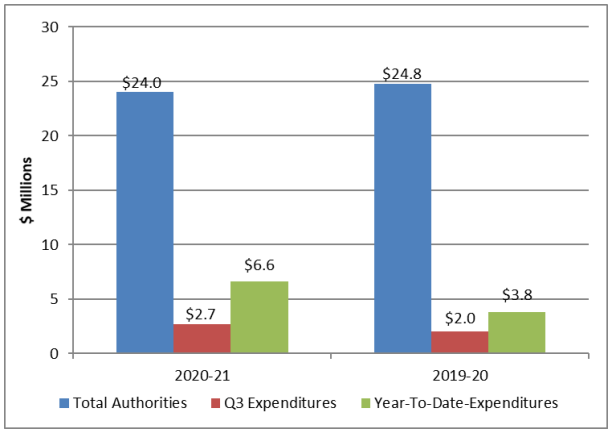
NSIRA spent approximately 28% of its authorities by the end of the third quarter, compared to 15% in the same quarter of 2019-20 (see graph 1 below).
Graph 1: Comparison of total authorities and total net budgetary expenditures, Q3 2020–21 and Q3 2019–20
Text version of Figure 1
Comparison of total authorities and total net budgetary expenditures, Q3 2020–21 and Q3 2019–20
2020-21
2019-20
Total Authorities
$24.0
$24.8
Q3 Expenditures
$2.7
$2.0
Year-to-Date Expenditures
$6.6
$3.8
Significant changes to authorities
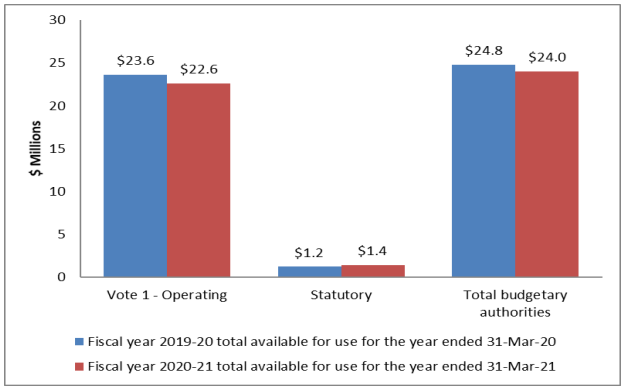
As per graph 2 below as at December 31, 2020, NSIRA had authorities available for use of $24.0 million in 2020-21 compared to $24.8 million as of December 31, 2019, for a net decrease of $0.8 million or 3.2%.
Graph 2: Variance in authorities as at December 31, 2020
Text version of Figure 2
Variance in authorities as at December 31, 2020 (in millions)
Fiscal year 2019-20 total available for use for the year ended March 31, 2020
Fiscal year 2020-21 total available for use for the year ended March 31, 2021
Vote 1 – Operating
$23.6
$22.6
Statutory
$1.2
$1.4
Total budgetary authorities
$24.8
$24.0
The authorities’ decrease of $0.8 million is mostly explained by a transfer of funding to CSE for the fit-up and maintenance of office space.
Significant changes to quarter expenditures
The third quarter expenditures totaled $2.7M for an increase of $0.7M when compared to $2.0M spent during the same period in 2019-20. Table 1 below presents budgetary expenditures by standard object.
Table 1
Material Variances to Expenditures by Standard Object
Fiscal year 2020-21: expended during the quarter ended December 31, 2020
Fiscal year 2019-20: expended during the quarter ended December 31, 2019
Variance $
Variance %
Personnel
1,732
1,504
228
15%
Transportation and communications
19
99
(80)
(81%)
Information
37
3
34
1133%
Professional and special services
389
377
12
3%
Rentals
41
4
37
925%
Repair and maintenance
189
47
142
302%
Utilities, materials and supplies
21
14
7
50%
Acquisition of machinery and equipment
257
6
251
4183%
Other subsidies and payment
(13)
(68)
55
(81%)
Total gross budgetary expenditures
2,671
1,985
686
35%
* Details may not sum to totals due to rounding
Personnel
The increase of $0.2M relates to additional staffing to support NSIRA’s new departmental mandate as well as higher statutory expenditures in 2020-21.
Transportation and communications
The decrease of $80K is mainly explained by the absence of travel due to the COVID-19 pandemic.
Information
The increase of $34K is explained by a contract for communication services.
Rentals
The increase of $37K is mostly due to new fees paid for the maintenance of NSIRA’s Finance and HR systems.
Repair and maintenance
The increase of $142K is explained by office accommodation fit-up costs.
Utilities, Materials and Supplies
The increase of $7K is mainly explained by higher expenditures for cleaning supplies and personal protective equipment due to the pandemic.
Acquisition of machinery and equipment
The increase of $251K is mainly explained by furniture acquisitions and office redesign to accommodate more employees and to equip NSIRA personnel to work from home.
Other Subsidies and payments
The increase of $55K is explained by fewer salary overpayment recoveries processed in the third quarter of 2020-21 compared to 2019-20.
Significant changes to year-to-date expenditures
Year-to-date expenditures recorded to the end of the third quarter totaled $6.7M for an increase of $2.8M when compared to the same year-to-date expenditures in 2019-20. Table 2 below presents budgetary expenditures by standard object.
Table 2
Material Variances to Expenditures by Standard Object
YTD Expenditures as of 31 December, 2020
YTD Expenditures as of 31 December 2019
Variance $
Variance %
Personnel
5,072
2,814
2,258
80%
Transportation and communications
37
184
(147)
(80%)
Information
78
7
71
1014%
Professional and special services
731
555
176
32%
Rentals
104
43
61
142%
Repair and maintenance
247
53
194
366%
Utilities, materials and supplies
28
20
8
40%
Acquisition of machinery and equipment
300
35
265
757%
Other subsidies and payment
28
76
(48)
(63%)
Total gross budgetary expenditures
6,626
3,786
2,840
75%
Details may not sum to totals due to rounding
Personnel
The increase of $2.3M is mainly explained by additional staffing to support NSIRA’s new departmental mandate as well as higher statutory payments.
Transportation and communications
The decrease of $147K is mainly explained by the absence of travel due to the COVID-19 pandemic.
Information
The increase of $71K is explained by higher expenditures for electronic subscriptions and communication consultants.
Professional and special services
The increase of $176K is mainly due to additional management consulting contracts.
Rentals
The increase of $61K is mostly explained by new fees paid for the maintenance of NSIRA’s corporate information technology systems.
Repair and maintenance
The increase of $194K is mainly due to office accommodation fit-up costs.
Utilities, Materials and Supplies
The increase of $8K is mainly explained by higher expenditures of cleaning supplies and personal protective equipment due to the pandemic.
Acquisition of machinery and equipment
The increase of $265K is mainly explained by furniture acquisitions and office redesign to accommodate more employees and to support home offices.
Other Subsidies and payments
The decrease of $48K is due to multiple salary overpayments processed in the first three quarters of 2019-20.
Risks and uncertainties
The COVID-19 pandemic had a significant impact on the ability of NSIRA to grow its organization in a way that is commensurate with its new mandate. The physical distancing requirements decreased the ability of staff to concurrently work with departments and agencies subject to reviews. In light of that, NSIRA revised its Review Plan and has advanced the introduction of a new approach to the review of complaints.
The ability to hire a sufficient number of qualified personnel within relevant timelines remains a short- and medium-term risk for NSIRA, particularly given the specialized knowledge and skillset required for many positions. This is further compounded by the requirement for candidates to obtain a Top Secret security clearance, which can incur significant delays, especially during the pandemic.
While NSIRA has been able to secure temporary space to address its immediate space requirements, significant delays have been incurred for the fit-up of this space due to the pandemic. The timing at which staff will be able to operate within this high security zone has yet to be determined. NSIRA is working closely with Public Services and Procurement Canada and Shared Services Canada to expedite the office expansion plans.
The ability of NSIRA to access the information it needs to do its work and speak to the relevant stakeholders to understand policies, operations and ongoing issues is closely tied to the reviewed departments’ and agencies’ capacity to respond to the demands of NSIRA. The pandemic impacts including the ability to conduct classified work at the workplace combined with existing resource constraints of the reviewed departments and agencies could delay NSIRA’s ability to deliver on its mandate in a timely way.
NSIRA is closely monitoring pay transactions to identify and address over and under payments in a timely manner and continues to apply ongoing mitigating controls, which were implemented in 2016.
Mitigation measures for the risks outlined above have been identified and are factored into NSIRA’s approach to the conduct of its mandate.
Significant changes in relation to operations, personnel and programs
The pandemic forced changes in the way NSIRA conducts operations. The requirement for physical distancing and the existing challenge with respect to the high security zone accommodation has led NSIRA to authorize staff to work with non-sensitive files from home.
In September 2020, Murray Rankin stepped down as Chair of NSIRA. The Honourable L. Yves Fortier was named acting Chair until the end of his term. Since, The Honourable Dr. Ian Holloway acted as Chair and now The Honourable MarieLucie Morin has been reappointed as acting Chair.
In addition, Faisal Mirza has been appointed as a new member of NSIRA.
Approved by senior officials:
John Davies Deputy Head
Pierre Souligny Senior Director, Corporate Services, Chief Financial Officer
Appendix
Statement of authorities (Unaudited)
(in thousands of dollars)
Fiscal year 2020–21
Fiscal year 2019–20
Total available for use for the year ending March 31, 2021 (note 1)
Used during the quarter ended December 31, 2020
Year to date used at quarter-end
Total available for use for the year ending March 31, 2020 (note 1)
Used during the quarter ended December 31, 2019
Year to date used at quarter-end
Vote 1 – Net operating expenditures
22,565
2,300
5,513
23,618
1,854
3,392
Budgetary statutory authorities
Contributions to employee benefit plans
1,484
371
1,113
1,240
131
394
Total budgetary authorities
24,049
2,671
6,626
24,858
1,985
3,786
Note 1: Includes only authorities available for use and granted by Parliament as at quarter-end.
Note 2: Details may not sum to totals due to rounding.
Departmental budgetary expenditures by standard object (unaudited)
(in thousands of dollars)
Fiscal year 2020–21
Fiscal year 2019–20
Planned expenditures for the year ending March 31, 2021 (note 1)
Expended during the quarter ended December 31, 2020
Year to date used at quarter-end
Planned expenditures for the year ending March 31, 2020
Expended during the quarter ended December 30, 2019
Year to date used at quarter-end
Expenditures
Personnel
11,512
1,732
5,072
8,677
1,504
2,814
Transportation and communications
1,162
19
37
961
99
184
Information
364
37
78
402
3
7
Professional and special services
3,250
389
731
3,353
377
555
Rentals
237
41
104
229
4
43
Repair and maintenance
6,681
189
247
9,641
47
53
Utilities, materials and supplies
173
21
28
179
14
20
Acquisition of machinery and equipment
293
257
299
1,356
6
25
Other subsidies and payments
278
(13)
28
70
(68)
76
Total gross budgetary expenditures
(note 2)
24,049
2,671
6,626
24,858
1,985
3,786
Note 1: Includes only authorities available for use and granted by Parliament as at quarter-end.
Note 2: Details may not sum to totals due to rounding.
The Avoiding Complicity in Mistreatment by Foreign Entities Act (Avoiding Complicity Act or Act) and its associated directions seek to prevent the mistreatment of any individual as a result of information exchanged between a Government of Canada department and a foreign entity. At the heart of the directions is the consideration of substantial risk, and whether that risk, if present, can be mitigated or not. To do this, the Act and the directions lay out a series of requirements that need to be met or implemented when handling information. This review covers the implementation of the directions sent to 12 departments and agencies from their date of issuance, September 4, 2019, to the end of the previous calendar year, December 31, 2019. It was conducted under subsection 8(2.2) of the National Security and Intelligence Review Agency Act (NSIRA Act), which requires NSIRA to review, each calendar year, the implementation of all directions issued under the Act.
While this was the inaugural annual review under the NSIRA Act, it builds upon previous work in this area undertaken by NSIRA and its predecessor SIRC. NSIRA’s review on the 2017 Ministerial Direction on information sharing with Foreign Entities is an example. The results from this previous review were sent to applicable departments in July 2020. NSIRA is building upon this previous review and strongly supports the findings and recommendations within it. As of the date of this report, departmental responses have not been received regarding the recommendations provided in NSIRA’s July 2020 Ministerial Direction review.
(U) It was essential to ensure that both NSIRA and the departments being reviewed met their obligations under the Avoiding Complicity Act and the NSIRA Act. The approach used to gather information during a global pandemic was purposely designed for this first and unique review period.
To capture a complete view on the departmental implementation, NSIRA requested information that related directly to every department’s specific obligations under the Act and the directions. The responses and associated information captured departmental activities related to the Act during the review period, and what procedures, policies, tools, etc. (frameworks) were leveraged to support these activities. NSIRA believes that having a robust framework is an essential part of an effective implementation of the directions departments have received.
Beyond the specific requirements of implementation, the information provided by the departments also helped to identify gaps, considerations for best practices, and the work departments have undertaken since the review period to build and formalize their frameworks. This information and knowledge will help set up the foundation for future reviews and assist efforts on creating consistent implementation across departments. While many of the issues discussed in this report go beyond the specific requirements of the directions, their consideration is critical to the overall improvement of the implementation process and how departments ultimately support the Act. No case studies were undertaken for this review. However, the information gathered has helped establish a baseline for overarching issues the community is facing. Building on this, future reviews will begin to examine specific sharing framework challenges and questions and look closely at specific cases and departmental legal opinions to guide review findings.
While NSIRA was pleased with the considerable efforts made by many departments new to the Avoiding Complicity Act in building up their supporting frameworks, it was clear during this review that departments are employing very different approaches to guide their information handling activities. The responses received demonstrate various inconsistencies across the departments. Having a consistent and coordinated approach when addressing the concerns related the Act is not a requirement for implementation, however, NSIRA believes that there is value in such an approach. And while departments will always require unique aspects in their sharing frameworks to address the unique characteristics of their mandates and activities, to improve the implementation process, a goal all involved likely have, the identification and sharing of best practices is critical.
For example, determining the best means for having a unified approach when engaging with foreign entities of concern or ensuring that an information sharing activity is consistently evaluated for risk by all departments. The recommendations provided on these issues in this review capture what NSIRA believes to be important concerns and considerations for supporting and improving departmental implementation.
Additionally, as the directives received under the Act do not describe the specific means by which departments ‘implement’ them, it is incumbent on the community to ensure that they have sufficiently robust frameworks and programs in place to fully support an assertion of implementation. Therefore, the information gathered during this review went beyond a strict assessment of implementation, but also considered the aspects required to better support this implementation. Going forward, this approach will help establish the foundation for subsequent reviews. Drawing on the findings and concerns identified here, NSIRA will continue to consider aspects that will ultimately improve underlying frameworks, thereby supporting an improved implementation of the Act across the community.
Authorities
This review was conducted under subsection 8(2.2) of the NSIRA Act, which requires NSIRA to review, each calendar year, the implementation of all directions issued under the Avoiding Complicity Act.
Introduction
Focus of the Act
In the same spirit as the Ministerial Direction (MD) that preceded it, the Avoiding Complicity Act and its associated directions seek to prevent the mistreatment of any individual due to the exchange of information between a Government of Canada department and a foreign entity. The Act also aims to limit the use of information received from a foreign entity that may have been obtained through the mistreatment of an individual. While the previous MD guided the activities of a selection of Canada’s security and intelligence departments, the Act broadened this scope to capture all departments whose interactions with foreign entities included information exchanges where such a concern may apply.
The focus of the Act is to ensure departments take the necessary steps during their information sharing activities to avoid contributing in any way to the mistreatment of an individual. To do this, the Act and the directions lay out a series of requirements that need to be met or implemented when handling information. There is an expectation that each department will satisfy these requirements by leveraging departmentally established mechanisms and procedures, or frameworks that will allow each department to confidently demonstrate how it has responded to its responsibilities under the Act.
During the first year that the Act was in force, written directions using nearly identical language were sent to the Deputy Heads of 12 departments. In regard to disclosure, the directions read as follows: “If the disclosure of information to a foreign entity would result in a substantial risk of mistreatment of an individual, the Deputy Head must ensure that Department officials do not disclose the information unless the officials determine that the risk can be mitigated, such as through the use of caveats or assurances, and appropriate measures are taken to mitigate the risk.”
With respect to requesting information, the directions state: “If the making of a request to a foreign entity for information would result in a substantial risk of mistreatment of an individual, the Deputy Head must ensure that Department officials do not make the request for information unless the officials determine that the risk can be mitigated, such as through the use of caveats or assurances, and appropriate measures are taken to mitigate the risk.”
Lastly, as it relates to the use of information, the directions indicate: “The Deputy Head must ensure that information that is likely to have been obtained through the mistreatment of an individual by a foreign entity is not used by the Department
(a) in any way that creates a substantial risk of further mistreatment;
(b) as evidence in any judicial, administrative or other proceeding; or (c) in any way that deprives someone of their rights or freedoms, unless the Deputy Head or, in exceptional circumstances, a senior official designated by the Deputy Head determines that the use of the information is necessary to prevent loss of life or significant personal injury and authorizes the use accordingly.”
At the heart of the directions is the consideration of substantial risk, and whether that risk, if present, can be mitigated or not. This determination is done on a case-by-case basis. Each department is responsible for making these determinations as it applies to its activities. Following the outcome of a department’s determination of these important questions, cases may be approved, denied, or elevated to the Deputy Head for consideration. For the latter cases, this then results in additional reporting requirements for the Deputy Head. Throughout this process, there is also a requirement to ensure the accuracy, reliability, and limitations of use of all information being handled.
Review Objectives
After the Avoiding Complicity Act came into force in July 2019, the Governor in Council’s written directions were sent to each applicable department in September 2019. The period for this year’s review is September 4, 2019 to December 31, 2019. The short timeframe (approximately 4 months) associated with this year’s review means that departments are being assessed, in large part, on what they would already have had in place to address risks of mistreatment associated with information sharing, or what they were able to implement in a four-month window. NSIRA is cognizant that for the departments that were not previously subject to the 2017 MD on Avoiding Complicity in Mistreatment by Foreign Entities, the timeframe to implement the written directions was somewhat limited, as it would have been challenging to create and operationalize new procedures such that they would be reflected in the department’s activities during the period being reviewed.
While it was essential to ensure that both NSIRA and the departments being reviewed met their obligations, these challenges were kept in mind when evaluating the objectives for this first review. Given these considerations, the objectives of this year’s review were to determine whether:
departments had fully implemented the directions received under the Act in conformity with the obligations set out therein;
departments had established and operationalized frameworks that sufficiently enabled them to meet the obligations set out in the Act and directions; and,
there was consistency in implementation across applicable departments.
Methodology and assessment focus
To capture a complete view of the departmental implementation of the Act, NSIRA constructed a series of questions related directly to every department’s obligations under the Act and the directions. The responses and associated information captured what specific activities took place during the review period and what departmental frameworks were leveraged to adequately support these activities.
The information provided by the departments also helped to identify gaps, considerations for best practices, and the work departments have undertaken to build and formalize their frameworks to meet their obligations under the Act and directions. The information provided and the knowledge gained will help set up the foundation for future reviews and help create consistent implementation across departments.
The method used to gather information during a global pandemic was designed for this first and unique review period. We believe it allowed departments to quickly and efficiently indicate both whether the directions had been implemented, and what frameworks, processes, and policies had been leveraged or put in place.
Responses to many of the RFI questions were simply yes/no answers. Often, answers were dependent on what information handling activities took place with foreign entities by the department during the review period. As such, a number of questions could be returned with ‘not applicable’, and this was an acceptable response. Many of the questions were related to specific and easily defined requirements under the Act and its associated directions, e.g. ‘was a report submitted to the Minister?’ or ‘Did the Deputy Minister inform the applicable bodies of all their decision made under the act?’.
Other questions were designed to capture the details of the underlying processes that supported a department’s implementation, i.e. a department may indicate that they ensured no substantial risk of mistreatment was present in any of their information sharing activities, but how did they support this claim? Likewise, for an assertion that a possible substantial risk of mistreatment had been mitigated, what was in place that allowed a department to make this assertion? Therefore, this series of questions required sufficiently detailed responses to fully capture what a department had in place that allowed it to confidently state that it has met its implementation obligations under the Act and the issued directions.
Finally, a portion of the questions was intended to capture the level of uniformity in implementation across departments. This includes such things as country/entity assessments, triage practices, and record keeping. Much of this information will also help with recommendations going forward. This multi-faceted approach resulted in three main areas being evaluated to assess implementation for this review period and help set the groundwork for future reviews.
Departments have clear and comprehensive frameworks, policies, and guidelines such that they can demonstrate how they have fully implemented the directions under the Act.
All reporting requirements associated with both the Act and its applicable directions have been met.
Differences or gaps associate with areas such as country/entities assessments, record keeping, case triage, etc., such that consistent implementation across departments would be challenging.
Summary of the results table
The table in Annex A captures a summary of both the departmental responses to the implementation questions and NSIRA’s assessment regarding these responses. The assessment was based on the associated details provided by departments in the context of the specific information requested. As explained above, many of the responses were returned as not applicable (n/a). Since many implementation requirements are connected to specific activities, the absence of such activities would mean that the requirement does not come into play. The best example of this for the current review is the absence of any Deputy Minister level determinations. All 12 departments indicated that they did not have any cases referred to the Deputy Minister level for determination. All additional reporting requirements associated with this level of decision were not applicable and thus considered satisfied.
If a specific requirement was not met, it was flagged. The relatively few instances of this were connected with departments not meeting certain reporting obligations under the Act. In all cases, the department involved pre-identified these missing requirements and indicated that efforts were underway to address them.
The concerns and findings captured in the table (and others) are discussed subsequently. A concern was flagged in two situations: where there was an uncertainty associated with a department’s ability to support their implementation requirements; and cross-cutting issues related to general aspects of all of the frameworks described, both of which led to the findings and recommendations proposed.
Findings and Recommendations
Realities of Implementation for 2019
A challenge for departments for this first review was associated with one of the assessment items listed above, i.e. whether they had established frameworks to demonstrate how they supported the implementation of the directions they received.
With the Avoiding Complicity Act coming into force in July 2019, it was not feasible that departments would create and stand-up new frameworks for information exchanges in time for the period being reviewed. Although the Act did specify several Deputy Heads that were to receive directions, it only included those who received the previous 2017 MD. The remaining new departments received their directions in September 2019. Regardless of this two-month difference, each department would have been required to rely on, to some extent, existing procedures when handling information sharing with foreign entities during the review period.
This put the departments that had previously formalized policies and processes at an advantage when implementing the directions. For those departments who were not subject to the previous 2017 MD on information sharing, NSIRA considered how they leveraged and adjusted what was already in place to respond to their new responsibilities under the Act. What we then expected to see, for all departments, was what subsequent steps were taken during the review period and afterwards, to either adjust or create frameworks to better meet implementation requirements going forward. NSIRA noted that in response to questions on frameworks for handling information and mitigating risk, several of the departments new to the considerations of the Act provided extensive detail on their efforts and progress on building out their frameworks to support the directives. References to having these frameworks formalized over the subsequent year were also encouraging.
Finding no. 1: NSIRA found that several departments, new to the considerations of the Act, described considerable progress being made during the review period and afterwards to build out formalized frameworks to support implementation.
Importance of establishing operational framework
As discussed, having fully established operational frameworks in place for this review period may not have been feasible for the departments that did not previously have processes to support their activities. This, however, did not exempt a department from the requirements of implementation. Each department was still expected to leverage what it currently had in place to properly address the concerns associated with the Avoiding Complicity Act. Furthermore, there was a logical follow-on expectation that departments would take subsequent steps to build out formal frameworks to address any perceived gaps to support the implementation of the Act going forward if necessary.
After reviewing the responses received, NSIRA is concerned that departments with minimal information sharing activities taking place during their operations have yet to address the necessity of having a robust framework in place, regardless of how often that framework is leveraged. For example, although PS and TC may primarily act as facilitators or coordinators for information exchanges on specific programs, they are still interacting with foreign entities, and therefore are required to fully assess their interactions with a foreign entity in this regard.
If a department without a formal framework assesses that it has few or no cases associated with the Act, then it may believe it is adequately positioned to address any sharing concerns should they arise. This, however, is not the case. Even single instances of information exchange in which the concerns of the Act may apply require a framework to support it properly. In many cases, it will be the framework itself that properly identifies whether a sharing activity raises concerns under the Act. If there is no formal process in place, then this identification becomes problematic. Simply saying that there are no cases or activities associated with the Act is not sufficient. That determination can only be made after a sharing activity is scrutinized through the lens of a robust framework. Going forward, all departments who receive directions should demonstrate a formal framework that ensures all information sharing activities are adequately evaluated against the considerations of the Act.
Finding no. 2: NSIRA found that departments conducting minimal information exchanges with foreign entities have not yet fully addressed the importance of having an official information sharing framework in place.
Recommendation no. 1: NSIRA recommends that all departments in receipt of directions under the Act have an official framework that ensures they can fully support their implementation of the directions.
Community coordination and best practices
While departmental coordination and the sharing of best practices are not a requirement of the Avoiding Complicity Act or the directions, NSIRA considered such an approach’s value. What became clear during this first review was that every department employs a very different framework to guide their information sharing activities with foreign entities. This is to be expected to some extent, given the different mandates, sharing requirements, and areas of focus associated with each department. However, these differences are also a reflection of the independent, internal development that has taken place for the different frameworks being used. While the departments receiving directions under the Act do interact on this subject to some extent, to date, based on the responses provided, it appears that the majority of the work done by the departments to build supporting frameworks to address their responsibilities associated with the Act have been done so independently. There was little to no overlap with how departments described the various aspects of their frameworks, even amongst the departments subject to the earlier MD on this issue.
There would be value in departments collectively identifying the key aspects common or required in all information exchanges with foreign entities and then working together to craft best practices, irrespective of what a department currently has in place. This process should draw on all available resources to make this determination. Each department can then turn to their existing frameworks to consider where and how they can be adjusted to match this community-agreed upon ideal. This is not to say that aspects of what a department already has in place in their framework will not ultimately be seen as the best practice. Several departments do have robust sharing frameworks in place, and these will contribute significantly to this exercise. However, arriving at this determination independently will provide an additional level of confidence.
Department-specific challenges, of course, cannot be ignored. In fact, they will weigh in strongly on such a conversation. Departments share information under their mandates for various reasons, and this will mean that coordination on certain aspects of a sharing framework may not be possible. However, this needs to be evaluated. It is important that what already exists, or what is hard change, does not unduly influence what may be best. This approach will create uniformity (where possible) across the community and provide a starting point for ‘must haves’ for each department to evaluate their existing processes against.
The Public Safety Information Sharing Coordination Group (ISCG) was established to support departments on information sharing. As such, it is in an ideal position to help mitigate issues arising from the lack of coordination. Leading such efforts would build on the work already being done by this group. During recent discussions with NSIRA, the ISCG indicated that the tracking of lessons learned and the sharing of best practices was not yet routine. Going forward, there would be value in a more coordinated effort when departments are updating/changing their framework. Ensuring that this coordination takes place will require support and leadership by senior-level officials. This will help in sharing best practices once identified, and establish more consistent approaches across departments.
Finding no. 3: NSIRA found that the differences and variability in departmental frameworks demonstrate a previous lack of coordination across the community and a need to identify best practices.
Recommendation no. 2: NSIRA recommends that departments coordinate to identify best practices for all essential components of information sharing frameworks and that the ISCG is leveraged to ensure these practices are shared where possible across the community to support the implementation of the Act.
Framework application inconsistency
A series of questions in this review was related to aspects of consistency in how departments apply their frameworks. From this series, a comparison was made on how many times an information sharing/use event triggered an evaluation of any kind against the considerations of the Avoiding Complicity Act, versus how many of these triaged cases were elevated or referred up for decision. The results helped gauge two important aspects of a framework: One, the threshold requirements, i.e. how often a sharing activity triggers an evaluation of any kind; and two, the decision making power given to the operators who are initially handling these activities.
The feedback and the responses received demonstrate potential inconsistencies in both aspects across departments. For example, several departments indicated zero cases as being triaged/evaluated under the concerns of the Act during the review period, yet also specified that they are involved in regular information sharing or, specified that no information received from foreign entities was derived from mistreatment. These responses appear to be inconsistent as it would be problematic to participate in information sharing or to make such mistreatment determinations without the activity being evaluated on some level.
Other departments indicated a larger number of cases as initial triaged/evaluated, but also indicated that none of them were elevated in their decision making process for higher-level decisions. This would seem to suggest that all determinations were being made at the operational level. Such a result puts significant weight on the operator and the initial assessment tools they are leveraging if they are making all determinations independently. This reinforces the importance of a robust framework to help make these determinations, as previously indicated in Finding no. 2. As a result of these differences, potential challenges arise on accurately assessing the volume of cases being handled by departments, the tracking of those cases deemed to present a substantial risk, those which can be mitigated for, and those where the risk was not found to be substantial or even present.
These responses may result from how each department defines a ‘case’ or how it records a case, or they may be a result of differences in how a department’s decision-making process is leveraged. NSIRA’s concern is that these differences may indicate an inconsistency in application thresholds at different departments. As such, the following results were viewed as a potential issue based on the responses received:
if a department was involved in any kind for information exchange with a foreign entity during the review period, but did not indicate that any cases were formally triaged/evaluated; or
if there was a significant number of cases triaged, but none were elevated to a higher level for determination.
Such results do not necessarily indicate a problem as aspects of a framework may be able to account for this, however, looking further into how and why the department’s framework produced these outcomes is important. Future reviews will be able to do this. Consistent initial steps for information sharing activities, including triage/evaluation thresholds and documentation, are critical to the effective application of a framework, and ultimately to identifying best practices.
Finding no. 4: NSIRA found that there are inconsistencies in the application of existing sharing frameworks between departments, specifically concerning information evaluation thresholds, and decisions being elevated for senior level determinations,
Recommendation no. 3: NSIRA recommends that departments establish consistent thresholds for triggers in their information sharing frameworks, including initial evaluations against the concerns of the Act, when a case is to be elevated in the decision process, and how this is documented.
Country and entity assessments
A key recommendation of NSIRA’s previous review on information sharing related to the country/entity assessments being used by departments to inform their decision making process when sharing or using information with a foreign entity. While the use of country/entity assessments is not a required aspect of implementing the directions under the Act, NSIRA continues to support this tool as an important aspect of any sharing framework. In its previous review, NSIRA determined that having a firm grasp on the human rights situation, as well as any other pertinent information associated with a country/entity, was essential to making an informed decision on whether there should be concerns, caveats, or limitations when handling information with that country/entity. Moreover, having such information captured to ensure all departments consistently approach these countries/entities is critical. At the time of the previous review, the following recommendation was made:
a unified set of assessments of the human rights situations in foreign countries including as standardized ‘risk of mistreatment’ classification level for each country; and
to the extent that multiple departments deal with the same foreign entities in a given country, standardized assessments of the risk of mistreatment of sharing information with foreign entities.
It is important to note that there has been no formal response from departments on this previous recommendation as of the date of this report. Furthermore, during this report, two departments continue to raise concerns with NSIRA’s stance on this issue during the consultation process. While NSIRA continues to support this recommendation, as explained below, further discussions with departments on how to approach this matter may be warranted, specifically on the distinction between how this recommendation may apply to a foreign country/entity vs a specific foreign partner a department may be dealing with.
Based on the responses provided on this topic for the current review period, there is still inconsistency in this area. While almost all departments indicated that country/entity assessments were a standard part of their framework, the responses also indicate differences in which country assessments are used, how they are leveraged, and who is responsible for updating them. For example, several departments rely on their own in-house created assessments, while others leverage the assessments created by Global Affairs Canada and others. While departments who indicated that they are leveraging country/entity assessment tools in their process also indicated that these assessments captured human rights concerns, this has yet to be independently evaluated. NSIRA is concerned that these differences could result in different approaches/stances being taken by departments when dealing with the same foreign entity. While the country/entity assessments tools themselves are not necessarily in question, the fact that every department is not leveraging or does not have access to all useful or applicable information is.
NSIRA remains of the view that having a consistent stance on all countries and entities when implementing the requirements of the Act is important. Issues such as mistreatment and human rights should not be decided at a departmental level, but on a whole-of-government level. While mindful of classification levels, ensuring all departments have access to the same relevant information associated with a foreign country/entity is critical to making an informed decision. Due to the nature of their work, departments may be privy to unique information on a country/entity, some or all of which can be shared. This would lead to fully informed assessments that allow for a consistent approach when dealing with any country/entity. In addition to improving duplication of effort in this area by departments, NSIRA continues to see standardized country and entity assessments, which can be accessed and contributed to by all departments, as key to moving toward a more consistent and effective implementation of the Act across the community
Finding no. 5: NSIRA found a lack of unification and standardization in the country and entity assessments being leveraged by departments, resulting in inconsistencies in approach/stance by the community when interacting with Foreign Entities of concern related to the Act.
Recommendation no. 4: NSIRA recommends that departments identify a means to establish unified and standardized country and entity risk assessment tools to support a consistent approach by departments when interacting with Foreign Entities of concern under the Act.
Conclusion
While aspects of implementation can be easily quantified and evaluated e.g. reporting requirements to a Minister, others, which support implementation are more difficult to measure, e.g.:
What does a sufficiently robust framework for assessing and mitigating risk when sharing with a foreign entity look like?
Does this depend on the specific requirements and activities of the department; or,
Are there steps that should always be involved when vetting a foreign entity under the considerations of the Act?
Measuring and weighing the answers to such questions is challenging. They are more nuanced, and can’t be as easily quantified. Regardless, they must be considered and addressed. Drawing on the considerations and concerns identified in this review will help departments to ask the questions that will improve their underlying frameworks with the following goals in mind:
To identify the essential/key elements that need to be a part of any framework for it to address the concerns associated with the Avoiding Complicity Act sufficiently; and,
To have all identified best practices implemented as consistently as possible across departments.
Future reviews will push towards these goals by seeking answers to those questions above. By looking more closely at specific case studies, departmental legal opinions, items of inconsistency, and the departmental frameworks that are already demonstrating best practices that should be shared. Ultimately the results of such efforts will contribute to improving the implementation of the Act across the community.