Review of Government of Canada Institutions’ Disclosures of Information Under the Security of Canada Information Disclosure Act in 2022: Backgrounder
Review of Government of Canada Institutions’ Disclosures of Information Under the Security of Canada Information Disclosure Act in 2022
Backgrounder
Backgrounder
ISSN: 2817-7525
This report presents findings and recommendations made in NSIRA’s annual review of disclosures of information under the Security of Canada Information Disclosure Act (SCIDA). It was tabled in Parliament by the Minister of Public Safety, as required under subsection 39(2) of the NSIRA Act, on November 1st, 2023.
The SCIDA provides an explicit, stand-alone authority to disclose information between Government of Canada institutions in order to protect Canada against activities that undermine its security. Its stated purpose is to encourage and facilitate such disclosures.
This report provides an overview of the SCIDA’s use in 2022. In doing so, it:
documents the volume and nature of information disclosures made under the SCIDA;
assesses compliance with the SCIDA; and
highlights patterns in the SCIDA’s use across Government of Canada institutions and over time.
The report contains six recommendations designed to increase standardization across the Government of Canada in a manner that is consistent with institutions’ demonstrated best practices and the SCIDA’s guiding principles.
Review of the Canadian Security Intelligence Service’s (CSIS) use of Geolocation information: Backgrounder
Review of the Canadian Security Intelligence Service’s (CSIS) use of Geolocation information
Backgrounder
Review Backgrounder
On August 23rd, 2019, the National Security and Intelligence Review Agency (NSIRA) presented the Minister of Public Safety and Emergency Preparedness with a classified report on its review of CSIS’s use of geolocation information.
In this review, NSIRA found that CSIS’s use of this geolocation data without a warrant risked breaching section 8 of the Canadian Charter of Rights and Freedoms (Charter), which protects against unreasonable search and seizure. On March 16, 2020, NSIRA submitted a report under section 35 of the NSIRA Act, to the Minister of Public Safety regarding the possible unlawful activity.
This review raised pressing questions regarding the use of publically available data, but that nevertheless engages a person’s reasonable expectation of privacy. NSIRA’s review examined the decision-making process that led CSIS to use this data without a warrant, and found that CSIS lacked the policies or procedures to ensure that, prior to using the data, CSIS sought legal advice to avoid its unlawful use.
The review was also an opportunity to note more broadly that, in this environment, ongoing legal support to CSIS’s data exploitation activities is essential in allowing CSIS to operate at an acceptable level of risk. It also noted that CSIS and the Department of Justice are expected to demonstrate institutional leadership in this regard.
Going forward, NSIRA will prioritize the scrutiny of CSIS’s use of technology, particularly new or emerging technologies that pose the greatest risks.
This quarterly report has been prepared by management as required by section 65.1 of the Financial Administration Act and in the form and manner prescribed by the Directive on Accounting Standards, GC 4400 Departmental Quarterly Financial Report. This quarterly financial report should be read in conjunction with the 2024–2025 Main Estimates.
This quarterly report has not been subject to an external audit or review.
Mandate
The National Security and Intelligence Review Agency (NSIRA) is an independent external review body that reports to Parliament. Established in July 2019, NSIRA is responsible for conducting reviews of the Government of Canada’s national security and intelligence activities to ensure that they are lawful, reasonable and necessary. NSIRA also hears public complaints regarding key national security agencies and their activities.
The NSIRA Secretariat supports the Agency in the delivery of its mandate. Independent scrutiny contributes to strengthening the accountability framework for national security and intelligence activities and to enhancing public confidence. Ministers and Canadians are informed whether national security and intelligence activities undertaken by Government of Canada institutions are lawful, reasonable, and necessary
This quarterly report has been prepared by management using an expenditure basis of accounting. The accompanying Statement of Authorities includes the agency’s spending authorities granted by Parliament and those used by the agency, consistent with the 2024–2025 Main Estimates. This quarterly report has been prepared using a special-purpose financial reporting framework (cash basis) designed to meet financial information needs with respect to the use of spending authorities.
The authority of Parliament is required before money can be spent by the government. Approvals are given in the form of annually approved limits through appropriation acts or through legislation in the form of statutory spending authorities for specific purposes.
The Department uses the full accrual method of accounting to prepare and present its annual departmental financial statements that are part of the departmental results reporting process. However, the spending authorities voted by Parliament remain on an expenditure basis.
Highlights of the fiscal quarter and fiscal year-to-date results
This section highlights the significant items that contributed to the net increase or decrease in authorities available for the year and actual expenditures for the quarter ended September 30, 2024.
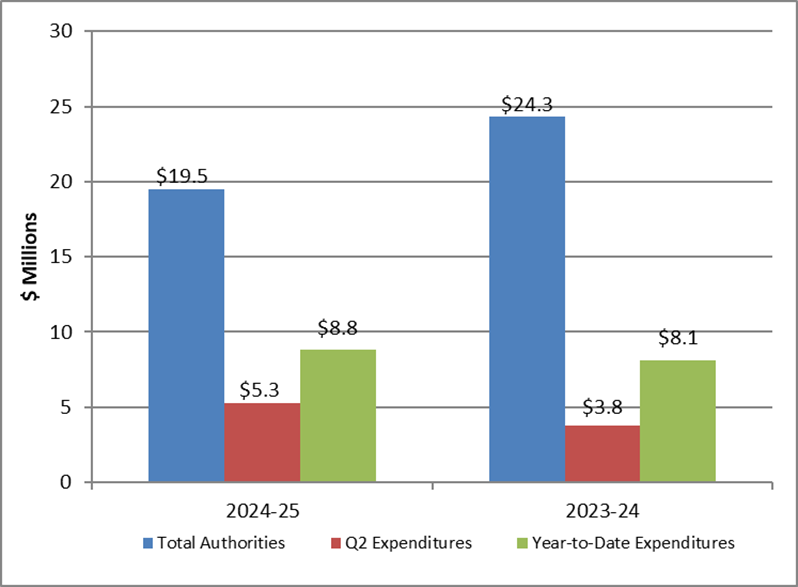
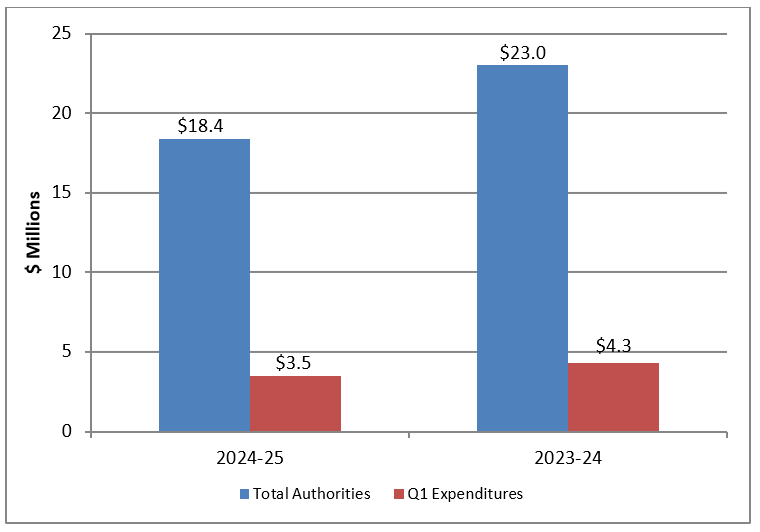
NSIRA Secretariat spent approximately 45% of its authorities by the end of the second quarter, compared with 33% in the same quarter of 2023–2024 (see graph 1).
Graph 1: Comparison of total authorities and total net budgetary expenditures, Q2 2024–2025 and Q2 2023–2024 (in millions of dollars)
Text version of Figure 1
Comparison of total authorities and total net budgetary expenditures, Q2 2024–2025 and Q2 2023–2024 (in millions of dollars)
2024-25
2023-24
Total Authorities
$19.5
$24.3
Q2 Expenditures
$5.3
$3.8
Year-to-Date Expenditures
$8.8
$8.1
Significant changes to authorities
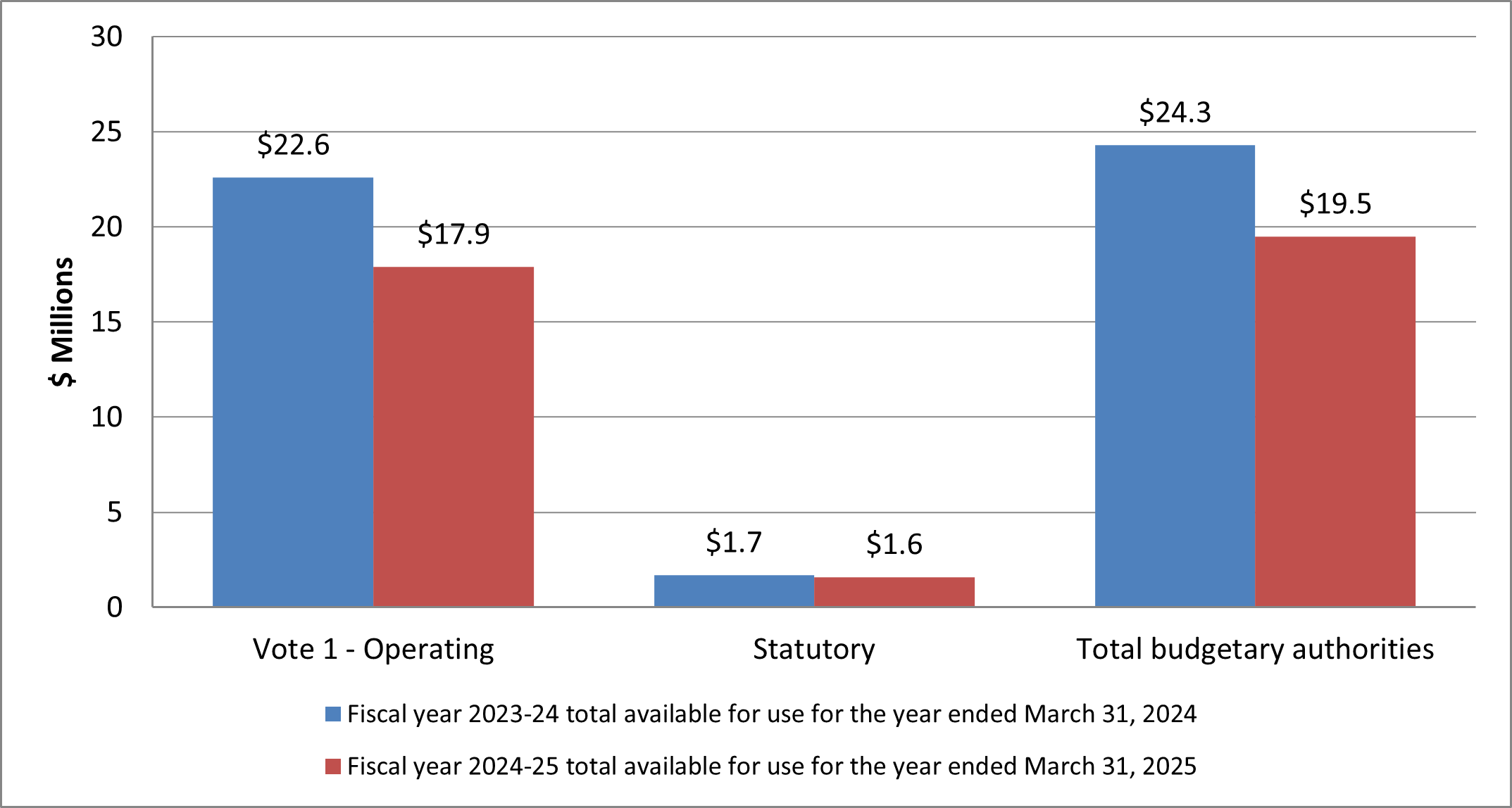
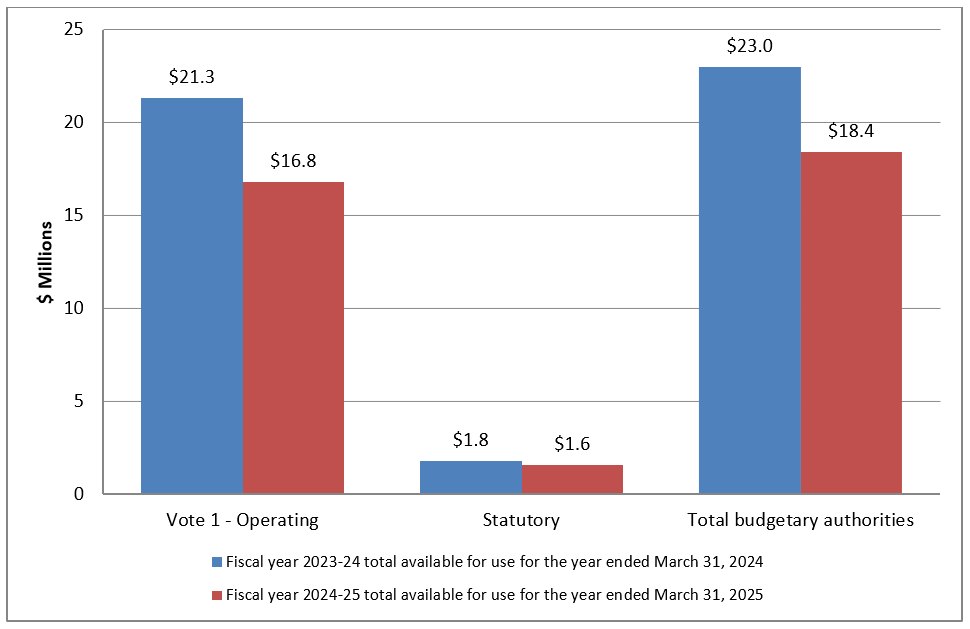
As of September 30, 2024, Parliament had approved $19.5 million in total authorities for use by NSIRA Secretariat for 2024–2025 compared with $24.3 million as of September 30, 2023, for a net decrease of $4.8 million or 19.8% (see graph 2).
Graph 2: Variance in authorities as of September 30, 2024 (in millions of dollars)
Text version of Figure 2
Variance in authorities as of September 30, 2024 (in millions of dollars)
Fiscal year 2023-24 total available for use for the year ended March 31, 2024
Fiscal year 2024-25 total available for use for the year ended March 31, 2025
Vote 1 – Operating
22.6
17.9
Statutory
1.7
1.6
Total budgetary authorities
24.3
19.5
*Details may not sum to totals due to rounding*
The decrease of $4.8 million in authorities is mostly explained by a reduction in capital funding for infrastructure projects due to the fact that they have reached completion in this fiscal year.
Significant changes to quarter expenditures
The second quarter expenditures totalled $5.3 million for an increase of $1.5 million when compared with $3.8 million spent during the same period in 2023–2024. Table 1 presents budgetary expenditures by standard object.
Table 1: Departmental budgetary expenditures by Standard Object (unaudited)
Fiscal year 2024-2025 (in thousands of dollars)
Variances in expenditures by standard object (in thousands of dollars)
Fiscal year 2024–25: expended during the quarter ended September 30, 2024
Fiscal year 2023–24: expended during the quarter ended September 30, 2023
Variance $
Variance %
Personnel
3,856
3,014
842
28%
Transportation and communications
77
62
15
24%
Information
7
4
3
75%
Professional and special services
1,320
504
816
162%
Rentals
17
25
(8)
(32%)
Repair and maintenance
37
3
34
1133%
Utilities, materials, and supplies
12
50
(38)
(76%)
Acquisition of machinery and equipment
8
4
4
100%
Other subsidies and payments
(38)
118
(156)
(132%)
Total gross budgetary expenditures
5,296
3,784
1,512
40%
Personnel
The increase of $842,000 reflects management’s decision to increase FTEs to enhance operational capacity in response to greater demand for output. It is also a result of an increase in average salary due to alignment with increases approved as part of collective bargaining.
Professional and special services
The increase of $816,000 is mainly explained by a change in the timing of the billing for maintenance and services in support of our classified IT network infrastructure.
Repair and maintenance
The increase of $34,000 is explained by some one-time office repairs in fiscal year 2024-2025.
Utilities, materials, and supplies
The decrease of $38,000 is explained by temporarily unreconciled acquisition card purchases in fiscal year 2023-2024.
Other subsidies and payments
The decrease of $156,000 is explained by an increase in the recovery of salary overpayments.
Significant changes to year-to-date expenditures
The year-to-date expenditures totalled $8.8 million for an increase of $0.7 million (8%) when compared with $8.1 million spent during the same period in 2023-2024. Table 2 presents budgetary expenditures by standard object.
Table 2: Departmental budgetary expenditures by Standard Object (unaudited) (continued)
Fiscal year 2024-2025 (in thousands of dollars)
Variances in expenditures by standard object (in thousands of dollars)
Fiscal year 2024–25: year-to-date expenditures as of September 30, 2024
Fiscal year 2023–24: year-to-date expenditures as of September 30, 2023
Variance $
Variance %
Personnel
6,864
5,900
964
16%
Transportation and communications
135
192
(57)
(30%)
Information
13
4
9
225%
Professional and special services
1,589
1,669
(80)
(5%)
Rentals
42
73
(31)
(42%)
Repair and maintenance
40
27
13
48%
Utilities, materials and supplies
40
57
(17)
(30%)
Acquisition of machinery and equipment
20
52
(32)
(62%)
Other subsidies and payments
41
122
(81)
(66%)
Total gross budgetary expenditures
8,784
8,096
688
8%
Transportation and communications
The decrease of $57,000 is due to the timing of invoicing for the organization’s Network Services.
Information
The increase of $9,000 is due to the timing of invoicing for printing services.
Acquisition of machinery and equipment
The decrease of $32,000 is mainly explained by the one-time purchase of a specialized laptop in 2023-2024.
Other subsidies and payments
The decrease of $81,000 is mainly explained by higher leasehold improvement amortization expenses in 2023-2024.
Risks and uncertainties
There is a risk that the funding received to offset pay increases will be insufficient to cover the costs of such increases and the year-over-year cost of services provided by other government departments/agencies is increasing significantly. To mitigate, NSIRA Secretariat is forecasting both personnel and operating expenditures three fiscal years out and identifying critical functions.
NSIRA Secretariat is closely monitoring pay transactions to identify and address over and under payments in a timely manner. It continues to apply ongoing mitigating controls such as participating in PSPC’s Reconciliation Tool (RT) initiative.
Mitigation measures for the risks outlined above have been identified and are factored into NSIRA Secretariat’s approach and timelines for the execution of its mandated activities.
Significant changes in relation to operations, personnel and programs
Mr. Charles Fugère was appointed by the Governor-in-Council to be Executive Director of the NSIRA Secretariat, for a period of three years, on July 27, 2024.
Approved by senior officials:
Charles Fugère Executive Director
Martyn Turcotte Chief Financial Officer
Appendix
Statement of authorities (Unaudited)
(in thousands of dollars)
Fiscal year 2024–25
Fiscal year 2023–24
Total available for use for the year ending March 31, 2025 (note 1)
Used during the quarter ended September 30, 2024
Year to date used at quarter-end
Total available for use for the year ending March 31, 2024 (note 1)
Used during the quarter ended September 30, 2023
Year to date used at quarter-end
Vote 1 – Net operating expenditures
17,857
4,895
7,983
22,564
3,345
7,218
Budgetary statutory authorities
Contributions to employee benefit plans
1,601
401
801
1,755
439
878
Total budgetary authorities (note 2)
19,458
5,296
8,784
24,319
3,784
8,096
Note 1: Includes only authorities available for use and granted by Parliament as at quarter-end.
Note 2: Details may not sum to totals due to rounding.
Departmental budgetary expenditures by standard object (unaudited)
(in thousands of dollars)
Fiscal year 2024–25
Fiscal year 2023–24
Planned expenditures for the year ending March 31, 2025 (note 1)
Expended during the quarter ended September 30, 2024
Year-to-date used at quarter-end
Planned expenditures for the year ending March 31, 2024
Expended during the quarter ended September 30, 2023
Year-to-date used at quarter-end
Expenditures
Personnel
13,205
3,856
6,864
13,303
3,014
5,900
Transportation and communications
685
77
135
650
62
192
Information
76
7
13
371
4
4
Professional and special services
4,624
1,320
1,589
4,906
504
1,669
Rentals
309
17
42
271
25
73
Repair and maintenance
436
37
40
4,580
3
27
Utilities, materials, and supplies
58
12
40
73
50
57
Acquisition of machinery and equipment
65
8
20
132
4
52
Other subsidies and payments
0
(38)
41
33
118
122
Total gross budgetary expenditures
(note 2)
19,458
5,296
8,784
24,319
3,784
8,096
Note 1: Includes only authorities available for use and granted by Parliament as at quarter-end.
Note 2: Details may not sum to totals due to rounding.
Ottawa, Ontario, November 6, 2024 – The National Security and Intelligence Review Agency’s (NSIRA) fifth annual report has been tabled in Parliament.
This report provides an overview and discussion of NSIRA’s review and investigation work throughout 2023, including its findings and recommendations. It highlights the significant outcomes achieved through strengthened partnerships and an unwavering commitment to all Canadians to provide accountability and transparency regarding the Government of Canada’s national security and intelligence activities.
The annual report also reflects on a major milestone: NSIRA’s five-year anniversary. The agency has matured since its inception in 2019, keeping pace with emerging threats, technological advancements, and evolving security and intelligence activities. In stride, NSIRA has built an enhanced capacity to address complex issues and conduct thorough and effective reviews and investigations with a team of dedicated professionals with diverse expertise.
In 2023, in addition to its mandatory reviews, NSIRA continued executing discretionary reviews that were deemed relevant and appropriate. Of the ongoing reviews in 2023, NSIRA has since completed 12. In particular, NSIRA’s review on the Dissemination of Intelligence on People’s Republic of China Political Foreign Interference, 2018–2023 was a significant achievement. NSIRA evaluated the flow of intelligence within government from the collectors to consumers, including senior public servants and elected officials. This involved scrutinizing internal processes regarding how collected information was shared and escalated to relevant decision-makers. NSIRA determined it was in the public interest to report on this matter and produced its first special report under section 40 of the NSIRA Act, which was tabled in both houses of Parliament in May 2024.
Review highlights in the report include the following:
A review of the Communications Security Establishment’s (CSE) use of the polygraph for security screening, which examined the way CSE operated its polygraph program and the role of the Treasury Board of Canada Secretariat (TBS) in establishing the Standard on Security Screening that governs the use of the polygraph for security screening by the Government of Canada;
A review of the Canadian Security Intelligence Service’s (CSIS) current application of its dataset regime, which enables CSIS to collect and retain datasets containing personal information that are not directly and immediately related to threats but likely to assist in national security investigations;
A review of operational collaboration between CSE and CSIS, NSIRA’s first review to examine the effectiveness of the collaboration by assessing their respective mandates and associated prohibitions;
Two mandated multi-departmental reviews: a review of directions issued with respect to the Avoiding Complicity in Mistreatment by Foreign Entities Act and a review of disclosures of information under the Security of Canada Information Disclosure Act; and
Three reviews concerning human source programs: the RCMP’s Human Source Program, CBSA’s Confidential Human Source Program, and the Department of National Defence/Canadian Armed Forces’ Human Source Handling Program.
NSIRA also closed 12 investigations in 2023. Last year, the agency saw an increase in complaints against CSIS under section 16 of the NSIRA Act, alleging process delays in immigration or citizenship security screening.
This annual report demonstrates the value of expanded partnerships and how the organization leveraged its network of international oversight partners in 2023, including lessons learned and shared. NSIRA’s integration into the global community of national security and intelligence oversight has advanced the agency’s development and enhanced its capacity to carry out its mandate.
Over the past five years, NSIRA has sought to demystify the often-opaque domain of national security and intelligence agencies and empower Canadians to participate in informed discussions about their security and rights. Recently, the agency codified its approach by formalizing its vision, mission, and values statements.
Looking ahead, NSIRA is committed to continuing its vital work reporting on whether national security or intelligence activities are respectful of the rights and freedoms of all Canadians and enhancing public awareness and understanding of the critical issues at stake in national security and intelligence.
As members of the National Security and Intelligence Review Agency (NSIRA), we are pleased to present our 2023 Annual Report, marking the five-year milestone of our agency’s journey. This report encapsulates our activities of the past year and provides an opportunity for reflection on the progress and evolution of our agency since 2019.
As world events have unfolded, and the pace of security and intelligence activities has advanced, the presence of our agency has never been more important. Since NSIRA’s inception, our mandate has been to provide independent oversight and accountability of Canada’s national security and intelligence activities. Over the last five years, we have brought greater transparency on such activities to the Canadian public, and we are proud of the strides we have made in fulfilling this crucial role.
Our agency has matured and strengthened in many ways. We have built enhanced capacity to conduct thorough and effective reviews and investigations of our country’s diverse range of national security and intelligence activities. We have assembled a team of dedicated professionals with a wealth of expertise in numerous fields, enabling us to address complex issues and provide informed assessments and recommendations.
We have also fostered constructive relationships with our reviewees, partner agencies, parliamentary committees, and civil society organizations. These partnerships have been instrumental in facilitating our access to information, engagement in meaningful dialogue, and our ability to promote transparency and accountability.
Over the last five years, we have enhanced public awareness and understanding of the critical issues at stake in the realm of national security and intelligence. Through the publication of our reports, we have sought to demystify this often-opaque domain and empower Canadians to participate in informed discussions about their security and rights.
As we reflect on our achievements to date, we are mindful of the challenges that lie ahead. The landscape of national security and intelligence is constantly evolving as emerging threats and technological advancements present new challenges. As adaptive and agile responses are required by Canada’s security and intelligence agencies, NSIRA will continue to assess whether such responses are lawful, reasonable, and necessary.
Looking ahead, we are committed to continuing our vital work. We remain dedicated and vigilant in our role of ensuring that Canada’s national security and intelligence framework remains accountable, and reporting on whether national security or intelligence activities are respectful of the rights and freedoms of all Canadians.
We extend our gratitude to all Secretariat staff, past and present, whose dedication and support has contributed to NSIRA’s evolution over the past five years. Their efforts have been invaluable in shaping our agency and our work serving the Canadian public.
Marie Deschamps Marie-Lucie Morin Foluke Laosebikan Jim Chu Craig Forcese Matthew Cassar Colleen Swords
Executive summary
2023 marked a momentous year for the National Security and Intelligence Review Agency (NSIRA). Relentless efforts to mature the agency’s processes and professionalize its approaches allowed NSIRA to conduct its reviews and investigations to the highest standards. This report highlights the significant outcomes achieved through refined methodologies, strengthened partnerships, and an unwavering commitment to all Canadians to provide accountability and transparency of the national security and intelligence activities of the Government of Canada.
NSIRA’s first five years
NSIRA celebrated its fifth anniversary in July 2024 and has used this as an opportunity to reflect on its growth and development, as well as lessons learned. The agency has embraced its broad and unique mandate, completing reviews that span organizations and increasing its transparency in implementing its investigations mandate. NSIRA has prioritized the growth and development of its staff, enhanced review literacy across reviewed entities, and continued to maintain best practices and the highest standards in implementing its mandate.
Value of expanded partnerships
NSIRA has expanded and leveraged its network of oversight partners through its numerous engagements with international counterparts and participation in international forums in 2023. This has benefitted all parties through sharing best practices, lessons learned, expertise, and research. NSIRA’s integration into the international community of national security and intelligence oversight has advanced the agency’s development and enhanced its capacity to carry out its mandate.
Reviews
The following are highlights and key outcomes of the reviews NSIRA completed in 2023. (Ongoing reviews are not included.) Annex B lists all the findings and recommendations associated with reviews completed in 2023.
Canadian Security Intelligence Service
NSIRA completed the following reviews where Canadian Security Intelligence Service (CSIS) activities were solely at issue:
a review of CSIS’ Dataset Regime, which examined its implementation, including aspects of governance, information management, retention practices, and training; and
an annual review of CSIS’ activities, which informed, in part, NSIRA’s 2023 classified annual report to the Minister of Public Safety.
Communications Security Establishment
NSIRA completed the following reviews where Communications Security Establishment (CSE) activities were mostly at issue:
a review on CSE’s use of the polygraph for security screening, which examined the way CSE operated its polygraph program and the role of the Treasury Board of Canada Secretariat (TBS) in establishing the Standard on Security Screening that governs the use of the polygraph for security screening by the Government of Canada;
a review of CSE’s network-based solutions and related cybersecurity and information assurance activities, which was NSIRA’s first review of these activities, as well as its first review of Shared Services Canada (SSC); and
an annual review of CSE’s activities, which informed, in part, NSIRA’s 2023 classified annual report to the Minister of National Defence.
Canada Border Services Agency
NSIRA completed a review of the Canada Border Services Agency’s (CBSA’s) Confidential Human Source (CHS) program, which examined the legal and policy frameworks governing the program, with particular attention to the management and assessment of risk; the agency’s discharge of its duty of care to its sources; and the sufficiency of ministerial direction and accountability in relation to the program.
Department of National Defence and the Canadian Armed Forces
NSIRA completed a review of the Department of National Defence (DND) and Canadian Armed Forces’ (CAFs) Human Source Handling program, which examined whether DND/CAF conducts its human source-handling activities lawfully, ethically, and with appropriate accountability.
Multi-departmental reviews
NSIRA completed a review of the operational collaboration between CSE and CSIS, which was NSIRA’s first review to examine the effectiveness of the collaboration by assessing their respective mandates and associated prohibitions. This review also satisfied NSIRA’s annual requirement under section 8(2) of the National Security and Intelligence Review Agency Act (NSIRA Act) to review an aspect of CSIS’ threat reduction measures (TRMs).
NSIRA completed two mandated multi-departmental reviews in 2023:
a review of directions issued with respect to the Avoiding Complicity in Mistreatment by Foreign Entities Act; and
a review of disclosures of information under the Security of Canada Information Disclosure Act (SCIDA).
Complaint investigations
The NSIRA Secretariat – in consultation with NSIRA members – established service standards for complaint investigations and set the goal of completing 90 percent of cases within the service standards. This commitment supports NSIRA’s complaint investigations by ensuring timeliness. NSIRA also implemented an independent verification process for complaints against CSE. Additionally, the agency completed a study on the collection of race-based data and other demographic information.
NSIRA observed an increase of complaints against CSIS, pursuant to section 16 of the NSIRA Act, alleging process delays in immigration or citizenship security screening.
Introduction
Mandate
The National Security and Intelligence Review Agency (NSIRA) is an independent agency that reports to Parliament and has the authority to conduct an integrated review of Government of Canada national security and intelligence activities. This provides Canada with one of the most extensive systems for independent review of national security in the world. NSIRA has a dual mandate: to conduct reviews, and to carry out investigations, of complaints related to Canada’s national security or intelligence activities. In fulfilling its mandate, the agency is assisted by a Secretariat headed by an Executive Director.
Reviews
NSIRA’s review mandate is broad, as outlined in subsection 8(1) of the National Security and Intelligence Review Agency Act (NSIRA Act). This mandate includes reviewing the activities of the Canadian Security Intelligence Service (CSIS) and the Communications Security Establishment (CSE), as well as those of any other federal department or agency that are related to national security or intelligence. The agency may also review any national security or intelligence matter that a Minister of the Crown refers to NSIRA.
Investigations
NSIRA is responsible for investigating complaints related to national security or intelligence. This is outlined in paragraph 8(1)(d) of the NSIRA Act, and involves investigating the following:
complaints about the activities of CSIS or CSE;
complaints referred to it by the Civilian Review and Complaints Commission (CRCC) about the conduct of the Royal Canadian Mounted Police (RCMP) insofar as they relate to national security;
complaints related to decisions to deny or revoke federal government security clearances;
matters referred to it under the Canadian Human Rights Act; and
ministerial reports under the Citizenship Act that recommend denying certain citizenship applications.
NSIRA’s first five years
A new era of security and intelligence accountability in Canada
The conversation on national security and intelligence issues is evolving in Canada. In recent years, armed conflicts, the COVID-19 pandemic, and activities of foreign and domestic security and intelligence agencies have all been featured in news headlines. Most recently, Parliament debated the role of Canada’s security and intelligence agencies in responding to the threat of foreign political interference. The importance of robust review and oversight has never been more clear or timely. As the conversation grows, Canadians will want more information about the functioning of their security and intelligence systems. NSIRA is the trusted eyes and ears of Canadians, providing transparency that did not previously exist.
NSIRA’s mandate is to review issues and conduct investigations of complaints related to Canada’s national security or intelligence activities. Prior to NSIRA, although some activities were subject to review, no single agency had the mandate and authority to review activities across the national security and intelligence landscape, and some departments lacked an independent review body.
The siloed framework limited NSIRA’s predecessor agencies, the Security and Intelligence Review Committee (SIRC) and the Office of the Communications Security Establishment Commissioner to reviews and investigations of complaints within their narrow mandates. For example, reviews did not trace the progression of an issue as it traversed government departments.
A unique mandate
NSIRA’s broad mandate is unique within the international community, providing a much greater understanding of how departments and agencies work and interact in the national security and intelligence space. For example, in 2023, NSIRA launched a review of the dissemination of intelligence on foreign interference, focusing on how intelligence progressed from departments charged with collecting intelligence through to its ultimate consumers. Such a review was not possible for NSIRA’s siloed predecessors.
NSIRA’s reviews have involved 19 departments and agencies to date. Its expanded mandate for investigating complaints encompasses those against CSIS, CSE and, upon referral, those from the CRCC concerning the RCMP and the Canadian Human Rights Commission (CHRC). NSIRA’s work gets to the heart of how national security and intelligence activities are conducted, allowing for precise and effective recommendations.
Building processes and excellence from the ground up
NSIRA has prioritized professionalizing how it conducts reviews by developing policies and processes to support the review process. These were created even as the agency was growing and delivering on its complex mandate, and through the COVID-19 pandemic.
NSIRA has also modernized its policies and processes for its investigations of complaints. The agency undertook significant reform of its investigative process and published new Rules of Procedure to replace the previous model, increasing procedural transparency for those involved in the complaints process. When the COVID-19 pandemic made in-person hearings impossible, NSIRA pivoted and introduced alternate solutions, such as conducting its investigative interviews over video conference, thereby retaining access for participants.
NSIRA has built a proactive disclosure practice to publish its reports on its website. It has also undertaken an effort to publish those prepared by SIRC, to the greatest extent possible. The goal is to make NSIRA’s reviews and its findings and recommendations available to the public as soon as possible. Proactive disclosure increases transparency and contributes to the dialogue on national security and intelligence in Canada.
Empowering professionals
The Secretariat is now staffed by almost 100 full-time employees. NSIRA’s greatest asset is its people, and the Secretariat continues to attract staff with a range of expertise in research, review, technology, and law. This breadth has resulted in a diversity of reviews and a professionalized investigative model for addressing complaints.
NSIRA has actively developed a unique culture and is innovative in how it manages its review process. Review teams are comprised of individuals with diverse skill sets that reflect the need for legal and technical expertise. Teams are responsible for executing reviews under the direction of NSIRA members, with the guidance and support of Secretariat management. The result is detailed, fearless reviews.
Similarly, NSIRA’s model for investigations of complaints is now designed for NSIRA members to be expertly supported by legal, registry, and research staff. This enhances members’ effectiveness in their adjudicative role conducting investigations.
The challenge of more effective review
NSIRA’s mission is to serve as the trusted eyes and ears of Canadians through independent, expert review and investigation of the Government of Canada’s national security and intelligence activities. To successfully implement its mission, NSIRA must select the right reviews and have access to the required information.
The NSIRA Act requires NSIRA to conduct certain annual reviews; it also gives the agency discretion to choose topics to review. This discretion is fundamental as NSIRA must be able to “follow the thread” to ensure that activities deserving scrutiny are independently reviewed. Specifically, NSIRA has developed a review planning and consideration matrix, consisting of formal criteria that help identify review topics in accordance with NSIRA’s core mandate and mission. The prioritization of reviews is informed by additional strategic factors, including assessments of the nature of the activity and the compliance risk its poses, the novelty of the activity and any technology it employs, as well as resourcing, ongoing reviews, and public interest.
Access to information is the lifeblood of review, and NSIRA continues to insist upon its access rights. Effective review requires timely and complete responses to NSIRA’s requests for information, open and candid briefings, and mutual respect. Despite the agency’s unfettered access under the NSIRA Act, navigating access issues has not been without its struggles. There has been a learning curve, for both reviewed entities and NSIRA, and increasing review literacy in the departments and agencies under NSIRA’s review mandate is an ongoing priority.
Successes of NSIRA’s mandate
NSIRA’s impact on the national security and intelligence community extends beyond that of the reviewed departments. Recently, the Federal Court released a decision on a CSIS warrant matter that used an NSIRA report to inform its background and analysis. The Court considered the issues identified by NSIRA to be important in relation to the sharing of information collected under certain warrants.
Additionally, Ministers accountable for the security and intelligence community’s activities have recognized the value of independent review and have referred matters to NSIRA. The first of such reviews stemmed from a Federal Court judgment. As a result, the Ministers of Public Safety and Justice referred the matter to NSIRA. NSIRA’s report made findings and recommendations on Justice’s provision of legal advice, CSIS and Justice’s management of the warrant acquisition process, and broader cultural and governance issues.
Since 2019, NSIRA has completed 39 reviews (13 statutory and 26 discretionary). Of these reviews, 21 involved more than one department. NSIRA has also issued 17 different compliance reports to responsible Ministers, as required under section 35 of the NSIRA Act, whenever the agency finds that an activity may not be in compliance with the law. Compliance issues range from a department missing a deadline prescribed in legislation to a potential Charter violation. NSIRA’s reports have included more than 200 recommendations, ranging from specific process changes to wide-ranging structural reform. NSIRA has also received more than 200 complaints, highlighting the importance of accessibility to an independent investigation process to address complaints concerning the activities of CSIS, CSE, and the RCMP.
Looking ahead
As NSIRA looks to its future, it will also turn attention inward to ensure NSIRA’s structure and governance is fit for purpose. The upcoming legislative review of the NSIRA Act provides the opportunity to make any required improvements.
NSIRA is immensely proud of its contributions to the scrutiny and transparency of Canada’s security and intelligence activities during its first five years. It has played a pivotal role in ensuring there is independent accountability for the organizations involved in Canada’s security and intelligence activities. As NSIRA looks ahead, it does so with enthusiasm and a renewed mission. NSIRA has recently codified its approach by formalizing its vision, mission, and values statements, and while the formal statements may be new, the underlying elements have provided the agency’s foundation from its beginning.
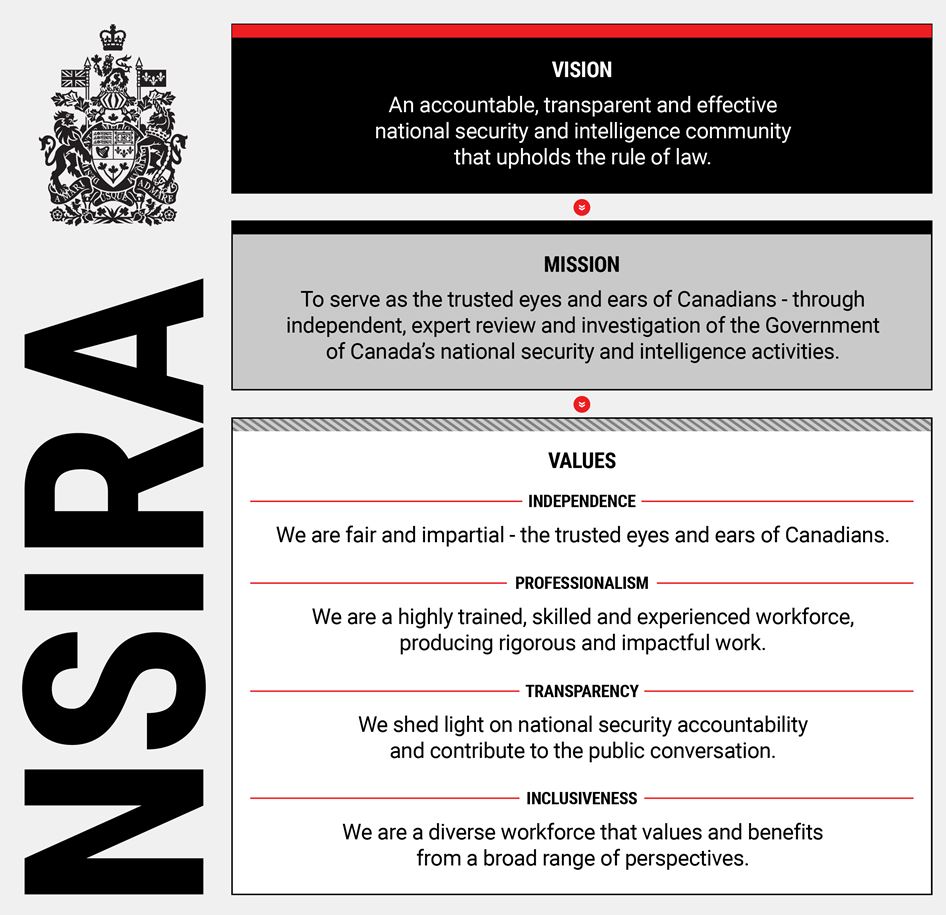
NSIRA’s Mission, Vision, and Values
Value of expanded partnerships
Expanded international partnerships and cooperation
Under NSIRA’s predecessors, international partnerships were primarily established through the Five Eyes Intelligence Oversight and Review Council (FIORC), which continues to be a foundational alliance for NSIRA. In addition to reinforcing and building upon the relationships it inherited, NSIRA has cultivated new partnerships with foreign counterparts and actively participated in international forums. In 2023 alone, NSIRA engaged with the following organizations and attended the following events:
Organizations:
Australia’s Inspector-General of Intelligence and Security (IGIS Australia)
New Zealand’s Inspector-General of Intelligence and Security (IGIS New Zealand)
The United States of America’s Inspector General of the Intelligence Community (IC IG US)
The United Kingdom’s Investigatory Powers Commissioner’s Office (IPCO UK)
The United Nations’ Counter-Terrorism Executive Directorate (UNCTED)
The United States Privacy and Civil Liberties Oversight Board (PCLOB US)
The Norwegian Parliamentary Oversight Committee on Intelligence and Security Services (EOS Norway)
The Danish Intelligence Oversight Board (TET Denmark)
The Independent Oversight Authority for Intelligence Activities of Switzerland (OA-IA)
The German Parliamentary Oversight Panel (PKGr)
The Dutch Review Committee on the Intelligence and Security Services (CTIVD Netherlands)
Events and forums:
Five Eyes Intelligence Oversight and Review Council Conference
International Intelligence Oversight Forum
European Intelligence Oversight Conference
Lessons learned and lessons shared with international partners
Connecting with international counterparts and participating in multilateral discussions has enabled NSIRA to tap into a network of partners. Relevant information is shared regarding best practices, methodologies, recent developments, and common issues. Information sharing and cooperation in the traditionally esoteric and insulated field of national security oversight has broadened NSIRA’s outlook and informed its expectations with respect to the departments and agencies that it oversees.
NSIRA has found that many of the challenges it faces have been experienced, and in some cases overcome, by international partners. These include challenges that are operational in nature, such as tactics for acquiring and verifying information, and those that relate to NSIRA’s Secretariat, such as the recruitment, training, and retention of staff. Leveraging the lessons learned by our international counterparts has accelerated NSIRA’s own development and contributed to the agency’s growing reputation as an exemplar in the realm of national security and intelligence oversight.
While certainly a voracious consumer of best practices, NSIRA is an equally active contributor. The agency has reciprocally shared its own unique approaches, processes, and methods with the broader oversight community, which in some instances has led partner organizations to follow NSIRA’s lead and adopt its practices. Even where NSIRA has not been confronted with a specific issue firsthand, its perspective has been sought and acted upon by partners that recognize NSIRA’s wealth of experience and renown for innovation.
Continuous and repeated engagements with international partners have allowed for working- level relationships to take root, flourish, and bear fruit in the form of both regularly scheduled touch points and casual, ad hoc, file-specific exchanges. Lowering the institutional barriers has promoted the exchange of expertise, had a more direct impact on the substantive work of each institution, and produced more tangible outcomes, as described in the examples below.
Examples of value gained from engagements
Benefits to NSIRA
Through an extended assignment to NSIRA, a communications expert from IPCO UK conducted a wholistic assessment of the agency’s current communications posture and played a critical role in crafting an inaugural communications strategy. The implementation of this strategy has helped NSIRA reach and build connections with domestic stakeholders. NSIRA’s members and Secretariat staff are deeply grateful for the expert’s contributions during their time with the agency.
TET Denmark and EOS Norway were influential in the development and use of a new IT system review inspection, first used as part of NSIRA’s Review of the Lifecycle of CSIS’ Warranted Information. They also contributed to functional and performance benchmarking used by NSIRA in its methodologies, common practices, and assessment criteria.
NSIRA has consulted the American Inspector General to improve the responsiveness of reviewed departments and agencies to NSIRA’s recommendations. NSIRA has begun adopting best practices for ensuring there is follow-up on recommendations it has provided.
NSIRA’s contributions
At an event hosted by Global Affairs Canada (GAC) as part of Canada’s work in cooperation with the UNCTED, NSIRA gave a presentation to the UNCTED delegation to explain the role that independent review plays in assessing the legality of Canadian activities in the counter-terrorism realm. This showcased to international assessors how the Canadian model has built robust independent mechanisms for review of counter-terrorism operations that reaches both law enforcement and the intelligence service.
NSIRA’s review planning and consideration matrix was shared with New Zealand’s IGIS, TET Denmark, and several other international partners. Following their visit to NSIRA, TET Denmark has updated its IT standards to include quality assurance steps and added additional factors to its risk assessment framework.
Greater collaboration leads to greater accountability
Just as security and intelligence agencies regularly cooperate and share information with international partners, so too must the bodies that oversee them. Collaboration among NSIRA and its foreign counterparts has produced, and continues to yield, mutual benefits for all parties involved. As a result, NSIRA has become a more capable organization with greater visibility in the transnational security and intelligence community, ensuring effective and exhaustive accountability of Canada’s national security apparatus.
Domestically, within Canada’s review and oversight community, NSIRA brings a distinct and valued perspective, filling a previously unoccupied space in this important network. As such, the agency complements the activities of its peers. In 2023, NSIRA met with numerous Agents of Parliament, including the Auditor General of Canada, the Public Sector Integrity Commissioner, and the Privacy Commissioner. The multi-decade institutional experience and maturity of these agents and their respective offices has proven to be invaluably instructive for NSIRA, and the exchange of best practices has been extremely helpful, particularly in the development of the Secretariat’s communications capacity.
As provided for in the NSIRA Act, NSIRA engages with other oversight bodies to deconflict on issues of mutual interest. For example, in 2023, both NSIRA and the National Security and Intelligence Committee of Parliamentarians (NSICOP) launched reviews on the issue of political foreign interference. While maintaining its independence, NSIRA coordinated with NSICOP to avoid any unnecessary duplication of work in relation to each organization’s review.
Reviews
Overview
In addition to its annual reviews, NSIRA continued to execute discretionary reviews that it deemed relevant and appropriate to the authorities of its mandate. Of note was NSIRA’s review on the Dissemination of Intelligence on People’s Republic of China Political Foreign Interference, 2018–2023. NSIRA evaluated the flow of intelligence within government from the collectors to consumers, including senior public servants and elected officials. This involved scrutinizing internal processes regarding how collected information was shared and escalated to relevant decision-makers. NSIRA determined that it was in the public interest to report on this matter and produced its first special report under section 40 of the NSIRA Act. This report was tabled in both houses of Parliament in May 2024.
Table 1 captures all review work that was underway in 2023. This includes annually mandated reviews, discretionary reviews, and annual reviews of CSE and CSIS activities. High-level summaries of their content and outcomes are provided in subsequent sections for those reviews completed by the end of the calendar year; the full findings and recommendations can be found in Annex B. NSIRA makes the reviews available once they have been redacted for public release.
Table 1. NSIRA Review Activities During 2023
Review
Department(s)
Status
Annual Report to the Minister of National Defence on CSE activities for 2022
CSE
Completed
Annual Report to the Minister of Public Safety on CSIS activities for 2022
CSIS
Completed
Review of Government of Canada Institutions’ Disclosures of Information Under the Security of Canada Information Disclosure Act in 2022
PS, CSE, CSIS, GAC, RCMP, IRCC
Completed
Review of CSE’s Network-based Solutions and Related Cybersecurity & Information Assurance Activities
CSE and SSC
Completed
Review of CSIS Dataset Regime
CSIS
Completed
Review of the Department of National Defence/Canadian Armed Forces’ Human Source Handling Program
DND/CAF
Completed
Review of Operational Collaboration Between the CSE and CSIS
CSE and CSIS
Completed
Review of the CBSA’s Confidential Human Source Program
CBSA
Completed
Review of Departmental Implementation of the Avoiding Complicity in Mistreatment by Foreign Entities Act for 2022
Review of the Dissemination of Intelligence on People’s Republic of China Political Foreign Interference, 2018–2023
CSIS, RCMP, GAC, CSE, PS, PCO
Completed
Review of Public Safety Canada and CSIS’s Accountability Mechanisms
CSIS, GAC, PS, DOJ
Completed
Review of the Lifecycle of CSIS’ Warranted Information
CSIS
Completed
Review of the RCMP’s Human Source Program
RCMP
Completed
Review of Government of Canada Institutions’ Disclosures of Information Under the Security of Canada Information Disclosure Act in 2023
PS, CSE, CSIS, GAC, RCMP, CBSA, IRCC
Ongoing
Review of CSE’s Vulnerabilities Equities Process
CSE, CSIS, RCMP
Ongoing
Review of CRA’s Review and Analysis Division (RAD)
CRA
Ongoing
Canadian Security Intelligence Service reviews
Overview
NSIRA has a mandate to review any Canadian Security Intelligence Service (CSIS) activity. The NSIRA Act requires the agency to submit an annual report on CSIS activities each year to the Minister of Public Safety and Emergency Preparedness. These reports are classified and include information related to CSIS’s compliance with the law and applicable ministerial directions, and the reasonableness and necessity of CSIS exercising its powers.
In 2023, NSIRA completed one dedicated review of CSIS and its annual review of CSIS activities, both summarized below. Furthermore, CSIS is involved in other NSIRA multi-departmental reviews, such as the agency’s review of the operational collaboration between CSE and CSIS, and the legally mandated annual reviews of the Security of Canada Information Disclosure Act (SCIDA) and the Avoiding Complicity in Mistreatment by Foreign Entities Act, the results of which are described in section 4.5, Multi-departmental reviews.
Review of CSIS Dataset Regime
In July 2019, the dataset regime came into force as part of the National Security Act 2017 (NSA 2017), creating sections 11.01–11.25 of the CSIS Act.The regime enables CSIS to collect and retain datasets containing personal information that are not directly and immediately related to threats, but likely to assist in national security investigations.
NSIRA examined the implementation of the regime, including aspects of governance, information management, retention practices, and training. The agency found compliance issues that permeated all aspects of the regime under review. Of concern, NSIRA found that CSIS’s current application of the dataset regime is inconsistent with the statutory framework. NSIRA also found multiple compliance issues with how CSIS has implemented the regime, including the retention of Canadian and foreign information without the requisite legally mandated authorizations and approvals.
The review concluded that CSIS has failed to adequately operationalize its dataset regime. CSIS did not seek to clarify legal ambiguities of the application of the regime before the Federal Court, despite having had the opportunity to do so. CSIS adopted multiple positions on its application and now risks limiting what is intended to be a collection and retention regime to a retention mechanism. Internally, CSIS has not provided sufficient resources and training to ensure compliance with the regime. Absent an internal commitment to adequately operationalize, resource, and support the implementation of a new legal regime, any such regime will fail no matter how fit for purpose it is believed to be.
Annual review of Canadian Security Intelligence Service activities
NSIRA completed its annual review of CSIS activities, which covers a range of activities contemplated and undertaken between January 1 and December 31, 2023. The review highlighted compliance-related challenges faced by CSIS, allowed NSIRA to continue monitoring ongoing trends, and identified emerging issues in CSIS’s exercise of its powers. Information obtained throughout the review, including that which CSIS is required to provide to NSIRA under the CSIS Act, was used in NSIRA’s Annual Report to the Minister of Public Safety on CSIS activities, as well as to inform ongoing NSIRA reviews and internal review planning for upcoming reviews.
Statistics and data
To achieve greater public accountability, NSIRA has requested that CSIS publish statistics and data about public interest and compliance-related aspects of its activities. NSIRA is of the opinion that the following statistics will provide the public with information related to the scope and breadth of CSIS operations, as well as display the evolution of activities from year to year.
Warrant applications
Section 21 of the CSIS Act authorizes CSIS to apply to a judge for a warrant if it believes, on reasonable grounds, that more intrusive powers are required to investigate a particular threat to the security of Canada. Warrants may be used by CSIS, for example, to intercept communications, enter a location, or obtain information, records, or documents. Each individual warrant application could include multiple individuals or request the use of multiple intrusive powers.
Table 2: Section 21 warrant applications made by the Canadian Security Intelligence Service, 2018–2023
Applications
2018
2019
2020
2021
2022*
2023
Total section 21 applications
24
24
15
31
28
30
Total approved warrants
24
23
15
31
28
30
New warrants
10
9
2
13
6
9
Replacements
11
12
8
14
14
10
Supplemental
3
2
5
4
8
11
Total denied warrants
0
1
0
0
0
0
*The applications submitted by CSIS to the Federal Court in 2022 resulted in the approval and issuance of 194 judicial authorities, including 164 warrants and 28 assistance orders issued pursuant to sections 12, 16, and 21 of the CSIS Act, as well as two judicial authorizations issued pursuant to section 11.13 of the Act. Each application is subject to a thorough production and vetting process that includes review by an independent Department of Justice counsel and challenge by a committee composed of executives of CSIS, PS, CSE, and the RCMP (as applicable) before seeking ministerial approval. A number of warrants issued during this period reflected the development of innovative new authorities and collection techniques, which required close collaboration between collectors, technology operators, policy analysts, and legal counsel.
Threat reduction measures
CSIS is authorized to seek a judicial warrant for a threat reduction measure (TRM) if it believes that certain intrusive measures, outlined in section 21 (1.1) of the CSIS Act, are required to reduce a threat. The CSIS Act is clear that when a proposed TRM would limit a right or freedom protected by the Canadian Charter of Rights and Freedoms or would otherwise be contrary to Canadian law, a judicial warrant authorizing the measure is required. To date, CSIS has sought no judicial authorizations to undertake warranted TRMs. TRMs approved in one year may be executed in future years. Operational reasons may also prevent an approved TRM from being executed.
Table 3: Total number of approved and executed threat reduction measures, 2015–2023
Threat reduction measures
2015
2016
2017
2018
2019
2020
2021
2022
2023
Approved
10
8
15
23
24
11
23
16
14
Executed
10
8
13
17
19
8
17
12
19
Warranted
0
0
0
0
0
0
0
0
0
Canadian Security Intelligence Service targets
CSISis mandated to investigate threats to the security of Canada, including espionage; foreign- influenced activities; political, religious, or ideologically motivated violence; and subversion. Section 12 of the CSIS Act sets out criteria for permitting the Service to investigate an individual, group, or entity for matters related to these threats. Subjects of a CSIS investigation, whether they be individuals or groups, are called “targets.”
Table 4: Number of Canadian Security Intelligence Service targets, 2018–2023
Targets
2018
2019
2020
2021
2022
2023
Number of targets
430
467
360
352
340
323
Datasets
Data analytics is an investigative tool for CSIS, through which it seeks to make connections and identify trends that may not be visible using traditional methods of investigation. NSA 2017 gave CSIS new powers, including a legal framework for the Service to collect, retain, and use datasets. The framework authorizes CSIS to collect datasets (divided into publicly available, Canadian, and foreign datasets) that may have the ability to assist it in the performance of its duties and functions. It also establishes safeguards for the protection of Canadian rights and freedoms, including privacy rights. These protections include enhanced requirements for ministerial accountability. Depending on the type of dataset, CSIS must meet different requirements before it is able to use a dataset.
The CSIS Act also requires that NSIRA be kept apprised of certain dataset-related activities. Reports prepared following the handling of datasets are to be provided to NSIRA under certain conditions and within reasonable timeframes. While CSIS is not required to advise NSIRA of judicial authorizations or ministerial approvals for the collection of Canadian and foreign datasets, CSIS has been proactively keeping NSIRA apprised of these activities.
Table 5: Evaluation and retention of publicly available, Canadian, and foreign datasets by the Canadian Security Intelligence Service, 2019–2023
Type of dataset
2019
2020
2021
2022
2023
Publicly available datasets
Evaluated
9
6
4
4
2
Retained
9
6
2
4
2
Canadian datasets
Evaluated
0
0
2
0
1
Retained (approved by the Federal Court)
0
0
0
2
0
Denied by the Federal Court
0
0
0
0
0
Foreign datasets
Evaluated
10
0
0
1
2
Retained (approved by the Minister of Public Safety and Intelligence Commissioner)
0
1
1
1
3
Denied by the Minister
0
0
0
0
0
Denied by the Intelligence Commissioner
0
0
0
0
0
Justification Framework
CSIS’s Justification Framework establishes a limited justification for its employees, and persons acting at their direction, to carry out activities that would otherwise constitute offences under Canadian law. CSIS’s framework is modelled on those already in place for Canadian law enforcement. It provides needed clarity to CSIS, and to Canadians, about what CSIS may lawfully do in the course of its activities. The framework recognizes that it is in the public interest to ensure that CSIS employees can effectively carry out intelligence collection duties and functions, including by engaging in otherwise unlawful acts or omissions, in the public interest and in accordance with the rule of law. The types of otherwise unlawful acts and omissions that are authorized by the Justification Framework are determined by the Minister of Public Safety and approved by the Intelligence Commissioner. There remain limitations on what activities can be undertaken, and nothing in the framework permits the commission of an act or omission that would infringe on a right or freedom guaranteed by the Charter.
According to section 20.1 of the CSIS Act, employees must be designated by the Minister of Public Safety and Emergency Preparedness to be covered under the Justification Framework while committing or directing an otherwise unlawful act or omission. Designated employees are CSIS employees who require the Justification Framework as part of their duties and functions. Designated employees are justified in committing an act or omission themselves (commissions by employees) and they may direct another person to commit an act or omission (directions to commit) as a part of their duties and functions.
Table 6: Authorizations, commissions, and directions under CSIS’ Justification Framework, 2019–2023
2019
2020
2021
2022
2023
Authorizations
49
147
178
172
172
Commissions by employees
1
39
51
61
47
Directions to commit
15
84
116
131
116
Emergency designations
0
0
0
0
0
Compliance
CSIS’s operational compliance program unit leads and manages overall compliance within the Service. The objective of this unit is to promote a culture of compliance within CSIS by leading an approach for reporting and assessing potential non-compliance incidents that provides timely advice and guidance related to internal policies and procedures for employees. This program is the centre for processing all instances of potential non-compliance related to operational activities.
NSIRA will continue to monitor closely the instances of non-compliance that relate to Canadian law and the Charter, and work with CSIS to improve transparency around these activities.
Table 7: Total number of non-compliance incidents processed by CSIS, 2019–2023
Incidents
2019
2020
2021
2022
2023
Processed compliance incidents
53
99
85
59
79
Administrative
53
64
42
48
Operational
40a
19b
21
17
31
Canadian law
N/A
N/A
1
2
4
Charter
N/A
N/A
6
5
15
Warrant conditions
N/A
N/A
6
3
11
CSIS governance
N/A
N/A
8
15
27
a For 2021, each operational non-compliance incident was reported based on the highest non-compliance (i.e., if the incident were non-compliant with the Charter and CSIS governance, it would be counted only under the Charter category). For 2022 and 2023, each incident is counted in all of the areas in which it was non-compliant. As such, the sum of operational non-compliance in the various categories exceeds the total number of such incidents.
b The total number of incidents of non-compliance were not further broken down in 2019 and 2020. This number represents the number of incidents of non-compliance with requirements such as the CSIS Act, the Charter, warrant terms and conditions, or CSIS internal policies or procedures.
Communications Security Establishment reviews
Overview
NSIRA has the mandate to review any activity conducted by the Communications Security Establishment (CSE). NSIRA must submit an annual report to the Minister of National Defence on CSE activities, including information related to CSE’s compliance with the law and applicable ministerial directions, and NSIRA’s assessment of the reasonableness and necessity of CSE exercising its powers.
In 2023, NSIRA completed two dedicated reviews of CSE and commenced an annual review of CSE activities, summarized below. Furthermore, CSE is included in other NSIRA multi-departmental reviews, such as the review of the operational collaboration between CSE and CSIS and the legally mandated annual reviews of the Security of Canada Information Disclosure Act (SCIDA) and the Avoiding Complicity in Mistreatment by Foreign Entities Act (see section 4.5).
Review of CSE’s Use of the Polygraph for Security Screening
NSIRA’s review of CSE’s use of the polygraph for security screening found that the policies and procedures in place at CSE inadequately addressed privacy issues. In particular, CSE’s use of personal information collected during polygraph exams for staffing purposes may have exceeded the consent provided and may not have complied with section 7 of the Privacy Act.
NSIRA also found issues with the way in which CSE operated its polygraph program, including unnecessarily repetitive and aggressive questioning by examiners, insufficient quality control of exams, and retention issues related to audiovisual recordings. Additionally, the way in which CSE used the results of polygraph exams to inform security screening decision-making could cause uncertainty over the opportunity to challenge denials of security clearances pursuant to the NSIRA Act. CSE generally over-relied on the results of polygraph exams for deciding security screening cases. When taken as a whole, CSE’s use of the polygraph for security screening raised serious concerns related to the Charter.
NSIRA also explored the role of the Treasury Board of Canada Secretariat (TBS) in establishing the Standard on Security Screening (the Standard), which governs the use of the polygraph for security screening by the Government of Canada. NSIRA found that TBS did not adequately consider the privacy or Charter implications of the use of the polygraph. TBS also did not implement sufficient safeguards in the Standard to address these implications.
As a result, NSIRA recommended that CSE and TBS both urgently address the fundamental issues related to the legality, reasonableness, and necessity of the use of the polygraph for security screening. If these issues cannot be addressed, NSIRA recommended that TBS remove the polygraph from the Standard and CSE should cease using it for security screening.
Review of CSE’s Network-based solutions and related Cybersecurity & Information Assurance activities
Since the CSE Act came into force in 2019, CSE’s cybersecurity and information assurance (CSIA) activities have grown in extent and importance. CSE acquires and analyzes vast amounts of information to identify and prevent cybersecurity threats, a necessary activity that nonetheless engages important privacy interests, a balance NSIRA sought to understand.
This was NSIRA’s first review of CSE’s CSIA activities, along with its first review of Shared Services Canada (SSC). The two departments work together on CSIA activities, as SSC is the system owner for most Government of Canada networks.
NSIRA found that CSE operates a comprehensive and integrated ecosystem of cybersecurity systems, tools, and capabilities to protect against cyber threats, with a design that incorporates measures meant to protect the privacy of Canadians and persons in Canada.
NSIRA made findings and recommendations in two areas of concern:
CSE’s communications to the Minister of National Defence about its CSIA program did not fully reflect its activities in practice. NSIRA made recommendations to CSE to improve its transparency in this regard.
CSE acquired information from sources that, in limited cases, may engage Canadian privacy interests. While this information has clear cybersecurity value, it was not acquired within the scheme of ministerial authorizations, due in part to an incongruence between subsections of the CSE Act. NSIRA recommended various actions to address this acquisition.
NSIRA built foundational knowledge about CSE’s CSIA activities through this review, which will inform NSIRA’s future activities.
Annual review of Communications Security Establishment activities
NSIRA conducted the second annual review of CSE activities. The 2023 review aimed to identify compliance-related challenges, general trends, and emerging issues based on information CSE is required by law to provide to NSIRA, as well as supplementary information. Primarily resulting in NSIRA’s Annual Report to the Minister of National Defence on CSE activities, the review also identified areas for future reviews of CSE activities and bolstered NSIRA’s knowledge of CSE activities.
Statistics and data
To achieve greater accountability and transparency, NSIRA has requested statistics and data from CSE about public interest and compliance-related aspects of its activities. NSIRA is of the opinion that these statistics will provide the public with important information related to the scope and breadth of CSE operations, as well as display the evolution of activities from year to year.
Ministerial authorizations and ministerial orders
Ministerial authorizations are issued to CSE by the Minister of National Defence. The authorizations support specific foreign intelligence, cybersecurity activities, defensive cyber operations, or active cyber operations conducted by CSE pursuant to those aspects of its mandate. Authorizations are issued when these activities could otherwise contravene an Act of Parliament or interfere with a reasonable expectation of privacy of a Canadian or a person in Canada.
Ministerial orders are issued by the Minister for the purpose of (1) designating any electronic information, any information infrastructures, or any class of electronic information or information infrastructures as electronic information or information infrastructures of importance to the Government of Canada (section 21[1] of the CSE Act); or (2) designating recipients of information related to Canadians or persons in Canada – that is, Canadian-identifying information (sections 45 and 44[1] of the CSE Act).
Table 9: Ministerial orders in effect as of 2023
Name of ministerial order
Enabling section of the CSE Act
Designating Recipients of Canadian Identifying Information Used, Analyzed or Retained Under a Foreign Intelligence Authorization
43
Designating Recipients of Information Relating to a Canadian or Person in Canada Acquired, Used or Analyzed Under the Cybersecurity and Information Assurance Aspects of the CSE Mandate
44
Designating Electronic Information and Information Infrastructures of Importance to the Government of Canada
21
Designating Electronic Information and Information Infrastructures of Ukraine as of Importance to the Government of Canada
21
Designating Electronic Information and Information Infrastructures of Latvia as of Importance to the Government of Canada
21
Foreign intelligence reporting
Under section 16 of the CSE Act, CSE is mandated to acquire information from or through the global information infrastructure. The CSE Act defines the global information infrastructure as including electromagnetic emissions; any equipment producing such emissions; communications systems; information technology systems and networks; and any data or technical information carried on, contained in, or relating to those emissions, that equipment, those systems, or those networks. CSE uses, analyzes, and disseminates the information for providing foreign intelligence in accordance with the Government of Canada’s intelligence priorities.
Table 10: Number of foreign intelligence reports issued, 2019–2023
CSE foreign intelligence reporting
2020 (#)
2021 (#)
2022 (#)
2023 (#)
Reports released
Not available
3,050
3,185
3,184
Departments and agencies
>25
28
26
28
Specific clients within departments and agencies
>2,100
1,627
1,761
2,049
Information relating to a Canadian or a person in Canada
Information relating to a Canadian or a person in Canada (IRTC) is information about Canadians or persons in Canada that may be incidentally collected by CSE while conducting foreign intelligence or cybersecurity activities under the authority of a ministerial authorization. Incidental collection refers to information acquired that CSE was not deliberately seeking and where the activity that enabled its acquisition was not directed at a Canadian or a person in Canada. According to CSE policy, IRTC is defined as any information recognized as having reference to a Canadian or person in Canada, regardless of whether that information could be used to identify that Canadian or person in Canada.
CSE was asked to release statistics or data about the regularity with which IRTC is included in CSE’s end-product reporting. CSE responded that this information “remains classified and cannot be published.”
Canadian-identifying information
CSE is prohibited from directing its activities at Canadians or persons in Canada. However, its collection methodologies sometimes result in incidentally acquiring such information. When such incidentally collected information is used in CSE’s foreign intelligence reporting, any part that potentially identifies a Canadian or a person in Canada is suppressed to protect the privacy of the individual(s) in question. CSE may release unsuppressed Canadian-identifying information (CII) to designated recipients when the recipients have the legal authority and operational justification to receive it, and when it is essential to international affairs, defence, or security (including cyber security).
Table 11: Number of requests for disclosure of Canadian-identifying information, 2021–2023
Type of request
2021 (#)
2022 (#)
2023 (#)
Government of Canada requests
741
657
1,087
Five Eyes requests
90
62
142
Non-Five Eyes requests
0
0
0
Total
831
719
1,229
In 2023, of the 1,229 requests received, CSE reported having denied 281 requests. By the end of the calendar year, 40 were still being processed.
CSE was asked to release the number of instances where CII is suppressed in CSE foreign intelligence or cyber security reporting. It indicated that this information “remains classified and cannot be published.”
Privacy incidents and procedural errors
A privacy incident occurs when the privacy of a Canadian or a person in Canada is put at risk in a manner that runs counter to, or is not provided for, in CSE’s policies. CSE tracks such incidents through its Privacy Incidents File, and for privacy incidents that are attributable to a second-party partner or a domestic partner, through its Second-Party Privacy Incidents File.
Table 12: Number of privacy incidents recorded by CSE, 2021–2023
Table 12: Number of privacy incidents recorded by CSE, 2021–2023
Type of incident
2021 (#)
2022 (#)
2023 (#)
Privacy incidents
96
114
107
Second-party privacy incidents
33
23
37
Non-privacy compliance incidents
Not available
Not available
28
Table 13: Number of privacy incidents that occurred under the foreign intelligence aspect of CSE’s mandate and recorded in 2023
Table 13: Number of privacy incidents that occurred under the foreign intelligence aspect of CSE’s mandate and recorded in 2023
Type of incident
2023 (#)
Privacy incidents
70
Second-party privacy incidents
37
Non-privacy compliance incidents
16
Table 14: Number of privacy incidents that occurred under the cybersecurity and information assurance aspect of CSE’s mandate and recorded in 2023
Table 14: Number of privacy incidents that occurred under the cybersecurity and information assurance aspect of CSE’s mandate and recorded in 2023
Type of incident
2023 (#)
Privacy incidents
37
Non-privacy compliance incidents
12
Cyber security and information assurance
Under section 17 of the CSE Act, CSE is mandated to provide advice, guidance, and services to help protect electronic information and information infrastructures of federal institutions, as well as those of non-federal entities that are designated by the Minister of National Defence as being of importance to the Government of Canada.
The Canadian Centre for Cyber Security (Cyber Centre) is Canada’s unified authority on cybersecurity. The Cyber Centre, which is a part of CSE, provides expert guidance, services, and education while working in collaboration with stakeholders in the private and public sectors. The Cyber Centre handles incidents in government and designated institutions that include:
reconnaissance activity by sophisticated threat actors;
phishing incidents (email containing malware);
unauthorized access to corporate IT environments;
imminent ransomware attacks; and
zero-day exploits, which involve exploration of critical vulnerabilities in unpatched software.
Table 15: Number of cyber incident cases opened by CSE, 2022 and 2023
Type of cyber incident
2022
2023
Federal institutions
1,070
977
Critical infrastructure
1,575
1,756
International
Not available
82
Total
2,645
2,815
Defensive and active cyber operations
Under section 18 of the CSE Act, CSE is mandated to conduct defensive cyber operations (DCO) to help protect electronic information and information infrastructures of federal institutions, as well as those of non-federal entities that are designated by the Minister as being of importance to the Government of Canada, from hostile cyber attacks.
Under section 19 of the CSE Act, CSE is mandated to conduct active cyber operations (ACO) against foreign individuals, states, organizations, or terrorist groups as they relate to international affairs, defence, or security.
CSE was asked to release the number of DCOs and ACOs approved, and the number carried out in 2023. CSE responded that this information “remains classified and cannot be published.”
Technical and operational assistance
As part of the assistance aspect of CSE’s mandate, CSE receives requests for assistance from Canadian law enforcement and security agencies, as well as from the Department of National Defence and the Canadian Forces (DND/CAF).
Table 16: Number of requests for assistance received and actioned by CSE, 2020–2023
Action
2020
2021
2022
2023
Approved
23
32
59
48
Not approved
1
3
0
0
Under review
Not available
Not available
0
2
Cancelled
Not available
Not available
1
0
Denied
Not available
Not available
2
1
Total received
24
35
62
53
Note: For 2020 and 2021, CSE was able to provide only the number of requests received and actioned. CSE advised, however, that it has since improved its internal tracking system for requests for assistance.
Other department reviews
Overview
In addition to the CSIS and CSE reviews above, NSIRA completed the following reviews of departments and agencies in 2023:
a review of the Canada Border Services Agency (CBSA);
a review of the Department of National Defence (DND) and the Canadian Armed Forces (CAF); and
NSIRA’s annual reviews of both the Security of Canada Information Disclosure Act and the Avoiding Complicity in Mistreatment by Foreign Entities Act, both of which involve a broader set of departments and agencies that make up the Canadian national security and intelligence community.
Canada Border Services Agency
Review of the CBSA’s Confidential Human Source Program
This review examined the legal and policy frameworks governing CBSA’s Confidential Human Source (CHS) program. The review had three areas of focus: the management and assessment of risk; CBSA’s discharge of its duty of care to its sources; and the sufficiency of ministerial direction and accountability in relation to the program. Together, these areas support CBSA’s ability to conduct its human source-handling activities lawfully, ethically, and with appropriate accountability.
The review reflects that, as an investigative tool used in support of CBSA’s mandate, the CHS Program rests on an adequate legal framework. However, the review found a number of gaps in the framework governing the program and was especially attentive to how CBSA manages the particular risks associated with the use of human sources without status in Canada. The review contains a number of findings that relate to CBSA’s risk management practices.
In two instances, NSRIA’s review concluded that CBSA’s activities may not be in compliance with the law. In the first, the review concluded through a detailed case study that CBSA may have twice breached the law of informer privilege by improperly disclosing information that might identify the human source. In this and another instance, NSIRA found that CBSA failed to inform the Minister of Public Safety of a human source activity that may have impacted the safety of an individual, as required by the Ministerial Direction on Surveillance and Confidential Human Sources. This constitutes non-compliance with subsection 12(2) of the CBSA Act.
NSIRA made six recommendations in this review. Collectively, they are meant to enhance the governance of the human source program to ensure CBSA is attentive to the welfare of its human sources across the full spectrum of activities. They also reflect NSIRA’s ongoing attention to the principle of ministerial accountability. Overall, NSIRA’s findings and recommendations reflect the level of maturity of CBSA’s program; although it has been operating for almost 40 years, the introduction of the policy suite specific to human sources is a relatively recent innovation. The review also reflects CBSA’s recent efforts to improve its program.
Department of National Defence and the Canadian Armed Forces
Review of DND/CAF’s Human Source Handling Program
This review examined whether DND/CAF conducts its human source-handling activities lawfully, ethically, and with appropriate accountability.
NSIRA found that DND/CAF’s policy framework allows human source-handling activities that may not be in compliance with the law. These risks arise particularly in relation to sources associated with terrorist groups. NSIRA recommended that Parliament enact a justification framework that would authorize DND/CAF and its sources to commit otherwise unlawful acts outside Canada, where reasonable for the collection of defence intelligence.
NSIRA found that DND/CAF’s risk assessment frameworks do not provide commanders with the accurate, consistent, and objective information they need to evaluate the risks of engaging with particular sources. NSIRA recommended that these frameworks be revised to ensure that all applicable risk factors are considered.
NSIRA found gaps in DND/CAF’s discharge of its duty of care to sources. Safeguarding processes were not always appropriately engaged; the complaints process was underdeveloped; and the risk posed to agents was, at times, insufficiently assessed. Measures to address these issues should be clearly operationalized in governance documents.
NSIRA found that the Minister of National Defence is not sufficiently informed on human source-handling operations to fulfill their ministerial accountabilities. The Minister should be aware of the legal, policy, and governance issues that may affect human source-handling operations.
NSIRA also found that further ministerial direction is required to support the governance of DND/CAF’s human source handling program. NSIRA recommended that the Minister issue ministerial direction to DND/CAF that will guide the lawful and ethical conduct of source-handling operations.
Multi-departmental reviews
Review of Operational Collaboration between CSE and CSIS
CSE and CSIS are two core pillars of Canadian intelligence collection, which means that effective collaboration between the departments is critical to national security. However, a tension exists between CSIS’s mandate, which authorizes collection and sharing of information about Canadians, and CSE’s core prohibition against directing its activities at Canadians. This is the first review that was able to access information from both departments and consider that tension.
NSIRA examined a sample of CSE and CSIS collaborative operational activities and information sharing, as well as collaboration between CSIS and CSE further to CSIS’s threat reduction measure (TRM) mandate. This satisfied NSIRA’s annual requirement under section 8(2) of the NSIRA Act to review an aspect of CSIS’s TRMs.
With respect to operational collaboration, including under CSIS’s TRM mandate, NSIRA found a lack of information sharing and proactive planning, as well as a failure on CSE’s part to properly account for and mitigate the risk of targeting Canadians when working with CSIS. NSIRA recommended some procedural changes to improve information flow, consultation, transparency, and accountability.
Concerning information sharing, NSIRA found that existing processes between the departments lacked guidance and accountability, and created risks of CSE targeting Canadians that were actualized in some instances. NSIRA recommended both departments establish policies, procedures, and analyst training. Additionally, NSIRA recommended that CSIS cease making requests to CSE pertaining to Canadians and consider the Canadian information it shares with CSE. NSIRA also recommended that CSE reconsider how it collects, retains, and reports Canadian information in certain scenarios and only use foreign lead information from CSIS reporting.
In this review, NSIRA found two cases of non-compliance with the law. Both involved CSE directing its activities at Canadians under its foreign intelligence mandate.
Review of federal institutions’ disclosures of information under the Security of Canada Information Disclosure Act in 2022
This review provided an overview of the use of the Security of Canada Information Disclosure Act (SCIDA) in 2022. In doing so, it documented the volume and nature of information disclosures made under the SCIDA, assesses compliance with the Act, and highlights patterns in its use across Government of Canada institutions and over time.
In 2022, four disclosing institutions made a total of 173 disclosures to five recipient institutions. NSIRA found that institutions complied with the SCIDA’s requirements for disclosure and record keeping in relation to the majority of these disclosures. Observed instances of non-compliance that were related to subsection 9(3), regarding the timeliness of records copied to NSIRA; subsection 5.1(1), regarding the timeliness of destruction or return of personal information; and subsection 5(2), regarding the provision of a statement on accuracy and reliability. These instances did not point to any systemic failures in Government of Canada institutions’ implementation of the Act.
NSIRA also made findings in relation to practices that, although compliant with the SCIDA, left room for improvement. NSIRA’s corresponding recommendations were designed to increase standardization across the Government of Canada in a manner that is consistent with the institutions’ demonstrated best practices and the Act’s guiding principles.
Overall, NSIRA observed improvements in reviewee performance compared to findings from prior years’ reports and over the course of the review. These improvements include corrective actions taken by reviewees in response to NSIRA’s requests for information in support of this review.
Review of departmental implementation of the Avoiding Complicity in Mistreatment by Foreign Entities Act for 2022
This review assessed departments’ compliance with the Avoiding Complicity in Mistreatment by Foreign Entities Act (ACA) and their implementation of the ACA’s associated directions during the 2022 calendar year. Within this context, the review pursued a thematic focus on departments’ conduct of risk assessments, including the ways in which their methodologies may lead to a systematic under-assessment of the level of risk involved in an information-sharing transaction.
NSIRA’s findings and recommendations in this report reflect both developments and stagnations in departments’ implementation of the directions over time. NSIRA observed efforts to collaborate interdepartmentally and standardize certain practices across the Government of Canada. While these efforts reflect an improvement over past approaches, they fall short of the consistent framework for foreign information sharing government-wide envisioned by the Act. Additionally, NSIRA observed a number of practices that may lead departments to systematically under-assess the risks involved in contemplated information exchanges. Such under-assessments may in turn lead to information being exchanged, in contravention of the directions’ prohibitions.
NSIRA made five recommendations in this review. Collectively, they would ensure that all departments’ ACA frameworks reflect a degree of standardization commensurate with the spirit of the Act and its associated directions; and that these frameworks are designed to support compliance with the directions.
Complaint investigations
Overview
NSIRA is mandated to investigate national security-related public complaints. NSIRA complaint investigations are conducted with consistency, fairness, and timeliness. The agency’s public complaint mandate plays a critical role in ensuring that Canada’s national security and intelligence organizations are accountable to the Canadian public.
In 2022, NSIRA had committed to establishing service standards for the investigation of complaints, with the goal of completing 90 percent of investigations within its new service standards. These service standards were implemented and have been in effect since April 1, 2023, and set internal time limits for certain investigative steps for each type of complaint, under normal circumstances. NSIRA is pleased to report that for the period of April 1 to December 31, 2023, 100 percent of the service standards have been met across all investigation files subject to these service standards.
While remaining mindful of the interests of the complainant and the security imperatives of the organization, NSIRA established an independent verification process with CSE for new complaints filed under section 17 of the NSIRA Act. More specifically, after receiving a complaint, NSIRA must evaluate whether it is within NSIRA’s jurisdiction to investigate, based on conditions stated in the NSIRA Act. For complaints against CSE, just as with complaints against CSIS and the RCMP, NSIRA must be satisfied that the complaint against the respondent organization refers to an activity carried out by the organization and is not trivial, frivolous, or vexatious. This new independent verification process assists NSIRA in ascertaining its jurisdiction to investigate complaints filed against CSE.
NSIRA has developed a new internal tracking tool to ensure effective case management of complaint files.
NSIRA previously reported that it would improve its website to promote accessibility to the investigation of complaints. During the overhaul of its public-facing website in the fall of 2023, NSIRA amended its complaint forms to ensure that they meet WCAG 2.0 accessibility criteria and conformity requirements.
In 2023, NSIRA completed the last phase of a study jointly commissioned with the Civilian Review and Complaints Commission (CRCC) regarding the collection of race-based data and other demographic information. The study assessed the viability of the collection of identity-based and demographic data as part of the Government of Canada’s ongoing anti-racism initiatives.
In the course of this study, interviews were conducted with community members familiar with NSIRA, the CRCC, and the agencies they review. The study ultimately found that the collection of raced-based data was feasible.
The study also included recommendations in relation to the collection of race-based data as follows:
collection of race data from complainants and how to collect such data;
collection of other biographical data from complainants;
collection of race data about the staff police and intelligence organizations;
analysis of the collected data;
provision of the collected data to interested stakeholders, the general public, or both;
development of an advanced data analysis plan.
NSIRA welcomes the insights provided by the joint study and will closely review the recommendations to determine how they might be implemented by NSIRA. The collection of race-based and other demographic data in the national security and intelligence space is an entirely novel area. The study’s literature review highlighted that this type of race-based and other demographic data collection has never been done before in the national security and intelligence space in Canada, or by any of Canada’s international partners. NSIRA and the CRCC will continue to collaborate on this important initiative by determining potential implementation strategies.
Ongoing initiatives
In 2023, NSIRA began revising its Rules of Procedure to refine the procedures governing its complaints investigations. This revision will continue in 2024 with the support of the Secretariat in ensuring that the agency’s obligations provided for in its Accessibility Plan are met.
Part of the revisions to NSIRA’s procedures in 2024 will be to review the privacy statement included in its complaint forms to ensure greater transparency about how the information submitted to NSIRA by complainants will be used in NSIRA’s investigations.
Investigation summaries
Final reports issued
Investigation concerning allegations against CSIS (NSIRA File 07-403-45)
The complainant alleged that CSIS agents interacted with them on multiple occasions and claimed that those interactions amounted to illegal arrests and detentions; that the agents illegally intimidated them by claiming that they would deport them to Guantanamo Bay; and that the Service erroneously applied the Privacy Act in refusing to provide documents the complainant claims they were coerced into signing under duress during one of the above-noted interactions.
Upon reviewing all of the evidence presented by the parties and available information, NSIRA observed that the complainant never had any interactions with CSIS. NSIRA found that none of their allegations could be substantiated.
Allegations against CSIS for travel difficulties, harassment, and discrimination (NSIRA File 07-403-23)
The complainant alleged that, following an overseas trip, they experienced difficulties travelling internationally, which they believed were attributable to CSIS and CSIS’ sharing of information with the governments of foreign countries. The complainant claimed that CSIS had placed them on a “blacklist” as a member of the Islamic State of Iraq and Syria. They further alleged that CSIS harassed them and discriminated against them on the basis of race, ethnic origin, and religion.
At the time of the complainant’s trip, certain countries were regularly being used by extremist travellers from North America and Europe as intermediate destinations to access Islamic State of Iraq and the Levant-controlled territory.
The complainant’s family was interviewed by CSIS to gain information about the complainant, their beliefs, and possible intentions. The complainant considered this interaction to have been an inappropriate and wrongful interrogation of members of their family.
Upon review of all of the evidence, NSIRA found the activities of CSIS in this matter to have been lawful and reasonable. While investigative steps were conducted by CSIS, there was no evidence suggesting that CSIS placed the complainant on a blacklist or that information pertaining to the complainant was shared improperly. Similarly, the allegation that CSIS was responsible for the complainant’s travel difficulties was found to be unsubstantiated. The source of the complainant’s travel difficulties may lie outside of Canadian authorities, and thus beyond the scope of NSIRA’s jurisdiction.
NSIRA concluded that CSIS conducted an interview with the complainant’s parent at their home and with other family members present, during which their parent participated voluntarily and expressed their willingness to be of further assistance if required. The basis for conducting this interview was found to be reasonable and NSIRA did not find any evidence of inappropriateness, intimidation, wrongdoing, or harassment.
NSIRA did not find an evidentiary basis to support the allegations of harassment and of discrimination on the basis of racial, ethnic origins, or religion by CSIS against the complainant.
The complainant’s allegations were found to be unsupported.
Allegations against CSIS regarding criminal activity conducted by a CSIS Agent (NSIRA File 07-403-39)
The complainant alleged that a CSIS agent invaded their house and stated that they were an intelligence officer in operation. According to the complainant, the CSIS agent physically assaulted them, video recorded the complainant while the complainant was undressed, and threatened to kill them. The complainant further alleged that the Service is trying to silence them.
Upon a review of all of the evidence, it became clear that the complainant’s own conduct brought them to the attention of CSIS. They first communicated with CSIS and raised complaints regarding an individual. These allegations were received and considered by CSIS, which acted on the complaints to determine whether the individual named by the complainant was affiliated with CSIS. Based on a review of the documents submitted by CSIS, NSIRA determined that the individual alleged by the complainant to be a CSIS Agent was not a CSIS employee or otherwise involved with CSIS.
NSIRA further found that as part of the Service’s activities conducted in relation to the complainant, CSIS collected limited information on the complainant. NSIRA concluded that the collection of the complainant’s personal information was justified by CSIS’ mandate.
NSIRA concluded that the CSIS’ activities in relation to the complainant after they came to their attention were lawful and reasonable in the circumstances.
Allegations against CSIS regarding a citizenship security screening interview (NSIRA File 07-403-65)
The complainant had applied for Canadian citizenship and was subsequently required to attend an interview with CSIS. The complainant attended this interview with their lawyer. The complainant alleged that the CSIS officers who conducted the interview:
denied them and their lawyer the right to record and take notes of the interview;
violated past SIRC recommendations by not recording the interview themselves;
interacted with the complainant’s lawyer in an intimidating manner, and did not allow the lawyer to interject or to interrupt;
did not provide an adequate translation service; and
lacked cultural sensitivity during the interview, used inappropriate interview tactics, chose discussion points that created unnecessary tension, and behaved improperly.
Upon considering all of the evidence, NSIRA found that the CSIS officers erred in denying the complainant and their counsel the opportunity to take notes that they could take from the premises. CSIS acknowledged that this practice was no longer in place. NSIRA recommended that CSIS adjust its governing policy to make clear that the interviewee and their representative may take and retain notes from interviews.
NSIRA commented that since 2000, numerous SIRC reports and decisions have recommended that CSIS record immigration security screening interviews. However, CSIS did not consistently record such interviews at the time of the complainant’s interview. CSIS indicated that efforts to require recording of all immigration interviews in its written procedures was in progress. NSIRA recommended that CSIS proactively record interviews in immigration and citizenship matters, and that CSIS retain this recording at least until a decision is made by Immigration, Refugees and Citizenship Canada (IRCC) on CSIS’ advice. In the event that CSIS provides a negative conclusion, the recording should be kept until the immigration status is determined and for the period of any appeal of that determination.
Given that the complainant was unable to retain notes from the interview and that no recording of the interview existed, NSIRA was unable to make findings on most of the improper statements that the CSIS interviewer was alleged to have made. However, one statement in particular, which was an English idiom that the CSIS officer acknowledged using, was found to be unnecessary and counterproductive, as it risked compounding tension in the interview and may not have had a reasonable, literal translation in the language spoken by the complainant.
CSIS indicated and NSIRA agreed that counsel to an interviewee has a role in, but not control of, the interview process. An interview subject’s lawyer is not limited to passive silence, but also must not act in a manner that impairs the Service’s ability to perform its mandate. To this end, it is not open to counsel to lead witnesses or have an intrusive role in questioning. NSIRA noted, however, that it is proper for counsel to raise concerns about interpretation or to suggest clarifying questions. These concerns are to be posed during a pause or in some other pre-organized manner that does not disrupt the questioning. NSIRA recommended, therefore, that CSIS articulate within its own operating procedure the role of counsel (or other third parties) in the manner elaborated above, and that it communicates these expectations in advance to those attending an interview.
Finally, to remedy these errors, NSIRA recommended that CSIS convene a second interview attended by different officers and a different interpreter. Given the irregularities in the first interview and the resulting concern that it may contain inaccuracies, NSIRA further recommended that in completing its assessment and in providing advice to the IRCC, CSIS avoid giving weight to the results of the first interview.
Allegations against the RCMP for failure to return seized items (NSIRA File 07-407-08)
The complainant filed a complaint against the RCMP alleging that it failed to return property that was seized from their office, resulting from an RCMP investigation into a terrorist plot. The complainant further alleged that the RCMP damaged his property.
Upon considering the facts and timeline of the RCMP’s investigation that resulted in the seizure of the complainant’s property, NSIRA found that the property was properly detained, pursuant to the provisions of the Criminal Code and in accordance with RCMP policy.
NSIRA further found that there was no evidence that would permit to conclude that the complainant’s property was damaged by the RCMP during and after the seizure.
The complainant’s allegations were found to be unsupported.
Allegation that the RCMP failed to investigate threats against the Complainant and their family made by a foreign government (NSIRA File 07-407-04)
The complainant came to Canada as a refugee fleeing violent persecution. As a result of litigation against their former employer, who was linked to the government of a foreign state, the complainant alleged that they had been the victim of death threats from their former employer and government officials of the country from which they had fled. The complainant believed these threats to be credible, as they were often accompanied by contemporaneous details, such as the complainant’s clothing during a particular outing and the location they attended. The complainant believed that representatives of the aforementioned government employed at the country’s embassy in Canada were assisting in the surveillance of the complainant and their family, including their children while at school.
The complainant alleged that the RCMP failed to conduct a complete investigation into incidents involving threats, including death threats, made against the complainant and their family, and that these decisions by the RCMP were improperly influenced by foreign individuals.
The evidence provided by the RCMP demonstrated that it took the necessary steps to review the information submitted by the complainant, but determined that there were insufficient grounds for the RCMP to continue their investigation of the foreign influence aspects of the threats. However, the local police force was the police of jurisdiction for investigating the criminal harassment, threats, and safety concerns related to the complainant. The RCMP advised this police force that information collected by the RCMP would be turned over to them, and asked to be notified should the local police force identify someone in Canada working on behalf of a foreign government to threaten or intimidate the complainant. NSIRA found the RCMP’s initial investigation to be reasonably thorough and their ultimate decision to be a justifiable exercise of police discretion.
Furthermore, there was no evidence before NSIRA to support the complainant’s allegation that the RCMP’s decision to discontinue their investigation was improperly influenced by foreign individuals.
The complainant’s allegations were found to be unsupported.
Allegations against the RCMP in relation to the treatment of family members as part of a tactical operation (NSIRA File 07-407-05)
The RCMP arrested the complainant at his home on terrorism-related charges. In the course of the operation, the complainant’s family members were handcuffed. It was the complainant’s position that this was improper and that the RCMP officers did not utilize their cultural sensitivity training.
NSIRA found that:
The officers securing the complainant’s residence and whose conduct gave rise to this complaint were members of other police forces and not RCMP members.
Given the police had, at the time, reasonable grounds to believe that the premises might have contained unsecured and dangerous weapons, the initial detention of the complainant’s family members by using handcuffs was not arbitrary. However, as soon as the officers had control of the scene, the use of handcuffs was no longer appropriate. It followed that the family members were arbitrarily detained within the meaning of section 9 of the Charter.
Considering the cultural sensitivity briefing that was provided by the RCMP to the investigators taking part in the operation did address the essential consideration, there was no act or omission by the RCMP that raised the risk of culturally insensitive conduct.
NSIRA determined that, although the RCMP assumed a general supervisory role over the execution of the operation, they depended on the professionalism of the other police forces in planning and executing a dynamic search. Given that the conduct of the other police officers who participated in the search could not be attributed to the RCMP, no findings or recommendations were made for the RCMP in keeping with NSIRA’s jurisdiction.
Other Outcomes
Allegations against CSIS’s role in delaying security assessment regarding immigration or citizenship applications (NSIRA Files 07-403-81, 07-403-87, 07-403-100)
The complainants filed complaints against CSIS, alleging that the Service caused a significant delay in submitting the security assessment for their immigration or citizenship applications. During the investigations, NSIRA inquired about whether CSIS could provide updates with respect to their involvement in the respective processes. The Service provided letters to NSIRA that could be shared with the complainants advising them that CSIS had completed its assessment in the security screening process. As the complainants’ main allegations were in relation to the delay in the security screening, the matters were informally resolved in accordance with Rule 10.10 of NSIRA’s Rules of Procedure and the files were closed.
Allegations against the CSE regarding the discrimination of an employment applicant (NSIRA File 07-406-07)
The complainant filed a section 17 complaint regarding their employment application with CSE. More specifically, upon completing a student term contract with CSE and receiving a verbal offer for a further contract, CSE decided not to renew the complainant’s employment. The complainant alleged that this decision from CSE was based on their ethnicity. Despite the Chief of CSE having received a letter of complaint from the complainant, CSE notified NSIRA that its notification letter constituted their first notice of the complaint and requested that the matter be placed in abeyance (on hold). After completing an internal investigation of the complainant’s allegations (independent of NSIRA’s complaints process), CSE and the complainant began discussions toward a settlement. The parties ultimately reached a settlement and notified NSIRA accordingly. The complaint was informally resolved pursuant to Rule 10 of NSIRA’s Rules of Procedure prior to NSIRA rendering a decision on its jurisdiction to investigate this matter.
Allegations against the RCMP for failure to investigate a complaint (NSIRA File 07-407-10)
This complaint was referred to NSIRA by the Civilian Review and Complaints Commission (CRCC) for the RCMP, pursuant to subsection 45.53(4.1) of the RCMP Act. The complaint alleged that the RCMP failed to investigate individuals allegedly participating in a militia group. NSIRA tried to establish contact with the complainant several times to proceed with its investigation. NSIRA found that reasonable attempts had been made to communicate with the complainant and that the agency had exhausted all options. Accordingly, NSIRA issued reasons that the complaint had been abandoned, as per NSIRA’s Rules of Procedure. The complaint investigation file was closed.
Statistics on complaints investigations
Investigations progressed at significant levels in 2023 (see Annex C). NSIRA concluded several investigations and issued seven final reports. Additionally, four files were informally resolved in accordance with Rule 10 of NSIRA’s Rules of Procedure.
In 2023, NSIRA observed an increase of complaints against CSIS, pursuant to section 16 of the NSIRA Act, alleging process delays in immigration or citizenship security screening. Of note, under sections 14 and 15 of the CSIS Act, CSIS provides security advice to IRCC and CBSA to guide determinations with respect to whether citizenship or immigration applicants are threats to the security of Canada. While CSIS is committed to performing its security screening mandate in a timely manner, there is no standard for time allotted. In the 2023 calendar year, out of the six complaints over which NSIRA assumed jurisdiction under section 16 of the NSIRA Act, five pertained to allegations of delays that complainants attributed to CSIS’s security screening activities.
Conclusion
The comprehensive reviews and investigations NSIRA conducted in 2023 underscore the agency’s dedication to transparency and accountability. This work has provided constructive recommendations to enhance the operational practices and policy frameworks of Canada’s important national security and intelligence actors.
NSIRA recognizes the persistent and evolving nature of security threats, which necessitates adaptive and proactive approaches by Canada’s security and intelligence agencies. NSIRA is likewise committed to continually refining its methodologies, embracing technological advancements, and strengthening its analytical capabilities to keep pace in a rapidly changing world. NSIRA will continue to engage with domestic and international security and intelligence review partners to improve its practices and foster better public understanding of its work and the value it provides.
NSIRA is driven by its role as the trusted eyes and ears of Canadians within the otherwise closed domain of national security and intelligence, providing the critical function of enhancing transparency and accountability. NSIRA’s vision, mission, and values reflect this commitment and will guide NSIRA’s work at it looks to the future.
Annexes
Annex A: Abbreviations
Abbreviations and Full Names
Abbreviation
Full Name
ACA
Avoiding Complicity in Mistreatment by Foreign Entities Act
ACO
active cyber operations
CAF
Canadian Armed Forces
CBSA
Canada Border Services Agency
CHRC
Canadian Human Rights Commission
CHS
Confidential Human Source (program)
CII
Canadian-identifying information
CRA
Canada Revenue Agency
CRCC
Civilian Review and Complaints Commission for the RCMP
CSE
Communications Security Establishment
CSIA
Cybersecurity and information assurance
CSIS
Canadian Security Intelligence Service
CTIVD Netherlands
Dutch Review Committee on the Intelligence and Security
Cyber Centre
Canadian Centre for Cyber Security
DCO
defensive cyber operations
DFO
Department of Fisheries and Oceans
DND
Department of National Defence
EOS Norway
Norwegian Parliamentary Oversight Committee on Intelligence and Security Services
FINTRAC
Financial Transactions and Reports Analysis Centre of Canada
FIORC
Five Eyes Intelligence Oversight and Review Committee
GAC
Global Affairs Canada
GC
Government of Canada
HUMINT
Human Intelligence
IC IG US
United States of America’s Inspector General of the Intelligence Community
IGIS Australia
Australia’s Inspector-General of Intelligence and Security
IGIS New Zealand
New Zealand’s Inspector-General of Intelligence and Security
IPCO UK
United Kingdom’s Investigatory Powers Commissioner’s Office
IRCC
Immigration, Refugees and Citizenship Canada
IRTC
information relating to a Canadian or a person in Canada
IT
information technology
MD
Ministerial Direction
NBS
network-based solutions
NDA
National Defence Act
NSICOP
National Security and Intelligence Committee of Parliamentarians
NSIRA
National Security and Intelligence Review Agency
OA-IA
Independent Oversight Authority for Intelligence Activities of Switzerland
PCLOB US
United States Privacy and Civil Liberties Oversight Board
PCO
Privy Council Office
PKGr
German Parliamentary Oversight Panel
PS
Public Safety Canada
RAD
Review and Analysis Division
RCMP
Royal Canadian Mounted Police
REP
reasonable expectation of privacy
SCIDA
Security of Canada Information Disclosure Act
SIRC
Security and Intelligence Review Committee
SSC
Shared Services Canada
TBS
Treasury Board of Canada Secretariat
TC
Transport Canada
TET Denmark
Danish Intelligence Oversight Board
the Standard
Standard on Security Screening
TRM
threat reduction measure
UNCTED
United Nations’ Counter-Terrorism Executive Directorate
Abréviations et Noms Complets
Abréviation
Nom Complet
AMC
Affaires mondiales Canada
ARC
Agence du revenu du Canada
ARVP
Attente raisonnable en matière de droit à la vie privée
ASFC
Agence des services frontaliers du Canada
AS-Rens
Autorité de surveillance indépendante des activités de renseignement
BCP
Bureau du Conseil Privé
CANAFE
Centre d’analyse des opérations et déclarations financières du Canada
CCC
Centre canadien pour la cybersécurité
CCDP
Commission canadienne des droits de la personne
CCETP
Commission civile d’examen et de traitement des plaintes relatives à la Gendarmerie royale du Canada
COA
Cyberopérations actives
COD
Cyberopérations défensives
CPSNR
Comité des parlementaires sur la sécurité nationale et le renseignement
CSAI
Cybersécurité et assurance de l’information
CSARS
Comité de surveillance des activités de renseignement de sécurité
CSERGC
Conseil de surveillance et d’examen du renseignement du Groupe des cinq
CST
Centre de la sécurité des télécommunications
CTIVD Pays-Bas
Commission néerlandaise de contrôle des services de renseignement et de sécurité
DECT
Direction exécutive du Comité contre le terrorisme des Nations Unies
DRA
Division de la recherche et de l’analyse
EOS Norvège
Commission parlementaire norvégienne de contrôle des services de renseignement et de sécurité
FAC
Forces armées canadiennes
GRC
Gendarmerie royale du Canada
HUMINT
Renseignement humain
IC IG É.-U.
Inspecteur général de la communauté du renseignement des États-Unis d’Amérique
IGIS Australie
Inspecteur général du renseignement et de la sécurité de l’Australie
IGIS Nouvelle-Zélande
Inspecteur général du renseignement et de la sécurité de la Nouvelle-Zélande
INC
Information nominative sur un Canadien
IPCO R.-U.
Bureau du commissaire aux pouvoirs d’enquête du Royaume-Uni
IRCC
Immigration, Réfugiés et Citoyenneté Canada
IRCPC
Information qui se rapporte à des Canadiens ou à des personnes au Canada
la Norme
Norme sur le filtrage de sécurité
LCISC
Loi sur la communication d’information ayant trait à la sécurité du Canada
LCMTIEE
Loi visant à éviter la complicité dans les cas de mauvais traitements infligés par des entités étrangères
MND
Ministère de la Défense nationale
MPO
Ministère des Pêches et des Océans
MRM
Mesure de réduction de la menace
OSSNR
Office de surveillance des activités en matière de sécurité nationale et de renseignement
PCLOB É.-U.
Conseil de surveillance de la vie privée et des libertés civiles des États-Unis
PKGr
Comité de surveillance parlementaire de l’Allemagne
SCRS
Service canadien du renseignement de sécurité
SCT
Secrétariat du Conseil du Trésor du Canada
SHC
(Programme) des sources humaines confidentielles
SP
Sécurité publique Canada
SPC
Services partagés Canada
SR
Solutions réseau
TC
Transports Canada
TET Danemark
Conseil danois de surveillance des services de renseignement
TI
Technologie de l’information
Annex B: Review findings and recommendations
This Annex lists the full findings and recommendations of NSIRA’s reviews that were completed in 2023. In certain instances, original language has been redacted and replaced with summary language designated by [*summary*]. Once redacted, full reviews and available government responses to recommendations are published on NSIRA’s website.
Canadian Security Intelligence Service review
Review of CSIS Dataset Regime
NSIRA’s findings
NSIRA found that CSIS’s current application of the dataset regime is inconsistent with the statutory framework.
NSIRA found that CSIS’s current approach to dataset information collection under section 12 risks the creation of a parallel collection mechanism, one that weakens section 12’s statutory thresholds and at the same time lacks the external oversight regime intended to protect personal information under the dataset regime.
NSIRA found that CSIS failed to fully apprise the Court on their interpretation and application of the dataset regime. CSIS should have sought clarification from the Court as to its views on the precise conduct permissible prior to invocating the dataset regime.
NSIRA found that when conducting queries in exigent circumstances, CSIS retained information that did not meet the section 12 strictly necessary threshold.
NSIRA found that the lack of explicit time limits in section 11.17 of the dataset provisions governing foreign datasets has resulted in datasets being retained for multiple years pending a decision by the Minister or Minister’s designate (the CSIS Director).
NSIRA found that CSIS runs the risk of collecting information that is publicly available but for which there may be a reasonable expectation of privacy.
NSIRA found that CSIS’s policies governing the collection and retention of Canadian and foreign datasets do not align with its current interpretation of the dataset regime.
NSIRA found that CSIS does not have a policy governing the handling of transitory information. In addition, the existing Interim Direction [***] does not provide employees with sufficient instruction, which may result in CSIS retaining information that would otherwise be subject to the dataset regime.
NSIRA found that CSIS information management practices are responsible for multiple compliance incidents and currently create duplicates of datasets within CSIS’s systems.
NSIRA found that, as of August 2023, CSIS did not comply with the dataset provisions in the CSIS Act because it retained Canadian information extracted from foreign datasets, and foreign information amounting to a dataset.
NSIRA found that CSIS did not comply with the dataset provisions in the CSIS Act because it retained Canadian information and referenced it as recently as 2022. This information should have been destroyed upon coming into force of the NSA 2017, in July 2019.
NSIRA found that CSIS has not exhaustively scanned all of its systems to identify information that is subject to the dataset regime so that it may be processed in a compliant manner.
NSIRA found that the training required to become a designated employee to evaluate, query, and exploit section 11.01 datasets offers clear information on the collection and retention requirements.
NSIRA found that CSIS operational personnel, including those predominantly dealing with bulk information collection, have not received adequate training allowing them to identify when collected information may fall within the dataset regime.
NSIRA found that CSIS has not prioritized resourcing the technical unit responsible for the evaluation, querying, and exploitation of Canadian and foreign datasets.
NSIRA found that CSIS has not devoted sufficient resources to improving the current technical systems or developing new ones that are equipped to support bulk data use.
NSIRA found that CSIS collected information in relation to activities that could not on reasonable grounds be suspected to have constituted a threat to the security of Canada and the collection, analysis, and retention of which was not strictly necessary.
NSIRA’s Recommendations
Details
Recommendation 1: NSIRA recommends that in the next judicial authorization application for a Canadian dataset CSIS put its current position on the application of the dataset regime before the Court, including any use of the information prior to the decision to retain under the dataset regime.
Recommendation 2: NSIRA recommends that CSIS immediately destroy any record containing names retained pursuant to the exigent circumstances queries, as they do not meet the strictly necessary threshold.
Recommendation 3: NSIRA recommends that Parliament legislates a time limitation for the authorization of a foreign dataset by the Minister or Minister’s designate.
Recommendation 4: NSIRA recommends that CSIS meaningfully analyze and document any possible reasonable expectation of privacy when evaluating publicly available datasets.
Recommendation 5: NSIRA recommends that CSIS develop:
Guidelines regarding the implementation of section 6 of the Interim Direction on [**redacted**] that also include consideration of how the Direction’s retention rule is to be reconciled with the 90 day evaluation period in the dataset regime; and
A policy governing the handling of transitory information.
Recommendation 6: NSIRA recommends that CSIS cease to create duplicates of the information reported in the operational system.
Recommendation 7: NSIRA recommends that CSIS immediately destroy Canadian and foreign dataset information that is not strictly necessary to retain. This information no longer falls within the legal 90 day evaluation period and retaining it pursuant to the dataset regime is no longer a possibility.
Recommendation 8: NSIRA recommends that CSIS conduct an exhaustive scan of its operational and corporate repositories to identify and destroy any non-compliant information.
Recommendation 9: NSIRA recommends that CSIS develop and deliver scenario-based workshops to train operational personnel on CSIS’s current application of the dataset regime so that they can engage subject matter experts as necessary.
Recommendation 10: NSIRA recommends that CSIS prioritize resourcing the technical unit responsible for the evaluation, querying, and exploitation of Canadian and foreign datasets.
Recommendation 11: NSIRA recommends that CSIS prioritize the improvement of current technical systems or development of new systems, equipped to support compliant bulk data use.
Recommendation 12: NSIRA recommends that CSIS immediately destroy the case study dataset it collected pursuant to section 12, as it does not meet the statutory thresholds. This information no longer falls within the legal 90 day evaluation period and retaining it pursuant to the dataset regime is no longer a possibility.
Recommendation 13: NSIRA recommends that CSIS share the full unredacted copy of this report with the Federal Court.
Communications Security Establishment reviews
Review of CSE’s Use of the Polygraph in Security Screening
NSIRA’s findings
NSIRA found that CSE’s governance of the use of the polygraph for security screening inadequately addresses privacy issues.
NSIRA found that CSE did not conduct a Privacy Impact Assessment related to its use of the polygraph for security screening.
NSIRA found that CSE may not have considered whether all information collected during the polygraph is directly related or necessary to the assessment of loyalty to Canada or criminality, as required by the Privacy Act and the Directive on Privacy Practices.
NSIRA found that polygraph examiners applied an ad hoc approach as they assessed medical information collected during the polygraph.
NSIRA found that CSE may not have complied with section 7 of the Privacy Act by using information collected during polygraph exams for suitability and hiring decisions without the consent of the subject.
NSIRA found that CSE provides subjects with information that overstates the reliability and validity of the polygraph prior to obtaining consent.
NSIRA found that, in some instances, the way in which CSE conducted polygraph exams risked prompting subjects to fabricate information in an effort to clear themselves when faced with an unfavourable polygraph assessment.
NSIRA found instances where CSE’s quality control practices for polygraph exams were not always consistent with CSE policy.
NSIRA found that approximately 20% of security files from the sample reviewed were missing audiovisual recordings of polygraph exams.
NSIRA found that in all cases, when initial polygraph exam results indicated deception or were inconclusive, CSE’s practice was to conduct multiple polygraph exams rather than a resolution of doubt process as provided for under the Standard.
NSIRA found that the polygraph had an inordinate importance in security screening decision-making at CSE and other less-intrusive security screening activities were under-used or not used at all.
NSIRA found that the polygraph was de facto determinative in security screening decisions at CSE.
NSIRA found that CSE’s security screening decision-making may not comply with record-keeping requirements of the Standard on Security Screening.
NSIRA found that CSE’s use of the polygraph in security screening decisions makes more uncertain the opportunity to challenge denials of security clearances pursuant to the NSIRA Act and the Standard.
NSIRA found that TBS did not adequately consider privacy or Charter implications when it included the polygraph as a security screening activity under the Standard on Security Screening.
NSIRA found that the Standard on Security Screening insufficiently addresses Charter and privacy implications related to the use of the polygraph.
NSIRA found that the Government of Canada’s current use of the polygraph for security screening in the manner described in this review may raise serious concerns in relation to the Canadian Charter of Rights and Freedoms.
NSIRA’s Recommendations
Details
Recommendation 1: NSIRA recommends that the Treasury Board of Canada urgently remedy the issues identified by this review related to the legality, reasonableness and necessity of the use of the polygraph for security screening in Canada, or remove it from the Standard on Security Screening.
Recommendation 2: NSIRA recommends that CSE urgently remedy the issues identified by this review, including Charter and Privacy Act compliance, or cease conducting polygraph exams for security screening.
Review of CSE’s Network-based solutions and related Cybersecurity & Information Assurance activities
NSIRA’s findings
NSIRA found that CSE operates a comprehensive and integrated ecosystem of cybersecurity systems, tools, and capabilities to protect against cyber threats, with a design that incorporates measures meant to protect the privacy of Canadians and persons in Canada.
NSIRA found that CSE treated all network-based solutions (NBS) information as information related to a Canadian or a person in Canada (IRTC), and applied measures intended to protect privacy to all NBS-acquired information.
NSIRA found that information acquired through NBS will, by its nature, always include information related to a Canadian or person in Canada (IRTC) and is certain to include some information for which there is a reasonable expectation of privacy (REP) of a Canadian or person in Canada. This was not transparently communicated in corresponding applications to the Minister.
NSIRA found that, due to a lack of clarity in its relationship with SSC, CSE did not obtain consent from system owners for its cybersecurity and information assurance activities in the way described to the Minister.
NSIRA found that SSC was not fully aware of its responsibilities as a system owner, as described in CSE’s applications to the Minister.
NSIRA found that, despite the existence of a Memorandum of Understanding between CSE and SSC, there was a lack of clarity between the organizations on the implementation of agreed-upon commitments about NBS activities on networks operated by SSC.
NSIRA found that CSE did not explain to the Minister why consent to CSE’s cybersecurity activities could not reasonably be obtained from users of Government of Canada systems.
NSIRA found that CSE’s narrow application of subsection 22(4) of the CSE Act introduces legal and accountability risks and resulted in CSE acquiring information that may interfere with a reasonable expectation of privacy of a Canadian or person in Canada. This information was from a source acquired outside of the scheme of Ministerial authorizations.
NSIRA found that an incongruence between subsections 27(1) and 22(4) of the CSE Act prevents CSE from acquiring certain information from [*specific type of*] sources such as [*specific information source*], where this information interferes with the reasonable expectation of privacy of a Canadian or person in Canada. Some of this information would enhance CSE’s ability to fulfill its cybersecurity and information assurance mandate.
NSIRA’s Recommendations
Details
Recommendation 1: NSIRA recommends that CSE clearly explain, in its applications to the Minister, that:
Network-based solutions acquire information relating to a Canadian or a person in Canada (IRTC), including information that interferes with the reasonable expectation of privacy (REP) of Canadians or persons in Canada; and,
CSE subsequently uses, analyses, and retains this information for use in cybersecurity and information assurance activities.
Recommendation 2: NSIRA recommends that CSE renew its Memorandum of Understanding with SSC to ensure CSE and SSC meet their respective commitments, including any that CSE makes to the Minister regarding SSC’s role in informing system owners about the NBS program.
Recommendation 3: NSIRA recommends that CSE update Memoranda of Understanding with all of its cybersecurity partners, to ensure these partners have consented to CSE cybersecurity activities, and to ensure these arrangements reflect, and conform to, contemporary governance authorities. CSE should continue these updates, as a standard practice, as authorities evolve.
Recommendation 4: NSIRA recommends that CSE explain to the Minister how consent to CSE’s cybersecurity activities is obtained from users of Government of Canada systems, or otherwise explain why this consent could not reasonably be obtained.
Recommendation 5: NSIRA recommends that CSE reconsider whether limits on the acquisition by CSE of information from the global internet infrastructure (as per subsection 22(4) of the CSE Act) apply to information [*specific source of information*] sources.
This should include an assessment of whether section 8 of the Charter of Rights and Freedoms may be engaged, as well as cases where [*specific source of information*] sources may contain information that interferes with the reasonable expectation of privacy of a Canadian or person in Canada.
Recommendation 6: NSIRA recommends that, in order to continue these acquisition activities that are necessary for cybersecurity and information assurance (CSIA) purposes, CSE assess its current sources of CSIA information—that are acquired outside of an Authorization—for interference with the reasonable expectation of privacy of a Canadian or person in Canada.
This assessment should be repeated as required to ensure such information is not acquired without a valid Ministerial authorization.
Recommendation 7: NSIRA recommends that section 27 of the CSE Act be amended to permit the Minister to authorize CSE to acquire information that is necessary for CSE’s cybersecurity and information assurance aspect (but which may contain information that interferes with the reasonable expectation of privacy of a Canadian or person in Canada, or contravene an Act of Parliament), from sources other than federal information infrastructures and systems of importance to the Government of Canada.
Canada Border Services Agency review
Review of the CBSA’s Confidential Human Source Program
NSIRA’s findings
NSIRA found that CBSA policy does not require any documented approval or a documented assessment of the risks of using a CHS outside of the registration process.
NSIRA found that there was incomplete documentation in the preregistration period such that the CHS Program is impeded from monitoring the full spectrum of CHS Program activities.
NSIRA found that CBSA’s policies and practices around obtaining informed consent are insufficient to ensure that it is obtained systematically, and before individuals incur the risks of providing information in confidence to CBSA.
NSIRA found that measures to mitigate risks to CHSs are often not present or implemented.
NSIRA found that CBSA may have breached the law of informer privilege in two instances.
NSIRA found that Inland Enforcement Officers collected information and promised confidentiality, but did so without training under the applicable policy to support a proper understanding of the consequences of extending confidentiality.
NSIRA found that CBSA’s approach to risk management in their new policy suite does not fully align with principles in the MD.
NSIRA found that the information CBSA will provide to the Minister as required by Ministerial Direction is not sufficient to convey the size and scope of the Confidential Human Source Program.
NSIRA found that in two cases the CBSA did not comply with subsection 12(2) of the CBSA Act in that it failed to follow the MD’s requirement to inform the Minister when there was a Confidential Human Source activity that “may have significant adverse impact such as impacting the safety of an individual”.
NSIRA’s Recommendations
Details
Recommendation 1: NSIRA recommends that CBSA amends its policy to require a documented risk assessment and formal approval for using a CHS in the preregistration period.
Recommendation 2: NSIRA recommends that CBSA require that the interview checklist be administered no later than when the promise of confidentiality is extended.
Recommendation 3: NSIRA recommends that CBSA provide guidance as to how obtaining informed consent should be tailored to the individual circumstances of the CHS.
Recommendation 4: NSIRA recommends that CBSA put in place specific guidance on how to mitigate the full range of risks to CHSs and ensure that those mitigation measures are implemented.
Recommendation 5: NSIRA recommends CBSA expand its definition of active Confidential Human Source so that reporting to the Minister covers the breadth of the CHS program.
Recommendation 6: NSIRA recommends that CBSA immediately notify the Minister of the two cases identified in this review where safety of an individual is at issue.
Department of National Defence and the Canadian Armed Forces Review
Review of DND/CAF’s Human Source Handling Program
NSIRA’s findings
NSIRA found that DND/CAF’s policy framework allows human source handling activities that may not be in compliance with the law.
NSIRA found that DND/CAF policy is insufficiently specific with respect to recognizing and avoiding mistreatment risks created by human source handling activities.
NSIRA found that DND/CAF’s risk assessment framework for human source handling operations is inadequate. The current assessments of risk do not provide adequate or reliable information to decision-makers because they:
are overly subjective;
do not present mitigated and unmitigated risks clearly;
conflate risks; and
narrowly focus the considerations of certain risks at the expense of others.
NSIRA found gaps in the discharge of DND/CAF’s duty of care from engagement of the human source to disengagement. These gaps include:
a safeguard process that is not appropriately engaged for certain sources;
an underdeveloped complaints process for sources; and
insufficient assessments of the risk posed to Agents.
NSIRA found that the Minister of National Defence is not adequately informed in order to fulfill ministerial accountabilities for human source handling operations.
NSIRA found that further ministerial direction is required to support the governance of DND/CAF’s human source handling program.
NSIRA’s Recommendations
Details
Recommendation 1: NSIRA recommends that Parliament enact a justification framework to authorize DND/CAF and its sources to commit acts or omissions outside Canada that would otherwise be unlawful, where reasonable for the collection of defence intelligence.
Recommendation 2: NSIRA recommends that DND/CAF develop policy governance to properly equip Field HUMINT teams to conduct their human source handling activities in compliance with the law. At minimum, this should include:
Increased attention to determine whether individuals are involved in terrorist activity;
Governance controls to increase accountability and enable responsiveness;
A change in policy to only accept information with plausible lawful provenance;
The development of training to support CAF members on how to handle human sources while mitigating legal risk; and
A review of operations with respect to their compliance with Canada’s foreign legal obligations.
Recommendation 3: NSIRA recommends that DND/CAF adopt an approach for assessing whether its exchanges with human sources create a substantial risk of mistreatment that is specific to human source handling, comprehensive with respect to its obligations in international human rights law and international humanitarian law, and formalized in policy and procedure.
Recommendation 4: NSIRA recommends that DND/CAF develop a risk assessment framework specific to human source handling, with appropriate doctrinal guidance for the assessment of human sources that includes consideration of all relevant risk factors.
All DND/CAF members implicated in the risk assessment process (including field HUMINT team members, commanders, intelligence staff, and legal and policy advisors) should be appropriately trained on the new risk assessment framework and guidance to ensure consistency across teams and deployments.
Recommendation 5: NSIRA recommends that DND/CAF adopt, in consultation with other departments as necessary, additional measures aimed at ensuring the welfare and protection of their human sources. These measures should be clearly operationalized in governance documents (directives, orders, procedures, etc.) and should address, at minimum, the issues identified in Finding #3.
Recommendation 6: NSIRA recommends that DND/CAF, in consultation with the Minister of National Defence, improve the content of biannual reports to the Minister to include, at minimum, the legal, policy and governance issues that may impact human source handling operations.
Recommendation 7: NSIRA recommends that, with respect to human source handling operations, DND/CAF create official written records of notifications and briefings to the Minister of National Defence, as well as records of decision to improve mutual accountability.
Recommendation 8: NSIRA recommends that the Minister of National Defence issue ministerial direction on human source handling to DND/CAF that includes, at minimum:
Fundamental principles guiding the lawful and ethical conduct of source handling operations;
The types of risk that should be assessed and when these risks should be consulted at the ministerial level;
Expectations regarding the management of human sources; and
Direction regarding the content and frequency of reporting.
Multi-departmental reviews
Review of Operational Collaboration between CSE and CSIS
NSIRA’s findings
NSIRA found that CSE does not routinely share its operational plans and associated risk assessments with CSIS when operating under CSIS authorities. This may leave CSIS unable to fully assess CSE’s activities for compliance.
NSIRA found that close collaboration at the working level created the right conditions for CSIS to monitor CSE’s assistance activities for compliance with warrant conditions.
NSIRA found that CSIS failed to submit an updated request for assistance to CSE in a timely manner when it sought new warrant powers.
NSIRA found that CSE and CSIS did not engage in any joint investigation, assessment, or tracking of a compliance incident.
NSIRA found that CSE and CSIS failed to implement an effective operational framework for their collection activity. This contributed to two instances of non-compliance with the Federal Court’s direction.
NSIRA found that CSE and CSIS identified an effective opportunity to collaborate under their respective mandates and carried out an operation that proved beneficial for both Canada and its allies.
NSIRA found that, while CSIS’s operational framework was sufficient, CSE’s operational framework did not assess legal and policy risk specific to the operation.
NSIRA found that CSE and CSIS did not draft joint terms of engagement, a joint operational plan, or engage in joint risk assessments.
NSIRA found that CSE’s foreignness assessment did not account for the increased risk of targeting Canadians when working with CSIS.
NSIRA found that both CSE and CSIS lack policies, procedures, and accountability mechanisms to govern CSIS lead information messages and associated requests and actions.
NSIRA found that CSIS’s use of lead information messages to share information and make requests about Canadians creates a high risk of potential for non-compliance for CSE.
NSIRA found that CSE’s application of incidental collection provisions may not be appropriate in situations where CSE knows there is a Canadian nexus to a CSIS foreign intelligence lead, and where it knows it is likely to collect Canadian information in pursuing the lead.
NSIRA found that CSE did not comply with section 22(1) of the CSE Act when it [*reviewed the contents*] of a Canadian’s device obtained through a CSIS lead information message.
NSIRA found that CSE did not comply with either section 22(1) of the CSE Act or section 273.64(2)(a) of the National Defence Act (NDA) when it used [*a number of*] complete exceptional reports for foreign intelligence purposes.
NSIRA found that CSE does not consistently utilize its protected entity tool to prevent targeting Canadian identifiers it receives from CSIS.
NSIRA found that while CSIS performs an initial consultation, it does not routinely pursue further engagement with CSE during Threat Reduction Measure activities that could overlap with CSE activities.
NSIRA found that CSE did not notify CSIS in a timely manner of a compliance incident in its Active Cyber Operation, which was connected to a CSIS Threat Reduction Measure.
NSIRA found that CSE failed to cooperate effectively with CSIS, leading to a missed opportunity to advance Canadian intelligence objectives via domestic collaboration.
NSIRA’s Recommendations
Details
Recommendation 1: NSIRA recommends that CSE share its operational plans and associated risk assessments with CSIS prior to operating under CSIS authorities.
Recommendation 2: NSIRA recommends that when CSIS engages CSE for assistance with the execution of warranted powers, a CSIS employee be involved to ensure compliance in CSE’s collection activities until the request for assistance has terminated.
Recommendation 3: NSIRA recommends that CSIS develop a process to ensure that necessary requests for assistance are submitted to CSE in a timely manner subsequent to obtaining warrant powers.
Recommendation 4: NSIRA recommends when working under a request for assistance CSIS and CSE develop a framework for joint investigation of potential compliance incidents.
Recommendation 5: NSIRA recommends that CSIS ensure roles and responsibilities are clearly agreed to prior to allowing partners to execute warrant powers. Where appropriate, these agreements should be shared with the Federal Court.
Recommendation 6: NSIRA recommends that CSIS ensure it is directly involved in all substantive communications with any partner actively executing its warrant powers.
Recommendation 7: NSIRA recommends that CSIS share paragraphs 32 through 41 of this review, along with associated recommendations, with the Federal Court.
Recommendation 8: NSIRA recommends that when CSE engages in joint operations with CSIS it should perform risk assessments for each operational activity. These should specifically consider the risk of targeting Canadians and implement proactive measures to mitigate this risk.
Recommendation 9: NSIRA recommends that when participating in joint operations, CSE and CSIS either jointly develop or share written terms of engagement, operational plans, and risk assessments.
Recommendation 10: NSIRA recommends that CSE perform foreignness assessments that account for the increased risk of targeting Canadians when working with CSIS.
Recommendation 11: NSIRA recommends CSIS cease making requests for action and/or further information to CSE in relation to Canadians or people in Canada via CSIS lead information messages.
Recommendation 12: NSIRA recommends that CSIS develop policies, procedures, and analyst training to standardize the disclosure of CSIS lead information messages to CSE.
Recommendation 13: NSIRA recommends that CSE develop policies, procedures, and analyst training to standardize the use of CSIS lead information messages.
Recommendation 14: NSIRA recommends that CSE develop a regime for collecting, retaining, and reporting to CSIS Canadian information it uncovers further to legitimate foreign intelligence activities where it has advance knowledge of the Canadian information.
Recommendation 15: NSIRA recommends that CSE update its policies to prohibit the analysis of information relating to a Canadian or person in Canada for the purposes of identifying foreign intelligence.
Recommendation 16: NSIRA recommends that if CSIS decides to disclose exceptional reporting to CSE, it should extract the relevant foreign intelligence for disclosure as opposed to sending the entire report.
Recommendation 17: NSIRA recommends that CSE cease using complete exceptional reports from CSIS under its foreign intelligence mandate.
Recommendation 18: NSIRA recommends that CSE introduce a requirement to always apply the protected entity tool to all Canadian identifiers.
Recommendation 19: NSIRA recommends that CSIS pursue routine engagement with CSE during the implementation of its Threat Reduction Measures when the potential for operational overlap exists.
Recommendation 20: NSIRA recommends that CSE share details of potential compliance incidents with CSIS when an overlap may exist with a CSIS Threat Reduction Measure.
Review of Federal Institutions’ Disclosures of Information under the Security of Canada Information Disclosure Act in 2022
NSIRA’s findings
NSIRA found that CSE, CSIS, GAC, and IRCC regularly use the SCIDA in a manner that warrants information sharing arrangements, as encouraged by subsection 4(c) of the SCIDA.
NSIRA found that CBSA, DND/CAF, and IRCC were non-compliant with subsection 9(3) of the SCIDA, as they failed to provide all records created under subsections 9(1) or 9(2) to NSIRA within the legislated timeframe.
NSIRA found improved compliance outcomes in instances where departments prepared record overview spreadsheets under subsections 9(1) and 9(2) of the SCIDA that displayed the following characteristics:
a row for each disclosure made or received;
columns explicitly tied to each individual paragraph under section 9; and
additional columns to capture relevant administrative details, such as whether the disclosure was requested or proactive; the date of the request (if applicable); and any applicable file reference numbers.
NSIRA found that all GC institutions complied with their obligation to prepare and keep records that set out the information prescribed under subsections 9(1) and 9(2) of the SCIDA.
NSIRA found that more than half of the descriptions provided by CBSA and IRCC under paragraph 9(1)(e) of the SCIDA did not explicitly address their satisfaction that the disclosure was authorized under paragraph 5(1)(b), the proportionality test.
NSIRA found, within the sample of disclosures reviewed, that disclosing institutions demonstrated they had satisfied themselves of both the contribution and proportionality tests, in compliance with subsection 5(1) of the SCIDA.
NSIRA found that GAC satisfied itself under the SCIDA’s paragraph 5(1)(a) contribution test based on an incorrect understanding of the recipient’s national security mandate in two cases.
NSIRA found, within the sample of disclosures reviewed, that CBSA and GAC (in one and two disclosures, respectively) were non-compliant with the SCIDA’s subsection 5(2) requirement to provide a statement regarding accuracy and reliability.
NSIRA found, in relation to the remaining disclosures within the sample, that GAC, IRCC, and RCMP included their statements regarding accuracy and reliability within the disclosures themselves, whereas CBSA provided its statements in the disclosures’ cover letters.
NSIRA found that DND/CAF destroyed information under the SCIDA subsection 5.1(1), but they were non-compliant with the requirement to do so “as soon as feasible after receiving it.”
NSIRA found delays between when a disclosure was authorized for sending and when it was received by the individual designated by the head of the recipient institution to receive it in at least 20% (n=34) of disclosures.
NSIRA’s Recommendations
Details
Recommendation 1: NSIRA recommends that information sharing arrangements be used to govern regular SCIDA disclosures between GAC and CSIS; IRCC and CSIS; as well as IRCC and CSE.
Recommendation 2: NSIRA recommends that all GC institutions prepare record overviews to clearly address the requirements of subsections 9(1) and 9(2) of the SCIDA; and provide them to NSIRA along with a copy of the disclosure itself and, where relevant, a copy of the request.
Recommendation 3: NSIRA recommends that disclosing institutions explicitly address the requirements of both paragraphs 5(1)(a) and 5(1)(b) in the records that they prepare under paragraph 9(1)(e) of the SCIDA.
Recommendation 4: NSIRA recommends that GC institutions contemplating the use of proactive disclosures under the SCIDA communicate with the recipient institution, ahead of making the disclosure, to inform their assessments under subsection 5(1).
Recommendation 5: NSIRA recommends that all disclosing institutions include statements regarding accuracy and reliability within the same document as the disclosed information.
Recommendation 6: NSIRA recommends that GC institutions review their administrative processes for sending and receiving disclosures under the SCIDA, and correct practices that cause delays.
Review of departmental implementation of the Avoiding Complicity in Mistreatment by Foreign Entities Act for 2022
NSIRA’s findings
NSIRA found that all departments, with the exception of DFO in respect of subsection 7(1), complied with the reporting requirements set out in the ACA.
NSIRA found that all departments had frameworks to govern their implementation of the ACA and its associated directions by the end of 2022.
NSIRA found that most departments demonstrated continual refinements of their ACA frameworks based on self-identified gaps, NSIRA recommendations, and community-wide coordination efforts.
NSIRA found that TC’s ACA governance framework did not include policies and procedures for:
escalating cases to the deputy head; or
assessing the risks of information sharing with foreign entities.
NSIRA found that all departments, with the exception of DFO, GAC, PS, and TC, used country and/or entity risk assessments to inform their assessments of substantial risk of mistreatment and corresponding case escalation.
NSIRA found that departments’ country risk assessments were inconsistent with one another.
NSIRA found that the simultaneous conduct of independent human rights risk assessments in different departments reflected a substantial duplication of effort across the GC, and created the opportunity for discrepant outcomes.
NSIRA found, for the fourth consecutive year, that no departments escalated cases to their deputy heads for determination or decision.
NSIRA found that some high-risk sharing activities were stopped prior to escalation for consideration of possible mitigations.
NSIRA found that certain departments’ ACA governance frameworks and risk assessment methodologies included features that may systematically under-assess the level of risk involved in a transaction. These features include:
discrepant applications of the threshold for substantial risk of mistreatment;
incorporating mitigations into baseline assessments of risk, while overestimating their effects; and
a lack of checks and balances in the risk assessment process.
NSIRA’s Recommendations
Details
Recommendation 1: NSIRA recommends that TC update its ACA governance framework to include policies and procedures for:
Escalating cases to the deputy head; and
Assessing the risks of information sharing with foreign entities.
Recommendation 2: NSIRA recommends that the Government of Canada designate a body responsible for developing:
A unified set of assessments of the human rights situations in foreign countries including a standard “risk of mistreatment” classification level for each country; and
To the extent that multiple departments deal with the same foreign entities in a given country, standardized assessments of the risk of mistreatment of sharing information with foreign entities.
Recommendation 3: NSIRA recommends that departments apply the “substantial risk” threshold in a manner consistent with the definition adopted government-wide; and that departments whose broader policy frameworks do not yet reflect this definition (CBSA, CRA, IRCC, and TC) make the attendant updates.
Recommendation 4: NSIRA recommends that departmental assessments of substantial risk of mistreatment be grounded in countries’ human rights records; and that subsequent entity-level considerations be based on validated, current, and consistent respect for caveats and assurances, rather than the absence of derogatory information particular to that entity or other bilateral considerations.
Recommendation 5: NSIRA recommends that all ACA governance frameworks incorporate layered checks and balances in the risk assessment and escalation of cases that may involve substantial risk of mistreatment.
Annex C: Statistics on complaints investigations
January 1–December 31, 2023
INTAKE INQUIRIES
135
New complaints filed
26
National Security and Intelligence Review Agency Act (NSIRA Act), section 16, Canadian Security and Intelligence Service (CSIS) complaints
I am pleased to present the National Security and Intelligence Review Agency (NSIRA) Secretariat’s Departmental Results Report for fiscal year 2023-24. This year, the Secretariat has effectively met its goals by supporting NSIRA in delivering comprehensive, impactful reviews and ensuring the integrity of complaint investigations. We have built upon our previous successes, significantly enhancing our capacity and expertise across all areas.
In 2023-24, the NSIRA Secretariat supported numerous national security and intelligence reviews, producing a range of high-quality expert reports, including ministerial reports, compliance reports, annual reports destined for tabling in Parliament, and NSIRA’s first special report. The reviews covered various Government of Canada organizations and were shared with key government leaders.
Our outreach and collaboration initiatives have bolstered NSIRA’s relationships with domestic review bodies, agents of Parliament, and international counterparts. The Secretariat played a pivotal role in hosting an international annual conference of NSIRA’s key partners, fostering the exchange of knowledge and best practices. This year, we also established connections with European partners and participated in key international oversight and review activities.
In terms of complaint investigations, the NSIRA Secretariat has continued to support the agency in the refinement of investigation processes, prioritizing timeliness, efficiency, and transparency. We have stabilized investigative procedures to ensure fair and timely conduct. With the normalization of our work environment post-pandemic, our efficiency increased, resulting in numerous formal investigations and informal resolutions. The implementation of service standards for investigative processes has been highly successful. Additionally, in cooperation with a domestic partner, we completed a study on the collection of race-based and demographic data, supporting anti-racism initiatives.
I extend my deepest gratitude to all NSIRA Secretariat employees for their unwavering dedication and commitment to our mission. Their efforts have ensured that our work reflects the highest standards and continues to ensure that Government of Canada security and intelligence activities are subject to expert scrutiny and independent assessment for legal compliance, reasonableness and necessity.
Results: what we achieved
Core responsibilities and internal services
Core responsibility 1: National Security and Intelligence Reviews and Complaints
Internal services
Core responsibility 1: National Security and Intelligence Reviews and Complaints
In this section
Description
Progress on results
Key risks
Resources required to achieve results
Related government-wide priorities
Program inventory
Description
NSIRA reviews Government of Canada national security and intelligence activities to assess whether they are lawful, reasonable, and necessary. The Agency also investigates complaints from members of the public on the activities of the Canadian Security Intelligence Service (CSIS), the Communications Security Establishment (CSE), the Royal Canadian Mounted Police (RCMP), as well as certain other national security-related complaints, independently and in a timely manner.
The NSIRA Secretariat supports the Agency in the delivery of its mandate. Independent scrutiny contributes to strengthening the accountability framework for national security and intelligence activities and to enhancing public confidence. Ministers and Canadians are informed whether national security and intelligence activities undertaken by Government of Canada institutions are lawful, reasonable, and necessary.
Progress on results
This section presents details on how the department performed to achieve results and meet targets for National Security and Intelligence Reviews and Complaints. Details are presented by departmental result.
Table 1: Targets and results for National Security and Intelligence Reviews and Complaints
Table 1 provides a summary of the target and actual results for each indicator associated with the results under National Security and Intelligence Reviews and Complaints.
Ministers and Canadians are informed whether national security and intelligence activities undertaken by Government of Canada institutions are lawful, reasonable and necessary
Departmental results
Target
Date to achieve target
Actual Results
All mandatory reviews are completed on an annual basis
100% completion of mandatory reviews
2021–22
2021–22: 100%
2022–23: 100%
2023–24: 100%
Reviews of national security or intelligence activities of at least five departments or agencies are conducted each year
At least one national security or intelligence activity is reviewed in at least five departments or agencies annually
2021–22
2021–22: 100%
2022–23: 100%
2023–24: 100%
All high priority national security or intelligence activities, as approved by members, are reviewed over a three-year period
100% completion over three years; at least 33% completed each year
2021–22
2021–22: 33%
2022–23: 33%
2023–24: 33%
National security related complaints are independently investigated in a timely manner
Departmental results
Target
Date to achieve target
Actual Results
Percentage of investigations completed within NSIRA Secretariat service standards.
90%
2022–23
2021–22: N/A
2022–23: N/A
2023–24: 100%
Note: The NSIRA Secretariat was created on July 12, 2019. Actual results for 2020–21 are not available because the new Departmental Results Framework in the changeover from the Security Intelligence Review Committee to the NSIRA Secretariat was being developed. This new framework is for measuring and reporting on results achieved starting in 2021–22.
The following section describes the results for National Security and Intelligence Reviews and Complaints Investigations in 2023–24 compared with the planned results set out in NSIRA Secretariat’s departmental plan for the year.
Ministers and Canadians are informed whether national security and intelligence activities undertaken by Government of Canada institutions are lawful, reasonable and necessary
NSIRA Secretariat staff supported NSIRA in the completion of 11 national security and intelligence reviews over the course of the 2023-24 fiscal year. A total of 13 Government of Canada organizations were subject to review and eight Ministers, plus the Prime Minister, went on to receive one or more of the NSIRA reports that were approved by members in the 2023-24 fiscal year.
10 section 34 ministerial reports
12 section 35 compliance reports
1 section 39 report on disclosures under the Security of Canada Information Disclosure Act
NSIRA’s first ever section 40 special report to the Prime Minister, which was tabled in Parliament
Of the 11 reviews completed this year, three reviews included multiple Government of Canada organizations by design. These three multi-organization reviews were:
The annual review of disclosures under the Security of Canada Information Disclosure Act (SCIDA)
The annual review of the implementation of directions issued under the Avoiding Complicity in Mistreatment by Foreign Entities Act (ACA)
Review of the dissemination of intelligence on People’s Republic of China political foreign interference, 2018-2024
All Departments/agencies covered in these multi-organizational reviews were: Canada Border Services Agency (CBSA), Canada Revenue Agency (CRA), Communications Security Establishment (CSE), Canadian Security Intelligence Service (CSIS), Department of Fisheries and Oceans (DFO), Department of National Defence and Canadian Armed Forces (DND/CAF), Financial Transactions and Reports Analysis Centre of Canada (FINTRAC), Global Affairs Canada (GAC), Immigration, Refugees and Citizenship Canada (IRCC), Privy Council Office (PCO), Public Safety Canada (PS), Royal Canadian Mounted Police (RCMP), and Transport Canada (TC).
Of the 11 reviews completed this year, four reviews focused on a topic that involved one Government of Canada organization:
CSIS – two reviews
CBSA – one review
DND/CAF – one review
Of the 11 reviews completed reviews this year, four reviews focused on topics that spanned across two Government of Canada organizations:
CSE and CSIS – one review
CSE and Treasury Board Secretariat (TBS) – one review
CSE and Shared Services Canada (SSC) – one review
CSIS and PS – one review
Two departments were subject to NSIRA review for the first time: TBS and SSC.
During the reporting period, the Secretariat continued to refine its processes and methodology to assist the NSIRA review mandate, with the goal of promoting high-quality, impactful reviews. This maturation included the implementation of developed tracking and data collection with a view to using business intelligence to support data-informed decision-making and to optimize review operations. NSIRA Secretariat staff promoted transparency and accountability by working with CBSA, CRA, CSE, CSIS, DFO, DND/CAF, FINTRAC, GAC, IRCC, PS, RCMP and TC to redact and proactively publish 7 reports on the NSIRA website.
National security related complaints are independently investigated in a timely manner
In 2023-24, the NSIRA Secretariat saw the continued maturation of the processes underpinning the fulfillment of its investigation mandate. The conduct of the investigative process has increased its emphasis on timeliness and efficiency, as well as transparency in order to enhance the relevance of the process for complainants.
The level of investigative activities remained high and included an increase in complaints against CSIS with respect to delays in security assessments related to immigration applications.
During the past year, NSIRA Secretariat stabilized its investigative processes for complaints as a result of the implementation of procedures and practices that ensured that the conduct of investigations is fair, timely and transparent. With the normalization of the NSIRA Secretariat’s work environment as a result of the dissipation of the constraints related to the COVID-19 pandemic, NSIRA investigations have seen an increase in efficiency. NSIRA completed six formal investigations and issued final reports in those cases, and concluded seven complaint matters by way of informal resolutions.
As of April 1, 2023, the NSIRA Secretariat implemented service standards related to the investigation of complaints. The service standards set internal time limits for important investigative steps for each type of complaint, under normal circumstances. The service standards specify the circumstances under which those time limits do not apply. The development of the service standards includes tracking and data collection on whether the NSIRA Secretariat is meeting its own service standards in the investigation of complaints. In 2023-24, it reached a success rate of 100% in meeting them.
Finally, the NSIRA Secretariat completed the last phase of a study on the collection of race-based data and other demographic information jointly commissioned with the CRCC. The study undertook work to assess the viability of the collection of identity-based and demographic data as part of the Government of Canada’s ongoing anti-racism initiatives. Improved, more precise and more consistent tracking, collection and measurement of data is necessary to support anti-racism efforts in government. NSIRA continued its collaboration with the CRCC in determining an implementation strategy and this work will continue in 2024-25.
Outreach and collaboration
Engagement and collaboration with current and new partners as well as public outreach were a big part of the support provided to NSIRA by Secretariat staff this year. Secretariat staff engaged in regular interactions with their counterparts in domestic review bodies such as the Secretariat of the National Security and Intelligence Committee of Parliamentarians and the Civilian Review and Complaints Commission to coordinate activities in a way to avoid of duplication in review efforts. Secretariat staff also established new collaborative relationships with counterparts at the various Agents of Parliament. In Fall 2023, the Secretariat supported NSIRA in hosting the Five Eyes Intelligence Oversight and Review Council (FIORC) annual conference in Ottawa. The 3-day event brought together review representatives from Canada, the United States, Australia, New Zealand, and the United Kingdom. The event was hosted in partnership with the Office of the Intelligence Commissioner. Secretariat staff further engaged in regular working level interactions with FIORC partners for the exchange of best practices and for the development of training in a variety of areas. As a result of Secretariat engagement efforts, NSIRA was able to establish important new connections with European partners and participated in the European Intelligence Oversight Conference. NSIRA also secured observer status participation in the Intelligence Oversight Working Group which gathers European oversight and review bodies. Secretariat staff also supported NSIRA in the production of the NSIRA Public Annual Report; the main public report informing Canadians about NSIRA’s work. In addition, Secretariat staff implemented timelier regular publication of unclassified versions of NSIRA reports throughout the year to engage the Canadian public regularly about NSIRA’s work.
Key risks
Effective review requires timely and complete responses to NSIRA’s requests for information, open and candid briefings, and mutual respect. Despite NSIRA’s expansive access rights under the NSIRA Act, Secretariat staff continued to note some instances where Government of Canada organizations did not prioritize the work of review or were not fully responsive to access requests. Compounding these challenges were outdated information management systems and practices within many reviewed organizations, which slowed down responsiveness. While work remains to be done on this front, Secretariat staff have shown excellent resilience and persistance in pushing Government of Canada organizations that are subject to NSIRA review to meet NSIRA’s expectations of responsiveness as an independent review body.
With respect to the Secretariat’s service standards, one risk to the achievement of the planned results for this core responsibility is the procedural unpredictability of NSIRA’s investigations due to the quasi-judicial nature of the process and the institutional independence of NSIRA members in the conduct of their investigations. Procedural unpredictability may result in some investigations becoming more protracted than others depending on the complexity of the complaint that NSIRA must address. In order to mitigate such a risk, the Secretariat’s service standards for the key steps in the process require that all necessary information, including documentary and oral evidence, be before NSIRA for the steps in question to be completed. With the variances in the length of time required for this totality of information to be before NSIRA, the Secretariat’s risk of a service standard lapsing is mitigated.
Resources required to achieve results
Table 2: Snapshot of resources required for National Security and Intelligence Reviews and Complaints Investigations
Table 2 provides a summary of the planned and actual spending and full-time equivalents (FTEs) required to achieve results.
In the fiscal year 2023-2024, the NSIRA Secretariat has continued to advance the Human Rights, Accessibility, Employment Equity, Diversity, and Inclusion (EEDI) Action Plan initiated on April 1, 2022. This includes incorporating a GBA+ lens into the design and implementation of policies and programs.
The Secretariat has continued to align its policies, programs, and practices with human rights, accessibility, and EE principles. The NSIRA Secretariat completed the final phase of a study on the collection of race-based and other demographic data, conducted in collaboration with the CRCC. This study evaluated the feasibility of collecting identity-based and demographic information to support the Government of Canada’s ongoing anti-racism initiatives. Enhanced, accurate, and consistent tracking, collection, and measurement of this data are essential for advancing anti-racism efforts within the government. NSIRA continued to work with the CRCC to develop an implementation strategy, with plans to further this initiative in 2024-25.
This year saw the publication of our Accessibility Plan – First Progress Report, which focused on increasing awareness and improving accessibility within the workforce and workplace. Through internal capacity building and new service agreements, NSIRA aims to address previously lagging areas and integrate accessibility sustainably across all operations.
In spring 2023, the Public Service Employee Survey (PSES) 2022 results were released to all staff, providing an opportunity to reflect on NSIRA employees’ views on the organization’s strengths and challenges regarding diversity and inclusion.
Additionally, the NSIRA Secretariat has initiated the development of a pay equity plan to ensure equitable compensation for all employees in compliance with the Pay Equity Act. These efforts reflect NSIRA’s ongoing commitment to fostering a more inclusive and equitable environment.
United Nations 2030 Agenda for Sustainable Development and the Sustainable Development Goals
More information on NSRIA Secretariat’s contributions to Canada’s Federal Implementation Plan on the 2030 Agenda and the Federal Sustainable Development Strategy can be found in our Departmental Sustainable Development Strategy.
Internal services
In this section
Description
Progress on results
Resources required to achieve results
Contracts awarded to Indigenous business
Description
Internal services are the services that are provided within a department so that it can meet its corporate obligations and deliver its programs. There are 8 categories of internal services:
management and oversight services
human resources management services
financial management services
information management services
information technology services
real property management services
materiel management services
acquisition management services
Progress on results
This section presents details on how the department performed to achieve results and meet targets for internal services.
During the reporting period, the NSIRA Secretariat continued to take steps to ensure resources were deployed in the most effective and efficient manner possible and its operations and administrative structures, tools and processes continued to focus on supporting the delivery of its priorities. Several tools to improve the ability for budget managers to plan and forecast were deployed and implemented in the forecasting cycle.
The Secretariat recognizes the need to be an inclusive, healthy, and flexible employer. Over the past year, we have encouraged flexible working arrangements, such as teleworking, to achieve work–life balance and meet performance expectations.
With the collaboration from PSPC, RCMP and CSE, the NSIRA Secretariat has completed a two-year construction project and has expanded its footprint with the addition of approx. 50 workstations with an occupancy target date of August 2024. The facilities team will continue the work associated with the Accessibility Canada Act management action plan, specifically the built environment.
The NSIRA Secretariat has explored various tools to assist with the material management program and will seek to implement the solution in the coming fiscal years once the tools and resources are in place.
The implementation of GCdocs within our organization is progressing significantly, reflecting our commitment to improving our information management. We have recently completed the configuration of the Protected B GCdocs environment, aligned with the updated organizational file plan. Additionally, we have initiated the document migration plan, marking a key milestone in our transition toward more efficient, secure, and compliant document handling. This advancement supports our goal of enhancing productivity, ensuring regulatory compliance, and improving collaboration across our organization.
Resources required to achieve results
Table 3: Resources required to achieve results for internal services this year
Table 3 provides a summary of the planned and actual spending and full-time equivalents (FTEs) required to achieve results.
Government of Canada departments are to meet a target of awarding at least 5% of the total value of contracts to Indigenous businesses each year. This commitment is to be fully implemented by the end of 2024–25.
NSIRA Secretariat is a Phase 3 department and is aiming to achieve the minimum 5% target by the end of 2024–25. For the year 2023-24, the actual percentage was 1% which includes commodities from Economic Object Code 1172 – Offices and Stationary Supplies and Economic Code 0630 Repairs and Maintenance Office buildings.
Some of the measures the NSIRA secretariat is taking to achieve the 5% minimum target include the implementation of a strategy to create more opportunities for Indigenous businesses, implementing tools such as an addition to our internal checklist that requires that indigenous procurement options are considered and the possibility of initiating discussion around potential set asides or areas of focus for indigenous procurement.
The Secretariat continues to explore various ways to improve our implementation strategy to create more opportunities for Indigenous businesses by including a periodic review of results against target and potential system adjustments to allow for more accurate and efficient tracking.
Spending and human resources
In this section
Spending
Funding
Financial statement highlights
Human resources
Spending
This section presents an overview of the department’s actual and planned expenditures from 2021–22 to 2026–27.
Budgetary performance summary
Table 4 Actual three-year spending on core responsibilities and internal services (dollars)
Table 4 presents how much money NSIRA Secretariat spent over the past three years to carry out its core responsibilities and for internal services.
Core responsibilities and internal services
2023–24 Main Estimates
2023–24 total authorities available for use
Actual spending over three years (authorities used)
National Security and Intelligence Reviews and Complaints Investigations
Table 5 Planned three-year spending on core responsibilities and internal services (dollars)
Table 5 presents how much money NSIRA Secretariat’s plans to spend over the next three years to carry out its core responsibilities and for internal services.
Core responsibilities and internal services
2024–25 planned spending
2025–26 planned spending
2026–27 planned spending
National Security and Intelligence Reviews and Complaints Investigations
$10,852,987
$10,852,051
$10,852,051
Internal services
$7,722,123
$7,758,034
$7,758,034
Total
$18,575,110
$18,610,085
$18,610,085
Analysis of the next three years of spending
Spending over the next three years is anticipated to remain constant as the facilities fit-up and expansion is completed and the organization is nearing a steady state. No additional special projects are planned that would impact overall spending.
This section provides an overview of the department’s voted and statutory funding for its core responsibilities and for internal services. For further information on funding authorities, consult the Government of Canada budgets and expenditures.
Graph 1: Approved funding (statutory and voted) over a six-year period
Graph 1 summarizes the department’s approved voted and statutory funding from 2021-22 to 2026-27.
Text version of Figure 1
Bar graph that summarizes the department’s approved voted and statutory funding from 2021-22 to 2026-27
2021-22
2022-23
2023-24
2024-25
2025-26
2026-27
Statutory
1,176,321
1,300,166
1,755,229
1,764,845
1,766,593
1,766,593
Voted
16,113,433
16,988,980
21,253,996
16,810,265
16,843,492
16,843,492
Total
17,289,754
18,289,147
23,009,225
18,575,110
18,610,085
18,610,085
Analysis of statutory and voted funding over a six-year period
Funding over the next six years is anticipated to remain constant as the facilities fit-up and expansion is completed and the organization is nearing a steady state. No additional special projects are planned or anticipated that would necessitate additional funding.
For further information on NSIRA Secretariat’s departmental voted and statutory expenditures, consult the Public Accounts of Canada.
Table 7 summarizes actual expenses and revenues which net to the cost of operations before government funding and transfers.
Financial information
2023–24 actual results
2022–23 actual results
Difference (2023-24 minus 2022-23)
Total expenses
$18,223
$19,586
-$1,363
Total revenues
$0
$0
$0
Net cost of operations before government funding and transfers
$18,223
$19,586
-$1,363
Table 8 Condensed Statement of Financial Position (unaudited) as of March 31, 2024 (dollars)
Table 8 provides a brief snapshot of the department’s liabilities (what it owes) and assets (what the department owns), which helps to indicate its ability to carry out programs and services.
Financial information
Actual fiscal year (2023–24)
Previous fiscal year (2022–23)
Difference (2023–24 minus 2022–23)
Total net liabilities
$2,374
$2,050
$324
Total net financial assets
$1,779
$1,578
$201
Departmental net debt
$595
$472
$123
Total non-financial assets
$7,391
$2,240
$5,151
Departmental net financial position
$6,796
$1,768
$5,028
Human resources
This section presents an overview of the department’s actual and planned human resources from 2021–22 to 2026–27.
Table 9: Actual human resources for core responsibilities and internal services
Table 9 shows a summary of human resources, in full-time equivalents (FTEs), for NSIRA Secretariat’s core responsibilities and for its internal services for the previous three fiscal years.
Core responsibilities and internal services
2021–22 actual FTEs
2022–23 actual FTEs
2023–24 actual FTEs
National Security and Intelligence Reviews and Complaints Investigations
52
53
51
Internal services
22
25
24
Total
74
78
75
Analysis of human resources over the last three years
The increase in FTEs from 74 in 2021–22 to 78 in 2022–23 is primarily a result of the staffing of vacant positions. There have been no significant differences in the past two years. NSIRA Secretariat human resources is expected to remain constant. Minor fluctuations reflect normal staff turnover.
Table 10: Human resources planning summary for core responsibilities and internal services
Table 10 shows information on human resources, in full-time equivalents (FTEs), for each of NSIRA Secretariat’s core responsibilities and for its internal services planned for the next three years. Human resources for the current fiscal year are forecasted based on year to date.
Core responsibilities and internal services
2024–25 planned FTEs
2025–26 planned FTEs
2026–27 planned FTEs
National Security and Intelligence Reviews and Complaints Investigations
69
69
69
Internal services
31
31
31
Total
100
100
100
Analysis of human resources for the next three years
FTE count to remain constant across the board.
Corporate information
Departmental profile
Appropriate minister(s): The Right Honourable Justin Trudeau, Prime Minister of Canada
Institutional head: Charles Fugère, Executive Director
The tax system can be used to achieve public policy objectives through the application of special measures such as low tax rates, exemptions, deductions, deferrals and credits. The Department of Finance Canada publishes cost estimates and projections for these measures each year in the Report on Federal Tax Expenditures. This report also provides detailed background information on tax expenditures, including descriptions, objectives, historical information and references to related federal spending programs as well as evaluations and GBA Plus of tax expenditures.
An enduring function or role performed by a department. The intentions of the department with respect to a core responsibility are reflected in one or more related departmental results that the department seeks to contribute to or influence.
Departmental Plan (plan ministériel)
A report on the plans and expected performance of an appropriated department over a 3year period. Departmental Plans are usually tabled in Parliament each spring.
departmental priority (priorité)
A plan or project that a department has chosen to focus and report on during the planning period. Priorities represent the things that are most important or what must be done first to support the achievement of the desired departmental results.
departmental result (résultat ministériel)
A consequence or outcome that a department seeks to achieve. A departmental result is often outside departments’ immediate control, but it should be influenced by program-level outcomes.
departmental result indicator (indicateur de résultat ministériel)
A quantitative measure of progress on a departmental result.
departmental results framework (cadre ministériel des résultats)
A framework that connects the department’s core responsibilities to its departmental results and departmental result indicators.
Departmental Results Report (rapport sur les résultats ministériels)
A report on a department’s actual accomplishments against the plans, priorities and expected results set out in the corresponding Departmental Plan.
Full-time equivalent (équivalent temps plein)
A measure of the extent to which an employee represents a full person-year charge against a departmental budget. For a particular position, the full-time equivalent figure is the ratio of number of hours the person actually works divided by the standard number of hours set out in the person’s collective agreement.
gender-based analysis plus (GBA Plus) (analyse comparative entre les sexes plus [ACS Plus])
An analytical tool used to assess support the development of responsive and inclusive how different groups of women, men and gender-diverse people experience policies, programs and policies, programs, and other initiatives. GBA Plus is a process for understanding who is impacted by the issue or opportunity being addressed by the initiative; identifying how the initiative could be tailored to meet diverse needs of the people most impacted; and anticipating and mitigating any barriers to accessing or benefitting from the initiative. GBA Plus is an intersectional analysis that goes beyond biological (sex) and socio-cultural (gender) differences to consider other factors, such as age, disability, education, ethnicity, economic status, geography (including rurality), language, race, religion, and sexual orientation.
An initiative where two or more federal departments are given funding to pursue a shared outcome, often linked to a government priority.
non‑budgetary expenditures (dépenses non budgétaires)
Net outlays and receipts related to loans, investments and advances, which change the composition of the financial assets of the Government of Canada.
performance (rendement)
What a department did with its resources to achieve its results, how well those results compare to what the department intended to achieve, and how well lessons learned have been identified.
performance indicator (indicateur de rendement)
A qualitative or quantitative means of measuring an output or outcome, with the intention of gauging the performance of an department, program, policy or initiative respecting expected results.
plan (plan)
The articulation of strategic choices, which provides information on how a department intends to achieve its priorities and associated results. Generally, a plan will explain the logic behind the strategies chosen and tend to focus on actions that lead to the expected result.
planned spending (dépenses prévues)
For Departmental Plans and Departmental Results Reports, planned spending refers to those amounts presented in Main Estimates.
A department is expected to be aware of the authorities that it has sought and received. The determination of planned spending is a departmental responsibility, and departments must be able to defend the expenditure and accrual numbers presented in their Departmental Plans and Departmental Results Reports.
program (programme)
Individual or groups of services, activities or combinations thereof that are managed together within the department and focus on a specific set of outputs, outcomes or service levels.
program inventory (répertoire des programmes)
Identifies all the department’s programs and describes how resources are organized to contribute to the department’s core responsibilities and results.
result (résultat)
A consequence attributed, in part, to an department, policy, program or initiative. Results are not within the control of a single department, policy, program or initiative; instead they are within the area of the department’s influence.
Indigenous business (entreprise autochtones)
For the purpose of the Directive on the Management of Procurement Appendix E: Mandatory Procedures for Contracts Awarded to Indigenous Businesses and the Government of Canada’s commitment that a mandatory minimum target of 5% of the total value of contracts is awarded to Indigenous businesses, a department that meets the definition and requirements as defined by the Indigenous Business Directory.
statutory expenditures (dépenses législatives)
Expenditures that Parliament has approved through legislation other than appropriation acts. The legislation sets out the purpose of the expenditures and the terms and conditions under which they may be made.
target (cible)
A measurable performance or success level that a department, program or initiative plans to achieve within a specified time period. Targets can be either quantitative or qualitative.
voted expenditures (dépenses votées)
Expenditures that Parliament approves annually through an appropriation act. The vote wording becomes the governing conditions under which these expenditures may be made.
This quarterly report has been prepared by management as required by section 65.1 of the Financial Administration Act and in the form and manner prescribed by the Directive on Accounting Standards, GC 4400 Departmental Quarterly Financial Report. This quarterly financial report should be read in conjunction with the 2024–2025 Main Estimates.
This quarterly report has not been subject to an external audit or review.
Mandate
The National Security and Intelligence Review Agency (NSIRA) is an independent external review body that reports to Parliament. Established in July 2019, NSIRA is responsible for conducting reviews of the Government of Canada’s national security and intelligence activities to ensure that they are lawful, reasonable and necessary. NSIRA also hears public complaints regarding key national security agencies and their activities.
The NSIRA Secretariat supports the Agency in the delivery of its mandate. Independent scrutiny contributes to strengthening the accountability framework for national security and intelligence activities and to enhancing public confidence. Ministers and Canadians are informed whether national security and intelligence activities undertaken by Government of Canada institutions are lawful, reasonable, and necessary
This quarterly report has been prepared by management using an expenditure basis of accounting. The accompanying Statement of Authorities includes the agency’s spending authorities granted by Parliament and those used by the agency, consistent with the 2024–2025 Main Estimates. This quarterly report has been prepared using a special-purpose financial reporting framework (cash basis) designed to meet financial information needs with respect to the use of spending authorities.
The authority of Parliament is required before money can be spent by the government. Approvals are given in the form of annually approved limits through appropriation acts or through legislation in the form of statutory spending authorities for specific purposes.
Highlights of the fiscal quarter and fiscal year-to-date results
This section highlights the significant items that contributed to the net increase or decrease in authorities available for the year and actual expenditures for the quarter ended June 30, 2024.
NSIRA Secretariat spent approximately 19% of its authorities by the end of the first quarter, compared with 19% in the same quarter of 2023–2024 (see graph 1).
Graph 1: Comparison of total authorities and total net budgetary expenditures, Q1 2024–25 and Q1 2023–24
Text version of Figure 1
Comparison of total authorities and total net budgetary expenditures, Q1 2024–25 and Q1 2023–24
2024-25
2023-24
Total Authorities
$18.4
$23.0
Q1 Expenditures
$3.5
$4.3
Significant changes to authorities
As of June 30, 2024, Parliament had approved $18.4 million in total authorities for use by NSIRA Secretariat for 2024–2025 compared with $23.0 million as of June 30, 2023, for a net decrease of $4.6 million or 20.0% (see graph 2).
Graph 2: Variance in authorities as at June 30, 2024
Text version of Figure 2
Variance in authorities as at June 30, 2024 (in millions)
Fiscal year 2023-24 total available for use for the year ended March 31, 2024
Fiscal year 2024-25 total available for use for the year ended March 31, 2025
Vote 1 – Operating
21.3
16.8.3
Statutory
1.8
1.6
Total budgetary authorities
23.0
18.4
*Details may not sum to totals due to rounding*
The decrease of $4.6 million in authorities is mostly explained by a reduction in capital funding for infrastructure projects.
Significant changes to quarter expenditures
The first quarter expenditures totalled $3.5 million for a decrease of $0.8 million when compared with $4.3 million spent during the same period in 2023–2024. Table 1 presents budgetary expenditures by standard object.
Table 1
Variances in expenditures by standard object (in thousands of dollars)
Fiscal year 2024–25: expended during the quarter ended June 30, 2024
Fiscal year 2023–24: expended during the quarter ended June 30, 2023
Variance $
Variance %
Personnel
3,008
2,886
122
4%
Transportation and communications
58
130
(72)
(55%)
Information
6
0
6
100%
Professional and special services
269
1,165
(896)
(77%)
Rentals
25
48
(23)
(48%)
Repair and maintenance
3
24
(21)
(88%)
Utilities, materials, and supplies
28
7
21
300%
Acquisition of machinery and equipment
12
48
(36)
(75%)
Other subsidies and payments
79
4
75
1875%
Total gross budgetary expenditures
3,488
4,312
(824)
(19%)
Transportation and communications
The decrease of $72,000 is explained by a change in the timing of invoicing for the internet connection.
Professional and special services
The decrease of $896,000 is mainly explained by a change in the timing of the billing for maintenance and services in support of our classified IT network infrastructure.
Rentals
The decrease of $23,000 is explained by a decrease in cost for the rent for temporary office space.
Repair and maintenance
The decrease of $21,000 is explained by a one-time maintenance contract purchased in fiscal year 2023-2024.
Utilities, materials, and supplies
The increase of $21,000 is explained by unreconciled acquisition card purchases.
Acquisition of machinery and equipment
The decrease of $36,000 is explained by a one-time purchase of a specialized laptop along with a wall mounted charging station and warranty in 2023-2024.
Other subsidies and payments
The increase of $75,000 is explained by an increase in salary overpayments.
Risks and uncertainties
There is a risk that the funding received to offset pay increases anticipated over the coming year will be insufficient to cover the costs of such increases and the year-over-year cost of services provided by other government departments/agencies is increasing significantly.
NSIRA Secretariat is closely monitoring pay transactions to identify and address over and under payments in a timely manner and continues to apply ongoing mitigating controls.
Mitigation measures for the risks outlined above have been identified and are factored into NSIRA Secretariat’s approach and timelines for the execution of its mandated activities.
Significant changes in relation to operations, personnel and programs
Mr. Charles Fugère was appointed by the Governor-in-Council to be Executive Director of the NSIRA Secretariat on an interim basis on June 3, 2024.
Mr. Marc-André Cloutier, NSIRA Secretariat’s Director General, Corporate Services and CFO since 2023, retired in Q4 of 2023-2024. He has been replaced by Mr. Martyn Turcotte.
Approved by senior officials:
Charles Fugère Executive Director
Amanda Wark A/Chief Financial Officer
Appendix
Statement of authorities (Unaudited)
(in thousands of dollars)
Fiscal year 2024–25
Fiscal year 2023–24
Total available for use for the year ending March 31, 2025 (note 1)
Used during the quarter ended June 30, 2024
Year to date used at quarter-end
Total available for use for the year ending March 31, 2024 (note 1)
Used during the quarter ended June 30, 2023
Year to date used at quarter-end
Vote 1 – Net operating expenditures
16,810
3,088
3,088
21,254
3,873
3,873
Budgetary statutory authorities
Contributions to employee benefit plans
1,601
400
400
1,755
439
439
Total budgetary authorities (note 2)
18,411
3,488
3,488
23,009
4,312
4,312
Note 1: Includes only authorities available for use and granted by Parliament as at quarter-end.
Note 2: Details may not sum to totals due to rounding.
Departmental budgetary expenditures by standard object (unaudited)
(in thousands of dollars)
Fiscal year 2024–25
Fiscal year 2023–24
Planned expenditures for the year ending March 31, 2025 (note 1)
Expended during the quarter ended June 30, 2024
Year to date used at quarter-end
Planned expenditures for the year ending March 31, 2024
Expended during the quarter ended June 30, 2023
Year to date used at quarter-end
Expenditures
Personnel
13,205
3,088
3,088
13,303
2,886
2,886
Transportation and communications
685
58
58
650
130
130
Information
76
6
6
372
0
0
Professional and special services
3,577
269
269
3,596
1,165
1,165
Rentals
309
25
25
271
48
48
Repair and maintenance
436
3
3
4,580
24
24
Utilities, materials, and supplies
58
28
28
73
7
7
Acquisition of machinery and equipment
65
12
12
132
48
48
Other subsidies and payments
0
79
79
33
4
4
Total gross budgetary expenditures
(note 2)
18,411
3,488
3,488
23,009
4,312
4,312
Note 1: Includes only authorities available for use and granted by Parliament as at quarter-end.
Note 2: Details may not sum to totals due to rounding.
Approved classes of Canadian datasets. Categories of Canadian datasets approved by the Minister and authorized by the Intelligence Commissioner. The Canadian Security Intelligence Service can only collect and retain a Canadian dataset if it falls under an approved class.
Canadian dataset. A dataset that predominantly relates to individuals within Canada or Canadians.
Dataset. A collection of information stored as an electronic record and characterized by a common subject matter.
Designated employee. An employee designated by the Minister who can carry out one or more activities referred to in sections 11.07 and 11.22, such as evaluating, querying, and exploiting section 11.05 datasets.
Dataset regime. Sections 11.01 to 11.25, 27.1 of the Canadian Security Intelligence Service Act governing datasets.
Evaluation. The period in which designated employees shall, as soon as feasible but no later than the 90th day after the day on which the dataset was collected, evaluate the dataset and confirm if it:
Was publicly available at the time of collection;
Predominantly relates to individuals within Canada or Canadians and whether it belongs to an approved class; or
Predominantly relates to individuals who are not Canadians and who are outside Canada or corporations that were not incorporated or continued under the laws of Canada and whoa re outside Canada
Exigent circumstances. A situation in which there is a danger to the life or safety of an individual or a situation requiring the acquisition of intelligence of significant importance to national security, the value of which would be diminished or lost if the Canadian Security Intelligence Service is required to comply with the authorization process under section 11.13 or sections 11.17 and 11.18.
Exploitation. A computational analysis of one or more datasets for obtaining intelligence that would not otherwise be apparent.
Foreign dataset. A dataset that predominantly relates to individuals who are not Canadians and who are outside Canada or corporations that were not incorporated or continued under the laws of Canada and who are outside Canada.
Judicial Authorization. The process by which a Federal Court judge authorizes the retention of a Canadian dataset.
Minister. In this report, Minister refers to the Minister of Public Safety.
Publicly available dataset. A dataset that was publicly available at the time of collection.
Query. A specific search, with respect to a person or entity, of one or more datasets, for obtaining intelligence.
Section 12 investigations. Investigations carried out by the Canadian Security Intelligence Service that relates to threats to the security of Canada.
Threat to the security of Canada. Activities within or that relate to Canada that involve the following:
Espionage or sabotage;
Foreign influenced activities;
The threat or use of acts of serious violence against persons or property for achieving a political, religious, or ideological objective; and
Activities directed toward undermining by covert unlawful acts, or directed toward or intended ultimately to lead to the destruction or overthrow by violence of, the constitutionally established system of government in Canada.
Executive Summary
The Government of Canada introduced the dataset regime through the National Security Act 2017 (NSA 2017) as a modification to the CSIS Act in July 2019. This regime, constituting sections 11.01-11.25 of the Canadian Security Intelligence Service Act (CSIS Act, hereafter the Act), enables CSIS to collect and retain datasets containing personal information that are not directly and immediately related to activities that constitute a threat to the security of Canada, but are likely to assist in national security investigations.
This review has four sections. The first section, the governance section, describes how CSIS has implemented the regime, CSIS’s first judicial authorization for a Canadian dataset, legislative gaps in the Act, and the department’s internal policies governing the regime. The second section of this review concerns CSIS’s dataset information management and retention practices. The third section concerns how CSIS trains its employees on their dataset regime-related duties and obligations as well as resourcing challenges. Finally, this review includes a case study that encompasses the issues and obstacles related to all of the above-mentioned sections.
In terms of governance and implementation, the National Security and Intelligence Review Agency (NSIRA) found that CSIS’s current application of the dataset regime is inconsistent with the statutory framework. CSIS’s current approach to dataset information collection under section 12 risks the creation of a parallel collection mechanism, one that weakens s.12’s statutory thresholds and simultaneously lacks the external oversight regime intended to protect personal information under the dataset regime.
In 2021, CSIS sought judicial authorization to retain the first Canadian dataset, but in a manner that leads NSIRA to doubt the Federal Court was fully apprised of the internal contradicting views concerning the datasets use prior to the invocation of the dataset regime. Moreover, pending the judicial authorization, CSIS conducted queries pursuant to the exigent circumstances authorization, and retained partial name matches. NSIRA found that the results retained thereof did not meet the strictly necessary threshold applicable for the retention of this information pursuant to section 12 of the Act. NSIRA recommends that CSIS immediately destroy any record containing the names retained pursuant to the exigent circumstances queries, as they do not meet the “strictly necessary” threshold.
This review highlights a gap in the CSIS Act that presents issues as to the governance of foreign datasets. NSIRA notes that the current Act does not provide a time limitation for the Minister, or the Minister’s designate, to authorize the retention of a foreign dataset. Prior to the dataset regime, CSIS collected bulk data that would no longer be compliant pursuant to the new regime. After the dataset regime came into force, CSIS submitted on October 11, 2019, several foreign datasets to the Director, acting as the Minister’s designate. The Intelligence Commissioner (IC) approved the first foreign dataset from this bulk data on December 16, 2020. As of December 2022, CSIS had only submitted two more requests for approval to the IC, totalling three approvals in three years. NSIRA notes that the legislative gap allows the authorization request to remain before the Director, un-actioned for years, and puts into question how CSIS will meet the “likely to assist” threshold and utility of these datasets. NSIRA recommends adding a time limitation for the authorization of a foreign dataset by the Minister or the Minister’s designate.
The final piece on the governance section of this review focuses on the policies CSIS adopted for the dataset regime. NSIRA found that CSIS policies governing publicly available datasets do not contain a requirement for a reasonable expectation of privacy analysis of the collected information. This issue is especially pertinent when considering the strong emerging market for data purchased through data brokers and risks associated with purchasing commercially available information that collectors may have unlawfully collected. NSIRA recommends that CSIS meaningfully analyze and document any possible reasonable expectation of privacy when evaluating publicly available datasets. NSIRA also found that CSIS does not have a policy governing transitory information and that the existing internal directive does not provide employees with sufficient instruction which may result in CSIS retaining information that would otherwise be subject to the dataset regime.
This review’s second section concerns information management and retention of section 11 datasets. From 2018-2019, CSIS conducted an inventory of its holdings to identify information that would be subject to the dataset regime once it came into force. In early 2022, CSIS identified multiple incidents of data, operational reports, and Canadian information extracted from foreign datasets that should have been destroyed. Having identified the non-compliance, CSIS proceeded to implement remedial actions to ensure that any such data is identified and destroyed. In October 2022, NSIRA conducted a search in CSIS’s corporate system and found files containing tens of thousands of entries of Canadian personal information extracted from foreign datasets as well as information amounting to foreign datasets. NSIRA was not provided a satisfactory explanation as to why this information continues to be retained in CSIS’s corporate system or how CSIS distinguishes this information from what it had previously identified as a non-compliance. NSIRA finds that, as of August 2023, CSIS did not comply with the dataset provisions in the CSIS Act because it retained Canadian information extracted from foreign datasets, and foreign information amounting to a dataset.
Moreover, NSIRA did another search in CSIS’s operational repository and found information that would amount to a Canadian dataset. CSIS had not sequestered the operational report, rendering it accessible to all who use the system, contrary to the dataset regime’s retention obligations. NSIRA informed CSIS of this report and was informed it would be treated as a compliance incident. NSIRA again conducted a second search and found another report containing information that would otherwise amount to a Canadian dataset. NSIRA finds that CSIS did not comply with the dataset provisions of the CSIS Act because it retained Canadian information and referenced it as recently as 2022. NSIRA recommends that CSIS immediately destroy Canadian and foreign information found in its corporate and operational repositories that is not strictly necessary to retain. This non-compliant information no longer falls within the legal 90-day evaluation period and retaining it pursuant to the dataset regime is no longer a possibility. NSIRA recommends that CSIS cease to create duplicates of information reported in the operational system and conduct an exhaustive scan of its operational and corporate repositories to identify any non- compliant information.
This review’s third section focuses on training and resourcing. Prior to the coming into force of the dataset regime, CSIS developed and implemented training for the designation of employees pursuant to the dataset regime and mandatory training for all operational employees. NSIRA finds that the training required to become a designated employee to evaluate, query, and exploit section 11 datasets offers clear information on collection and retention requirements. However, NSIRA finds that CSIS operational personnel, including those predominantly dealing with bulk information collection, have not received adequate training allowing them to identify when collected information may fall within the dataset regime. The training is offered on a once-and-done basis for operational employees and contradicts CSIS’s current application of the regime. NSIRA recommends that CSIS develop and deliver scenario-based workshops to train operational personnel on CSIS’s current application of the dataset regime so that they can engage subject matter experts as necessary.
Encompassing all the above-mentioned issues, NSIRA identified a case study that illustrates the challenges CSIS faces in its implementation of the dataset regime. The case involved a dataset containing information regarding thousands of Canadians. NSIRA finds CSIS collected information in relation to activities that could not on reasonable grounds be suspected to have constituted a threat to the security of Canada and the collection, analysis and retention of which was not strictly necessary. The Department of Justice and CSIS managers did not present CSIS executives the totality of information regarding the dataset at the point of collection. The information was also collected absent an analysis of the Charter and privacy considerations. NSIRA recommends that CSIS immediately destroy the case study dataset it collected pursuant to section 12. This information no longer falls within the legal 90-day evaluation period and retaining it pursuant to the dataset regime is no longer a possibility.
The review concludes that CSIS has failed to adequately operationalize the dataset regime. CSIS did not seek to clarify legal ambiguities [**redacted**] of the application of the regime before the Court when given the opportunity to do so. Rather, CSIS has adopted multiple positions on the application of the dataset regime, and now risk limiting what is a collection and retention regime to a retention mechanism. Internally, CSIS has not provided sufficient resources and training to ensure compliance with the regime. Absent an internal commitment to adequately operationalize, resource and support the implementation of a new legal regime, any such regime will fail no matter how fit for purpose it is perceived.
Introduction
Authority
The National Security Intelligence Review Agency (NSIRA) conducted this review pursuant to 8(1)(a) of the National Security Intelligence Review Agency Act.
Scope of the review
NSIRA reviewed the Canadian Security Intelligence Service’s (CSIS, or the Service) implementation of the dataset regime between January, 2019 and June 30, 2022. As the review progressed, NSIRA found it necessary to also consider pertinent information outside of this scope.
Methodology
NSIRA conducted document reviews, interviews, and received briefings. NSIRA also received onsite demonstrations of systems by CSIS subject matter experts. Direct access to these systems was also granted to NSIRA.
Review statements
NSIRA was able to verify the information it received during the review in a manner that met its internal expectations and requirements. NSIRA had direct access to CSIS systems and repositories, and therefore was able to corroborate information.
With respect to responsiveness, while there were minor instances where CSIS did not provide the totality of the information to NSIRA, overall CSIS met NSIRA’s expectations for responsiveness.
Background
In 2015, the Security Intelligence Review Committee (SIRC), NSIRA’s predecessor, reviewed the collection and retention of information related to CSIS’s Data Acquisition Program. The review examined CSIS’s bulk datasets regime and noted that “SIRC has seen no evidence to suggest that CSIS has systematically taken the CSIS Act s 12 statutory threshold of ‘strictly necessary’ into consideration; CSIS’s lack of process, governance and legal guidance around the acquisition and management of bulk data is lacking and non consistent with the practice of close allies.”
Following the publication of SIRC’s annual report, the Federal Court (hereafter the Court) considered data retention issues in the 2016 “Associated Data” decision. The Court found that CSIS had exceeded the limitations of its legislative mandate by retaining information contrary to the “strictly necessary” limitations prescribed by section 12(1) of the Canadian Security Intelligence Service Act (CSIS Act). Under the “strictly necessary” statutory requirement as applicable to the facts in that judgment, CSIS cannot retain information that is not directly threat-related to the security of Canada unless such information can be related to a warranted target. The Court concluded that CSIS was acting unlawfully when retaining non-threat-related information under the “strictly necessary” qualifier past the warranted time limits.
The Government of Canada introduced the dataset regime through the National Security Act 2017 (NSA 2017) as a modification to the CSIS Act in July 2019. This regime authorizes CSIS to collect datasets that are likely to assist it in its duties and functions; that is, datasets that do not meet the “strictly necessary” otherwise required by s 12.
NSIRA’s review of the dataset regime is the first since the NSA 2017 came into force. This review examines and scrutinizes the governance and operationalization of the regime. In looking at the implementation of the regime, NSIRA also reviews the systems and processes in place for the ingestion, evaluation, query, and exploitation of datasets, a detailed description of which is provided in the Technical Annex A of this report.
Summary of the dataset regime in legislation
The CSIS Act’s (hereafter the Act) provisions governing the regime are found at sections 11.01 to 11.25, 21, 27 & 27.1 of the Act (henceforth referred to as the dataset regime). The Act defines a dataset as a “collection of information stored as an electronic record and characterized by a common subject matter.” The application clause at section 11.02 states that: “Sections 11.01 to 11.25 apply to every dataset that contains personal information, as defined in section 3 of the Privacy Act, that does not directly and immediately relate to activities that represent a threat to the security of Canada.”
The level of authorizations and approvals for collection and retention of a dataset are proportionate with the level of privacy intrusion. For all categories of datasets, publicly available, Canadian, and foreign, CSIS may: “collect the dataset if it is satisfied that the dataset is relevant to the performance of its duties and functions under sections 12 to 16.” An additional, higher threshold exists for the retention of foreign and Canadian datasets where CSIS must establish that the collected dataset is “likely to assist” in the performance of its duties or functions.
The legal framework for the publicly available datasets (PADs), the foreign dataset and Canadian datasets is summarized in the table below:
Publicly Available
Foreign
Canadian
Definition
A dataset that was publicly available at the time of collection.
A dataset that predominately relates to individuals who are not Canadians and who are outside Canada or corporations that were not incorporated or continued under the law of Canada who are outside Canada.
A dataset that predominately relates to individuals within Canada or Canadians.
Collection
Threshold: Relevant to the performance of duties and functions under s. 12 to s.16
Must belong to an approved class authorized by the Minister and approved by the Intelligence Commissioner (IC)
Evaluation
Within 90 days of the day on which it was collected (no query or exploitation): Designated employee shall delete any personal information that is not relevant to CSIS’s performance of its duties and functions. Designated employee may delete extraneous/erroneous/poor quality information; conduct translation and/or decryption, apply privacy protection techniques; any activity to organize the dataset.
Designated employee shall delete any information where there is reasonable expectation of privacy that relates to physical or mental health.
Designated employee to remove any information that relates to a Canadian or person in Canada.
Designated employee to delete any information that is subject to solicitor client privilege.
Retention
May retain for purposes of s. 12 to s.16.
Threshold: Must be likely to assist in the performance of duties and functions.
Minister or Ministers designate authorize, followed by approval
by the IC.
Minister approval followed by application for judicial
authorization.
Retention period
No limitations
(internal retention policy)
Maximum 5 years (can reapply)
Maximum 2 years (can reapply)
Query/Exploit
May query, exploit, and retain results for s. 12 to 16.
Designated employee may query or exploit (and retain results) to extent that is strictly necessary for s. 12, 12.1, and as required
under s. 16.
May query and exploit
(and retain results) for
s. 15.
Record Keeping
Record:
– rationale for collection;
– details of every exploitation; and
– details of statutory authority under which query/exploit information is retained.
Conduct random and periodic verification
Must:
– Store and manage separately from other information; and
– Limit access to designated employees and ensure that information is communicated only for performing
duties under the act.
Exigent Circumstances
Director may authorize (subject to IC approval) the query of a dataset that has not been authorized if there are exigent circumstances that require the query to preserve life of safety of an individual or to acquire intelligence of significant importance to national security the value of which would be diminished or lost if CSIS were too comply
with the authorization process.
Reporting
Report to NSIRA:
– Any verification done as required by record keeping provisions.
– Removal of information from a foreign dataset that concerns Canadians or persons in Canada.
– Copy of the Director’s authorization for exigent circumstances query, the results of the query, and the actions taken after obtaining the results of the query.
*NSIRA may report to the Director if it is of the view that query/exploitation of the dataset did not comply with the law. Director to send report along with any additional information to the Federal Court. Federal Court may issue a direction or order or take
any other measure considered appropriate
Governance
CSIS’s interpretation and application of the dataset regime
Finding 1: NSIRA finds that CSIS’s current application of the dataset regime is inconsistent with the statutory framework.
Finding 2: NSIRA finds that CSIS’s current approach to dataset information collection under section 12 risks the creation of a parallel collection mechanism, one that weakens section 12’s statutory thresholds and at the same time lacks the external oversight regime intended to protect personal information under the dataset regime.
The dataset regime sought to create a method of allowing the collection and retention of certain information that would not be possible pursuant to section 12 of the CSIS Act. CSIS was actively involved in advocating for this detailed regime and noted during the senate hearings that it (sections 11.01-11.24) was “quite a complex piece of legislation” which required that they work closely with the Department of Justice (hereafter Justice) to examine the “various processes that [they] could employ to make sure” that it was a very “charter compliant regime.” Having been so involved with the drafting of the regime, CSIS was thus well positioned to develop policies and procedures governing the collection, evaluation, query, exploitation and verification of datasets. At issue for CSIS was whether the dataset regime limits collection authorities of datasets under CSIS’s information collection mandates in section 12 (security intelligence), section 15 (security screening investigations), or section 16 (foreign intelligence). CSIS initially adopted the position that, in cases where the dataset was not directly and immediately related to threat activities, it had to be ingested under the section 11.01 regime (hereafter, CSIS’s initial position). This position did not affect the ability to collect information that directly and immediately related to threat activities under section 12.
[**redacted**] CSIS shifted its position to consider the dataset regime as, in effect, subordinate to the collection authorities in sections 12, 15, or 16 of the CSIS Act. In practice, CSIS relies on the dataset regime if and when it has determined that the information falls outside these collection authorities (hereafter, CSIS’s current position). This position reflects an evolution in understanding about the dataset regime’s scope.
CSIS’s application of the dataset regime as reflected in their policies, presentations, and NSA 2017 training materials more closely conformed to their initial position. However, by April 2022, CSIS adopted its current position on the application of the dataset regime, concluding also that the Court supported this interpretation. CSIS now regards the dataset regime as allowing the collection and use (searches) of datasets pursuant to section 12, followed by their retention pursuant to the dataset regime. CSIS has continued to evolve its current position to allow for broader collection and retention under section 12.
Notably, section 12 includes conditions on collection (and retention) that are more demanding than the equivalent thresholds for collection and retention under the dataset regime. Under section 12, an investigation depends on a reasonable grounds to suspect a threat to the security of Canada, and information collection and retention only to the extent “strictly necessary.” The dataset regime, for its part, permits collection where CSIS is “satisfied that the dataset is relevant to the performance of its duties and functions” under sections 12 to 16. Retention of foreign and Canadian datasets is permitted on the threshold of “likely to assist” the enumerated CSIS mandates. Section 12 and the dataset regime also differ in terms of control regimes. CSIS retains under section 12 without any external oversight. Retention under the dataset regime of Canadian datasets requires the Court’s authorization, retention of foreign datasets requires the IC’s approval.
The dataset regime was created for the purpose of broadening carefully-regulated dataset collection and retention in circumstances where the section 12 “strictly necessary” threshold could not be met. NSIRA noted, however, that in the period since the evolution of CSIS’s current position, discussed above, CSIS’s operationalization of the dataset regime and their understanding of the application of the regime seems to have significantly broadened the scope of information captured under its section 12 authorities. This evolution is discussed in the case study at the end of this report.
The [**redacted**] formerly the Data Management and Exploitation or DMEX) is a branch whose primary function is the governance of the dataset regime. By June 2023, CSIS informed NSIRA that [**redacted**] would now move to fully prioritize s. 12 collection over dataset regime collection. CSIS stated that absent a less prescriptive legislative framework for dataset collection, CSIS would not be collecting datasets unless the intention was to exploit them. CSIS then presented NSIRA with a clear example of a foreign dataset within the meaning of the dataset regime and indicated that since there was a possibility that there may be hostile actors on the list, it could be collected pursuant either to section 11.05 of the dataset regime or collected pursuant to s. 12. It could also be searched under section 12, with any threat related search results retained under section 12 and the remainder of the list destroyed.
Two concerns stem from CSIS’s evolving approach to datasets illustrated by the case studies that follow. First, the ingestion of datasets under section 12 may now, in practice, reflect a broadened understanding of the section 12 “reasonable grounds to suspect” and “strictly necessary” thresholds. The standards now invoked to justify the collection and retention of some datasets putatively under section 12, are closer to the “satisfied” and “likely to assist” thresholds for the dataset regime. NSIRA acknowledges that some information meeting the definition of a dataset, i.e. the collection of information stored as an electronic record and characterized by a common subject matter, may fall within section 12 collection and use authorities, e.g. a list of Canadian Extremist Travelers. However, NSIRA’s concerns relate to when s. 12 authorities are interpreted to allow for the collection and use of personal information that is not directly and immediately related to activities that represent a threat to the security of Canada. This approach is inconsistent with the statutory framework and risks the creation of a parallel collection mechanism, one that weakens section 12’s statutory thresholds and at the same time lacks the external oversight regime intended to protect personal information under the dataset regime.
Second, a multi-stage vetting process necessarily follows from an interpretation of the CSIS Act in which the dataset regime applies only where datasets (meeting the section 11.02 definition) cannot be collected or retained under the section 12, 15, or 16 mandates. Not least, there will be a preliminary phase in which CSIS will need to decide which authority applies and whether (because no other collection or retention authority is available) the dataset must be processed under the dataset regime. Without careful guidance, there is a considerable risk of confusion as to what may be done with the dataset during this triage vetting, especially since that vetting process is not expressly anticipated by the Act. It is not clear that the Act accommodates a parallel and separate process in which a dataset is collected under section 12, searched for intelligence purposes, and only then transferred for retention under the dataset regime. This would seem to render the exigent search powers in s 11.22 redundant. While NSIRA was not able to fully confirm the sequence of events, the Canadian dataset judicial authorization case study discussed in the next section reflects the risk of confusion.
Canadian Dataset Judicial Authorization
Finding 3: NSIRA finds that CSIS failed to fully apprise the Court on their interpretation and application of the dataset regime. CSIS should have sought clarification from the Court as to its views on the precise conduct permissible prior to invocating the dataset regime.
Finding 4: NSIRA finds that when conducting queries in exigent circumstances, CSIS retained information that did not meet the section 12 strictly necessary threshold.
From [**redacted**], CSIS collected [**redacted**] individuals [**redacted**] contained personal information of [**redacted**]. The datasets were provided to CSIS from multiple government [**redacted**] departments [**redacted**]. These datasets were [**redacted**] received by the [**redacted**] Unit and therefore [**redacted**] deemed collected pursuant to s. 12. However, CSIS then sought to retain the pursuant to the dataset regime, requiring authorization by the Federal Court (FC). The result was the first judicial authorization decision under the dataset regime. There are two concerns about the management of this dataset.
Initial consideration of the dataset under section 12
In the lead-up to this authorization, there appears to have been considerable uncertainty as to how this dataset might be used. The evidence shows that [**redacted**] received the [**redacted**] through the Security of Canada Information Disclosure Act. [**redacted**] considers all information disclosed and collected by their branch as section 12 information. Upon receipt of the dataset, [**redacted**] was not aware of the discussions occurring within other branches regarding the possibility of applying to the Court for the retention of [**redacted**] through judicial authorization. [**redacted**] treated the information much like any other section 12 information and searched at least two of the names [**redacted**] within CSIS’s operational database, [**redacted**], one of which yielded results.
NSIRA was initially informed that these searches did not amount to queries because they were not searches within the [**redacted**], rather they were searches of names from the [**redacted**] against [**redacted**]. NSIRA was also informed that the searches were not queries because they were not for “the purposes of obtaining intelligence” as defined in the Act, since the results of the searches were not reported [**redacted**]. In [**redacted**] discussion with CSIS, NSIRA received conflicting information that demonstrated internal contradictions and confusion on these points.
In the cover letter to the affidavit for judicial authorization (JA) for a Canadian dataset filed with the Court, Counsel notes that “the Service’s initial collection and use of this information as described in the affidavit falls with the scope of the service’s [**redacted**]. In the affidavit, CSIS stated that “… [**redacted**] verified whether this collection of information was already within Service holdings and assessed the potential intelligence value for its investigations. No searches were conducted for intelligence purposes…” In a previous draft of the affidavit, the chief of DMEX had expressed their concern regarding this wording of the draft affidavit.
They noted that “We have already clearly stated that the datasets were initially collected [**redacted**]authorities. We can also say that checks were done under those authorities but immediately ordered stopped once s.11 was invoked (which happened quickly).” NSIRA could not determine if searches of names from the list against CSIS’s operational system were conducted with the objective of “verifying” whether the “collection of information was already with Service holdings.” In examining this issue, it became apparent that there were multiple opinions and conflicting narratives regarding what actions were taken upon receipt of the dataset and what CSIS perceives as permissible when dataset information is collected through s. 12.
The Federal Court found in its authorization decision that it was reasonable to collect the dataset pursuant to s. 12, in the circumstances of this matter. The Court notes that “the decision was taken to invoke the dataset regime and to request approval to query the information under the exigent circumstances provision in s. 11.22 of the Act.” It is unclear if the Court knew the full record of uncertainty about what could be done with the dataset in the interim between collection under section 12 and the commencement of the dataset regime retention process. CSIS should have fully apprised the Court of this uncertainty (including the conflicting narratives regarding how the data was and may be used) and sought clarification from the Court as to its views on the precise conduct permissible prior to the invocation of the dataset regime.
This is especially the case since, both in the decision and during the hearings for the JA, the Court expressed its concern that the classes authorized by the Minister and approved by the IC were too broad. The Court added that “just about anything under the sun could be captured by one of those classes.” Yet, CSIS assured the Court more than once that information collected was pursuant to s. 11.05 and was protected by the safeguards of the regime, that the information had high access control and could not be queried or exploited. Accordingly, the Court was informed that while the classes are broad, the regime provides the necessary safeguards to protect the privacy of Canadians. This response deemphasized the degree to which information from the dataset might be used during the triage period. Again, this discussion presented CSIS with the opportunity to judicially test its application of the interpretation of the dataset regime before the Court. CSIS could have informed the Court that these safeguards may not necessarily be in place where information is collected pursuant to section 12 prior to a pivot to the dataset regime as the retention authority. It appears that CSIS chose to carry this legal uncertainty at the risk of receiving a constraining interpretation of the regime by the Court.
Querying and retention under exigent circumstances
Notably, once CSIS initiated the dataset regime process, the dataset for which the JA was sought was the subject of an authorization and approval pursuant to s. 11.22 exigent circumstances. CSIS sought and received authorization from the Director and approval from the IC to query the datasets. As per the requirements of section 11.13(2) of the Act, CSIS included in its application for JA the contents of the exigent circumstances authorization, the results of the authorized query, and any actions taken after obtaining these results. This information was also provided to NSIRA as required by s. 11.25(c) of the Act.
CSIS queried the names [**redacted**] CSIS retained [**redacted**] partial matches and reported them in their section 12 operational system. In examining the queries conducted, NSIRA found that the initial searches were extremely broad with many name [**redacted**] searched using extensive use of [**redacted**], and a very large margin for date of birth [**redacted**].
These broad queries resulted in numerous “hits” against the list. For example, [**redacted**] were all considered by the CSIS analyst as appropriate search results against [**redacted**]. These names were then searched in [**redacted**]. Information from an exigent query may be retained if “carried out under section 12”, imposing that section’s “strictly necessary” threshold. Despite there being no results for any of full [**redacted**] names in [**redacted**], CSIS determined that the absence of the names in its operational system meant that the names could not be eliminated as “a possible candidate for identification” and that “ultimately, those possible matches that cannot be excluded will be reported to the desk and retained under s. 12 for further investigation.”28 Similarly, should the name of [**redacted**] be too common to rule out, CSIS retained that name as strictly necessary.
The results of these unnecessarily broad queries did not meet the strictly necessary threshold for retention. [**redacted**] In March 2022, CSIS reported that [**redacted**] has determined it would not pursue investigative steps regarding the results (reported in [**redacted**]) absent additional information” and that the [**redacted**] results retained were “captured in their entirety for retention in the event that the dataset is destroyed.” The exigent circumstances queries cannot be used to circumvent the retention obligations that would apply under s.12 or as means to retain information pending the outcome of the judicial authorization.
Recommendation 1: NSIRA recommends that in the next judicial authorization application for a Canadian dataset CSIS put its current position on the application of the dataset regime before the Court, including any use of the information prior to the decision to retain under the dataset regime.
Recommendation 2: NSIRA recommends that CSIS immediately destroy any record containing names retained pursuant to the exigent circumstances queries as they do not meet the strictly necessary threshold.
Gap in the legislation
Finding 5: NSIRA finds that the lack of explicit time limits in section 11.17 of the dataset provisions governing foreign datasets has resulted in datasets being retained for multiple years pending a decision by the Minister or the Minister’s designate (the CSIS Director).
The dataset regime added many detailed provisions to the CSIS Act. Despite the complexity of the regime, NSIRA noted gaps in the legislation. The provisions of the Act governing the authorization of the retention of foreign datasets do not provide a time limitation for the Minister or the Minister’s designate to authorize the retention of a foreign dataset. Prior to the coming into force of the dataset regime, CSIS had accumulated bulk data that would no longer be compliant pursuant to the new regime. Accordingly, the transitional provisions of Bill C-59 recognized the presence of this information and deemed it collected on July 13, 2019 as per the Order in Council. CSIS then had 90 days to evaluate the foreign datasets it wished to retain, and determine if it wished to evaluate and seek judicial authorization for any bulk Canadian information.
On October 11, 2019, CSIS submitted ten applications for authorization to retain foreign datasets to the Director. The first dataset authorization was approved by the IC on December 16, 2020. In their December 16, 2020, decision, the IC made recommendations regarding the contents of the authorization. One of these recommendations concerned how these datasets collected in [**redacted**] remain likely to assist CSIS in the performance of its duties and functions. The [**redacted**] remaining datasets that had been submitted to the Director for authorization were then edited to include the information requested by the IC. These edits were included as an appendix to the applications. Despite the fact that the edits included material information regarding how the datasets remain likely to assist CSIS in its duties and functions, they were not considered resubmissions to the Director. As of December 2022, CSIS had only submitted two more requests for approval to the IC, totalling three approvals in three years.
CSIS asserted that there were no statutory deadlines that would limit the Director from having these applications for years and that resourcing constraints meant that the requisite edits would take time to complete. This legislative gap has allowed for a parallel mechanism of retention of data that is otherwise strictly governed. While CSIS cannot ingest, query, or exploit the data until the IC approves it, the gap in legislation allows them to query the data in exigent circumstances as per section 11.22 of the CSIS Act.
Furthermore, the legislative gap allowing the authorization request to remain before the Director, un-actioned for years, puts into question how CSIS will meet the “likely to assist” threshold tied to the utility of these datasets. It should be noted that as of April 2023, the dataset approved in 2020 had not been queried, while the one approved in 2021 has been queried only [**redacted**]. This gap in legislation was also noted by the IC, stating: “I am unconvinced that Parliament’s intent was for there to be such a long delay between a request from CSIS for authorization to retain a foreign dataset and the Director’s authorization.”
Recommendation 3: NSIRA recommends that Parliament legislates a time limitation for the authorization of a foreign dataset by the Minister or Minister’s designate.
CSIS dataset Policies
Finding 6: NSIRA finds that CSIS runs the risk of collecting information that is publicly available but for which there may be a reasonable expectation of privacy.
Finding 7: NSIRA finds that CSIS’s policies governing the collection and retention of Canadian and foreign datasets do not align with its current interpretation of the dataset regime.
Finding 8: NSIRA finds that CSIS does not have a policy governing the handling of transitory information. In addition, the existing Interim Direction[**redacted**]does not provide employees with sufficient instruction, which may result in CSIS retaining information that would otherwise be subject to the dataset regime.
CSIS codified in policy its commitment during the enactment of Bill C-59 to not collect hacked or stolen datasets. It acknowledged that there would be a “much higher expectation of privacy associated with those datasets,” and noted that even if adversaries had access to this information CSIS would hold itself to “a higher standard.” However, overall CSIS found itself struggling to implement the provisions of the Act and align its policies and procedures with it.
NSIRA flags four specific concerns. First, the policy center for datasets is the Data Management and Exploitation Branch (DMEX), recently restructured and renamed as [**redacted**]. The dataset policy suite [**redacted**] includes a number of policies pertaining to the identification, collection and retention of section 11.01 datasets. Although the commitment to not collect stolen, hacked or leaked datasets is codified in [**redacted**], there is no corresponding requirement to ensure that information contained in publicly-available datasets (PADs) does not contain information for which there is a reasonable expectation of privacy. Yet, this requirement is especially pertinent when considering the strong emerging market for data purchased through data brokers and the risks associated with purchasing commercially available information that may have been unlawfully collected by said brokers.
Second, as discussed earlier, the shift in CSIS’s position on the relationship between datasets and its regular collection powers has resulted in discrepancies between what information amounts to s.11.01 datasets and what information may be collected pursuant to s. 12. CSIS’s interpretation of the applicability of the dataset regime was reconsidered in 2021, two years after the dataset governing policies were developed. The existing policy suite aligns more with CSIS’s initial position. This has resulted in a policy suite that no longer aligns with CSIS’s current position on the implementation of the dataset regime (discussed above) or with the current structure of the [**redacted**] branch.
Third, the [**redacted**] policy sought to guide and educate employees on the dataset regime. It also placed the onus on “employees who collect the dataset” to determine the appropriate collection authority. This further emphasizes the importance of training received by employees, discussed further below.
Fourth, in 2021, CSIS developed an Interim Direction to support its section 12 collection of datasets. The introduction of this Direction corresponded with the pivot in the interpretation and operationalization of the dataset regime, discussed in section 4 above. The Direction allows for collection of electronic information that has been assessed to be threat-related where threat and non threat information are inextricably co-mingled. It allows for the temporary retention of this information in these circumstances. The direction does not provide any information as to what amounts to inextricably co-mingled information but allows for its sequestered retention for up to [**redacted**] with extension. This non-threat related information would have been subject to the dataset regime, yet the Direction is silent on the requirements of the dataset regime including the connection and relationship to that regime’s 90 day evaluation period. In practice, CSIS does not have a central repository for temporary information, which results in this information being held on unit shared drives absent centralized monitoring, access controls, and auditing. This, along with the constant rotation of employees, lack of training on the Direction, the absence of clear points of accountability and responsibility in the policy, and the [**redacted**] time limitation which greatly exceeds the 90 days limitation in the dataset regime, creates a situation where CSIS risks retaining depositories of information that would otherwise be subject to the dataset regime.
Recommendation 4: NSIRA recommends that CSIS meaningfully analyze and document any possible reasonable expectation of privacy when evaluating publicly available datasets.
Recommendation 5: NSIRA recommends that CSIS develop:
Guidelines regarding the implementation of section 6 of the Interim Direction [**redacted**] that also include consideration of how the Direction’s retention rule is to be reconciled with the 90 day evaluation period in the dataset regime; and
A policy governing the handling of transitory information.
Information Management and Retention
Finding 9: NSIRA finds that CSIS information management practices are responsible for multiple compliance incidents and currently create duplicates of datasets within CSIS’s systems.
Finding 10: NSIRA finds that, as of August 2023, CSIS did not comply with the dataset provisions in the CSIS Act because it retained Canadian information extracted from foreign datasets, and foreign information amounting to a dataset.
Finding 11: NSIRA finds that CSIS did not comply with the dataset provisions in the CSIS Act because it retained Canadian information and referenced it as recently as 2022. This information should have been destroyed upon coming into force of the NSA 2017, in July, 2019.
Finding 12: NSIRA finds that CSIS has not exhaustively scanned all of its systems to identify information that is subject to the dataset regime so that it may be processed in a compliant manner.
From 2018-2019, CSIS conducted an inventory of its holdings to identify information that would be subject to the dataset regime—and therefore need to be deleted— once the regime came into force. CSIS identified several categories of operational reports containing collected Canadian or Foreign information, and developed caveats to insert into the reports indicating that information had been removed.
For foreign datasets, CSIS senior management identified which foreign datasets would be submitted for authorization. Technical analysts conducted a number of exercises on the foreign datasets to test their ability to identify and extract Canadian information as would be required under the dataset regime. These exercises led to the creation of multiple [**redacted**] containing the extracted Canadian data, which was then uploaded [**redacted**] for storage in CSIS’s corporate repository. In doing so, CSIS retained copies of data that should have been deleted.
According to CSIS, duplication is a requirement of CSIS’s information management policy (see Annex A). For example, when a query of a dataset is conducted, CSIS’s information management policy requires analysts to attach the results of the query to the report that gets saved in the operational system. Analysts are also required to save a copy of that report and its attachments to [**redacted**], CSIS’s corporate repository. This has contributed to compliance issues. It also increases the difficulty of deleting information when compliance incidents arise or if CSIS has retained information that is not strictly necessary. Additional examples of where data duplication occurs are described in Annex A.
On September 5, 2019, CSIS assured the Minister that it “undertook significant efforts to ensure compliance with the coming-into force of the dataset framework created by Bill C-59” and that “as a direct result of this exercise, a number of Canadian and foreign datasets were assessed as not meeting the criteria for retention under section 12 or the `likely to assist’ retention threshold under the new dataset framework. These datasets were therefore destroyed prior to coming-into force.” In September 2021, CSIS asserted to NSIRA that all the foreign datasets that were not before the Director for authorization were destroyed.
In [**redacted**] a former DMEX employee discovered [**redacted**] containing a foreign dataset, which had been collected prior to the coming into force of the dataset regime and subsequently submitted for Ministerial authorization. [**redacted**] contained the entire pre-evaluation dataset, including Canadian information. In [**redacted**] another DMEX employee discovered Canadian information extracted from foreign datasets [**redacted**] accessible only by designated employees. These latter records included Canadian information and foreign samples extracted from [**redacted**] foreign datasets, [**redacted**] of which were pending Ministerial authorization, [**redacted**] of which was already approved by the IC, and of [**redacted**] which were destroyed in their entirety prior to the coming into force of the regime. CSIS destroyed this information because it was unlawfully retained.
These incidents prompted DMEX to conduct a file review “to determine what steps has been taken prior to coming into force of NSA 2017 and what remediation efforts might be necessary. Although employees had been directed to delete potential dataset candidates for which it would not seek authorization to retain with the coming into force of NSA 2017 in July 2019, similar steps had not been taken to direct employees to identify and destroy other copies of datasets and any Canadian or other records removed from these datasets prior to coming into force of NSA 2017 or in the 90 day evaluation period that followed.” DMEX then instructed employees to “conduct a thorough search [**redacted**].” The outcome of these searches was that significant additional Canadian and foreign information was found. This included information pertaining to the [**redacted**] Dataset discussed below. DMEX reported these multiple compliance incidents to CSIS’s review and compliance branch by submitting a fact finding report with supporting material The concluding comments of the report state that a “fulsome” effort was made to identify residual data however [**redacted**] ”.
In October 2022, NSIRA conducted searches of CSIS’s corporate repository and found [**redacted**] files containing tens of thousands of entries of Canadian personal information extracted from [**redacted**] foreign datasets, including information extracted from datasets that have been destroyed, approved by the IC, and pending authorization. The files also contained foreign information. The Canadian information was extracted as part of the exercise to prepare for the coming into force of the Act and should have been destroyed.
NSIRA enquired as to why these files containing Canadian information extracted mostly from destroyed foreign datasets remained in CSIS’s corporate repository and the legal authority under which they are retained. CSIS failed to provide an adequate explanation as to this legal non-compliance, they stated that the information was part of a project in preparation for the coming into force of the dataset regime, and that:
“those Canadian records continue to exist in the PA’d file even though the original datasets were either all destroyed or sequestered pending Ministerial Authorisation. While certainly contrary to current (since June 2019) s.11 obligations, at that time, this work and retention would have been done under (implicit) s.12 authorities. As this predates the dataset framework, we are unclear if this presents a legal or compliance risk. [**redacted**]
CSIS stated that the records were retained “appropriately at the time, pre C-59, under s.12 implicit authorities”. It is unclear how CSIS distinguishes between the information found by NSIRA and that found by DMEX in [**redacted**] mentioned at paragraph 55 above. As of August 2023, information that NSIRA found in October 2022, containing Canadian and foreign data was being retained by CSIS, in contravention of its legal obligations pursuant to the dataset provisions in the CSIS Act.
NSIRA also searched for operational reports that had been identified prior to the coming into force of the dataset regime as containing information that would amount to Canadian datasets. NSIRA found a number of reports where the information had indeed been deleted and a caveat added. However, NSIRA found [**redacted**] report related to [**redacted**] dataset containing the [**redacted**]. It should be noted that the operational report in question was not sequestered, rather was accessible to all those using the system and was referenced in a report as recently as August, 2022. This would have amounted to a query of what should have otherwise been a Canadian dataset.
NSIRA requested that CSIS provide the authorities under which it is retaining this information. CSIS initially responded that they could not find the report as it had been previously destroyed. Shortly thereafter, CSIS stated that they have found the report and were treating it as a compliance incident. Upon searching the operational system once more, NSIRA found another report containing the [**redacted**] Both reports found by NSIRA contained information that would otherwise amount to a Canadian dataset, [**redacted**]. By retaining this Canadian information, CSIS did not comply with legal obligations pursuant to its dataset regime provisions in the CSIS Act.
The non-compliant information found by NSIRA (Canadian and foreign information from foreign datasets and Canadian information in operational reports) was discovered following CSIS’s initial pre C-59 scan of holdings reported to the Minister and following CSIS’s “thorough search of personal and shared holdings” due to the compliance incident in 2022. CSIS has not exhaustively scanned all of its systems to identify information that is subject to the dataset regime so that it may be processed in a compliant manner.
Recommendation 6: NSIRA recommends that CSIS cease to create duplicates of the information reported in the operational system.
Recommendation 7: NSIRA recommends that CSIS immediately destroy Canadian and foreign dataset information that is not strictly necessary to retain. This information no longer falls within the legal 90 day evaluation period and retaining it pursuant to the dataset regime is no longer a possibility.
Recommendation 8: NSIRA recommends that CSIS conduct an exhaustive scan of its operational and corporate repositories to identify and destroy any non-compliant information.
Training and Resourcing
Training
Finding 13: NSIRA finds that the training required to become a designated employee to evaluate, query, and exploit s. 11.01 datasets offers clear information on collection and retention requirements.
Finding 14: NSIRA finds that CSIS operational personnel, including those predominantly dealing with bulk information collection, have not received adequate training allowing them to identify when collected information may fall within the dataset regime.
Prior to the coming into force of the NSA 2017, including the dataset regime, CSIS developed and implemented specialized training for employees to be designated pursuant to s. 11.06(1) of the CSIS Act, and mandatory Bill C-59 training for all operational employees. CSIS also developed and delivered a number of presentations to assistant directors, management, relevant branches, other government departments, and the Federal Court. This suite of training and presentations align with CSIS’s initial position, discussed above, on the applicability of the dataset regime.
CSIS currently offers two mandatory training courses for the designation of employees. These courses emphasize the distinction between s. 12 “strictly necessary” information and what may be collected pursuant to the dataset regime “likely to assist threshold.” The courses require that an employee familiarizes themselves with the standard operating procedures and requirements of the regime. While online training may not be the ideal training method, the training content along with the mix of standard and scenario based questions offered employees clear instruction on the regime and its requirements.
As noted above, CSIS also implemented mandatory training for all operational personnel. CSIS developed most of the dataset regime training prior to and immediately following the coming into force of the NSA 2017. As discussed at Section 4 of this report, CSIS’s understanding of its statutory obligations pursuant to the regime and how these obligations are perceived and implemented, has changed. The result is that the mandatory training received on a once-and-done basis by operational personnel in 2019 does not align with and may in fact contradict CSIS’s current operationalization and implementation of the regime.
Additionally, the very little training that is received by operational personnel does not allow collectors to determine what information is a dataset despite the onus placed on them to do so. This has resulted in individuals who deal with bulk information collection not being sufficiently aware or trained on the dataset regime.
For intelligence officers, CSIS developed a presentation on the dataset regime as part of the [**redacted**], the mandatory course offered to intelligence officers within a few years of their career [**redacted**]. Initially, when CSIS implemented the training program, employees had to work in groups in a series of workshops to identify the properties of s. 11.01 datasets, including distinguishing them from s. 12 datasets and relating Canadian datasets to approved sets of classes. This training was offered as an instructor-led course until March 2020, after which CSIS removed the workshop component from the updated training program, effectively eliminating any scenario-based questions and exercises. While CSIS has told NSIRA that it is currently working on updating the program, the current training offers little opportunity for collectors to distinguish s.11.01 datasets from s. 12 information.
NSIRA finds that CSIS’s once-and-done approach to training on datasets has resulted in a lack of understanding and sensitization of employees to the dataset regime. CSIS should increase its efforts to sensitize its collectors to the dataset regime requirements and particularities while encouraging them to contact the data exploitation branch when in doubt.
Recommendation 9: NSIRA recommends that CSIS develop and deliver scenario-based workshops to train operational personnel on CSIS’s current application of the dataset regime so that they can engage subject matter experts as necessary.
Resourcing
Finding 15: NSIRA finds that CSIS has not prioritized resourcing the technical unit responsible for the evaluation, query and exploitation of Canadian and foreign datasets.
Finding 16: NSIRA finds that CSIS has not devoted sufficient resources to improving the current technical systems or developing new ones that are equipped to support bulk data use.
In NSIRA’s past review work, issues of training and resourcing often arise together and correlate to an organization’s commitment to a particular program or branch. In April and in November 2022, CSIS informed NSIRA that the Operational Data Analysis Center (ODAC), housed within DMEX and responsible for the technical implementation of the dataset regime including the ingestion, query, and exploitation of datasets was [**redacted**] percent vacancy respectively.
In 2020, no employees were designated for the query or exploitation of datasets despite the authorization and approval of the first foreign dataset. CSIS’s approach to ensuring that they have individuals who are designated and therefore lawfully able to query and exploit information was reactive. In a 2020 verification report provided to NSIRA, CSIS stated that first foreign dataset was authorized by the Director and approved by the IC, yet “there were no employees designated for queries of exploitation of s. 11 Canadian or foreign datasets.
Consequently, no queries or exploitations” of the dataset were conducted. The fact that CSIS had sent its first dataset approval to the IC without having resourced its specialized unit and enabled them to conduct the potential requisite queries and exploitation of the dataset is indicative of [**redacted**]. It took CSIS almost [**redacted**] years to designate an employee for query and exploitation of foreign and Canadian datasets. With the exception of the queries conducted pursuant to the exigent circumstances, no other queries were conducted in 2021.
In November 2022, CSIS expressed concerns that the 90 days provided for evaluation in the Act is too inhibiting and has often resulted in missed collection opportunities. [**redacted**]. Upon further discussion NSIRA was informed that [**redacted**]. Similarly, in 2023 NSIRA was again informed of CSIS’s inability to work within the parameters of the current legislation; in this instance, CSIS had greater resources but had chosen to allocate them to [**redacted**] collection rather than the dataset regime.
The resourcing issues are further compounded by CSIS’s current technical ecosystem. The lifecycle of a dataset involves many different digital tools and systems, [**redacted**] Moreover, these tools and systems can only be customized and maintained by people with niche technical expertise. These compounding factors have created a situation where DMEX employees have limited options for conducting data exploitation, and this has affected the utility of all three categories of datasets. Based on briefings with technical experts and technical demonstrations, it is evident that the current systems are not designed to support bulk data use in a compliant manner.
Recommendation 10: NSIRA recommends that CSIS prioritize resourcing the technical unit responsible for the evaluation, query and exploitation of Canadian and foreign datasets.
Recommendation 11: NSIRA recommends that CSIS prioritize the improvement of current technical systems or development of new systems, equipped to support compliant bulk data use.
Case Study: [**redacted**]
Finding 17: NSIRA finds that CSIS collected information in relation to activities that could not on reasonable grounds be suspected to have constituted a threat to the security of Canada and the collection, analysis and retention of which was not strictly necessary.
Background
[**redacted**]
[**redacted**]
On [**redacted**], CSIS sent a brief to the Privy Council Office and Public Safety outlining the information in [**redacted**] noting that prior [**redacted**].
CSIS [**redacted**]. The brief discusses the possibility of collecting the dataset under section 11, utilizing the 90-day evaluation period to assess whether it is a publicly available or Canadian dataset, and “if retaining and using the dataset for analysis will help ensure the security of Canada.”
The following day, [**redacted**].
[**redacted**], the Director General of the Data Management and Exploitation branch and of [**redacted**] submitted a co-drafted Memo to the Deputy Director of Operations (DDO) seeking the authorization to collect [**redacted**] pursuant to section 12 of the CSIS Act. The memo provides a summary of [**redacted**]. The memo notes [**redacted**] concerns regarding [**redacted**]. While the memo outlines the contents of the dataset as described [**redacted**], it fails to mention [**redacted**] within the database [**redacted**] likely stolen.
The memo quotes [**redacted**]. This statement again contradicts [**redacted**] assessment that information was likely collected for [**redacted**]. Based on that statement, the memo argues: [**redacted**].
Upon receipt of the memo, the DDO requests [**redacted**] ” In response, the DDO notes her concerns that [**redacted**] found no evidence suggesting that the [**redacted**]. The DDO further states that she will accept that the information “may indeed assist” CSIS’s investigation and that while no evidence of [**redacted**], “it is more likely than not” that this is the type of information [**redacted**] “would be interested in.” The DDO approved the collection pursuant to section 12 [**redacted**], CSIS received and ingested the Canadian [**redacted**].
[**redacted**]” It is unclear how this assessment was made, as it does not align with CSIS’s analysis of the [**redacted**], which was used to develop a CSIS Case Report, circulated to partners in government. The report states: “the portion of the dataset referencing Canadians appears [**redacted**]. The brief further notes that [**redacted**]. It should be noted that following the distribution of the Case Analysis Brief, CSIS has not conducted any further intelligence analysis or reporting on the dataset.
Analysis
When CSIS became aware of [**redacted**], the initial discussions focused on the potential collection of the information pursuant to the dataset regime provisions and utilizing the 90 day evaluation period to determine the scope of the dataset, whether it would be a Canadian, foreign, or publicly available dataset. It remains unclear to NSIRA why or what led the discussion to focus instead on a section 12 collection.
At the point of collection, CSIS had limited information regarding the dataset. Much of this information was also conflicting. [**redacted**]. Unfortunately, the full scope of this information was not presented to the DDO when seeking approval for collection pursuant to s.12.
Section 12 of the CSIS Act requires that “The Service shall collect by investigation or otherwise, to the extent that is strictly necessary, and analyse and retain information and intelligence respecting activities that may on reasonable grounds be suspected of constituting threats to the security of Canada.” The threshold to be met is reasonable grounds to suspect. The Supreme Court of Canada has defined a reasonable suspicion as “something more than mere suspicion and something less than a belief based upon reasonable and probable grounds.” It is a “robust standard,” which is “determined by the totality of the circumstances based on the objectively discernable facts.”
Applying the Supreme Court of Canada’s jurisprudence regarding the reasonable suspicion standard to the case at hand, CSIS did not provide any evidence or intelligence to support that the information [**redacted**]. In its analytical tools [**redacted**]. NSIRA found no evidence to support this statement at the point of collection, nor could CSIS explain how they reached said conclusion. That is to say, there were no objectively discernable facts to support that the dataset was indeed connected to a threat to the security of Canada. Rather, CSIS’s explanations to NSIRA, as well as the written records, focus on the potential utility of the information [**redacted**]. CSIS could not provide sufficient evidence to demonstrate how the collection of the information would be strictly necessary pursuant to s. 12. This is best articulated by the DDO’s comments stating that she is “not sold on the rationale” presented to her in the briefing note, but that she was convinced that given the importance of such information to [**redacted**] “it may indeed assist our [**redacted**] investigation of the threat represented [**redacted**]” NSIRA does contend that the information may be of use to [**redacted**] and the analysis of the dataset may be of use to CSIS. However, this dataset does not meet the strictly necessary threshold. Rather, it may meet the s. 11.05 threshold of “relevant to the performance of its duties and functions.”
Furthermore, the CSIS memo to the DDO did not disclose [**redacted**] belief that some of the information was not publicly available and that [**redacted**] may have been “stolen” [**redacted**]. Instead, it focused on [**redacted**]. The memo drafters used [**redacted**] statements to support their belief that there were ties to threat actors [**redacted**]. [**redacted**]. There was no preliminary assessment conducted by CSIS of the dataset as they did not have access to it. [**redacted**] stated [**redacted**] likely “stolen.”. Yet, there was no analysis of the privacy implications of the collection, nor an analysis on whether the collection of this dataset pursuant to section 12 may require a warrant.
Upon collection of the information CSIS analysed the dataset. It should be emphasized that this would have amounted to an exploitation of what should have otherwise been a Canadian dataset.
[**redacted**] the Data Management and Exploitation branch engaged [**redacted**] on the issue of retention of the dataset in light of the requirements in the policy.
[**redacted**]. This statement directly contradicts CSIS’ own assessment of the dataset, which states that [**redacted**]. It proceeds to justify retention by noting that [**redacted**].
A plain dictionary reading of the words “strictly necessary” in s. 12 of the CSIS Act would render a requirement that the information be “rigidly” “indispensable.” However, CSIS did not demonstrate in its justification how the information in the dataset is indispensable to its investigation. Rather, there is a “just in case” type argument put forward that states that it is important to retain the information as it could help a future targeting trend analysis. This justification may meet a likely to assist threshold but does not meet a strictly necessary threshold.
CSIS informed NSIRA that there has been no decision regarding the retention of the dataset, [**redacted**]. NSIRA also learned that should another relevant dataset or associated information arise in the future, at that point [**redacted**]. The dataset is currently in a controlled access shared drive, however no measures are in place to prevent its duplication or movement to other locations.
Recommendation 12: NSIRA recommends that CSIS immediately destroy the case study dataset it collected pursuant to section 12 as it does not meet the statutory thresholds. This information no longer falls within the legal 90 day evaluation period and retaining it pursuant to the dataset regime is no longer a possibility.
Conclusion
In its annual classified report to the Minister, CSIS stated “When considering the challenges with both the exigent circumstances and normal applications of the dataset regime, it is clear that as currently designed, the regime is incapable of managing the volume and variety of data needed to build a robust and sustainable data analytics program, while maintaining Parliament’s intended control and oversight.”
Having been so involved with the drafting of the regime, CSIS was well positioned to develop policies and procedures governing the collection, evaluation, query, exploitation and verification of datasets. NSIRA expected to find a more mature and compliant application of the dataset regime.
As discussed in this report, CSIS has failed to adequately operationalize the dataset regime. While the regime is indeed complex, CSIS has not sought to clarify legal ambiguities [**redacted**] of the application of the regime before the Court when given the opportunity to do so. Rather, CSIS has adopted multiple positions on the application of the dataset regime that risk limiting what is a collection and retention regime to a retention mechanism. Internally, CSIS has not devoted sufficient resources to ensure compliance to the regime, this extends beyond the compliance incidents noted in this report and includes a lack of dedicated technical experts and systems capable of handling and exploiting bulk data. Nor has CSIS devoted adequate resources to sensitizing its employees to the requirements of the regime through training. Absent appropriate training and internal commitment to adequately resource and support the implementation of a new legal regime, any such regime will fail no matter how fit for purpose it is perceived.
Recommendation 13: NSIRA recommends that CSIS share the full unredacted copy of this report with the Federal Court.
ANNEX A: Technical considerations in the lifecycle of Canadian and foreign datasets
This annex describes the technical processes and systems involved with CSIS’s identification, collection, evaluation, retention, querying, exploitation, ingestion, and destruction of Section 11.01 datasets. CSIS uses similar processes and systems for all Canadian and Foreign datasets. The following description of the technical processes and systems involved with the lifecycle of s.11.01 datasets stems from CSIS briefings delivered on 12 May 2022 and 3 October 2022, a technical demo delivered on 1 November 2022, as well as from the policy suite that governs the collection, evaluation and retention of s.11.01 datasets. This annex should be seen as reflective of the technical processes and systems in place until the end of this report’s review period.
Because datasets are defined by Section 2 of the CSIS Act as “a collection of information stored as an electronic record and characterized by a common subject matter,” the scope and breadth of what may be considered a ‘dataset’ is considerable. Some of the technical challenges that CSIS encounters with datasets stem from the variety of data types [**redacted**], and sizes of files [**redacted**] that can comprise a ‘dataset’.
SIS acknowledges that “while comprehensive, there remains residual risk in these complex systems. They are manual, resource-intensive and subject to error. They reflect the complexity of the datasets regime, and offer limited resilience and scalability.”
Identification and Collection
S.11.01 datasets can be identified and collected by CSIS in a number of ways. For example, Service employees can receive datasets from national and international partners or informants via email, USB drives, external hard drives, or other data storage devices. CSIS employees can [**redacted**], encounter a dataset while performing searches on the internet, [**redacted**]. These diverse processes involve any number of technical processes and systems depending on how, where, and by whom the datasets are identified and collected.
Evaluation
DMEX has centralized the s.11.01 dataset evaluation process; one of DMEX’s designated employees must evaluate the dataset within 90 days of its initial collection. During this 90 day period, a designated employee must determine if the dataset meets the requirements for retention as either a Canadian or foreign dataset. The technical processes and systems involved with the evaluation phase vary depending on the format(s), size(s), and location(s) of the dataset. [**redacted**]. Each dataset must be evaluated using techniques and tools suitable to its unique characteristics. If CSIS initially collected multiple versions of the same dataset, DMEX is responsible for ensuring that all other copies of the dataset have been deleted from Service systems.
If the evaluation results lead DMEX to attempt to retain a Canadian or foreign dataset, CSIS must proceed with the requisite applications for approval and authorization. The systems and programs used to develop materials submitted for approvals and authorizations often lead to the creation of substantial documentation (e.g. memos, briefing notes, and affidavits prepared in Microsoft Word or Excel) describing the datasets. In some cases, copies or subsets of information from the datasets are included in the materials submitted for approval and authorization.
To manage and track a dataset’s evaluation workflow, [**redacted**]. For each dataset it evaluates, DMEX [**redacted**].
Retention and Ingestion
Once a Canadian or foreign dataset has been approved for retention, it is ingested [**redacted**], which is CSIS’s [**redacted**] enables CSIS to store and aggregate all of their operational information and datasets, apply access controls to that information, and perform all requisite security logging processes.
All information ingested into [**redacted**] assigned attribute-based access controls that are mapped to CSIS’s [**redacted**] for designated employees who are evaluating a dataset and [**redacted**] for designated employees who can query and exploit the retained datasets. No other employees can access the datasets.
When employees access datasets, CSIS uses [**redacted**] to collect and index information about what they are doing. CSIS collects [**redacted**].
Querying and Exploitation
[**redacted figure**]
Figure 1: Map of [**redacted**] for querying and exploiting foreign and Canadian datasets.
Only ‘designated employees’ can query and exploit Canadian or foreign datasets, and DMEX has centralized these processes. When a Service employee wants to query a s.11.01 dataset in support of an investigation, they must submit a [**redacted**] to DMEX [**redacted**] . Alongside this request, [**redacted**] The information supplied in each [**redacted**] is used to select the appropriate “justification” when a designated DMEX Analyst performs queries or exploitations [**redacted**] or [**redacted**]. [**redacted**]
If the DMEX analyst finds any results from their queries or exploitations, they record [**redacted**]. They must then contact [**redacted**]. [**redacted**]. This manual set of processes creates multiple copies of raw data from datasets, which can be unintentionally retained on Service employees’ desktop computers or in their email sent/received folders.
[**redacted**] Data is compartmentalized (s.12, s.15, s.16, s.17) based on an investigation’s [**redacted**] and retained as per the [**redacted**] rules associated with it.
[**redacted**] CSIS’s corporate repository. This leads to further duplication of raw data from s.11.01 datasets within CSIS’s digital ecosystem.
Destruction
When datasets are initially ingested into [**redacted**], they are assigned a retention period based on whether they are Canadian or foreign. When that retention period ends, [**redacted**].
ANNEX B: Briefings & Interviews
Date
Subject
Briefings:
February 17, 2021
Publicly Available Datasets.
September 9, 2021
Foreign Datasets.
April 22, 2022
CSIS Dataset Regime.
May 12, 2022
[**redacted**] Evaluation, Query, Exploitation, Retention & Reporting of Canadian and Foreign Datasets.
October 3, 2022
[**redacted**]
November 1, 2022
Technical Demonstration on Dataset Systems.
[**redacted**]
Case Study Briefing.
June 6, 2023
[**redacted**]
Interviews:
August 18, 2022
Canadian dataset.
September 6, 2022
Canadian dataset.
October 14, 2022
Canadian dataset.
October 21, 2022
Canadian dataset.
ANNEX C: Findings & Recommendations
Finding 1: NSIRA finds that CSIS’s current application of the dataset regime is inconsistent with the statutory framework.
Recommendation 1: NSIRA recommends that in the next judicial authorization application for a Canadian dataset CSIS put its current position on the application of the dataset regime before the Court, including any use of the information prior to the decision to retain under the dataset regime.
Finding 2: NSIRA finds that CSIS’s current approach to dataset information collection under section 12 risks the creation of a parallel collection mechanism, one that weakens section 12’s statutory thresholds and at the same time lacks the external oversight regime intended to protect personal information under the dataset regime.
Finding 3: NSIRA finds that CSIS failed to fully apprise the Court on their interpretation and application of the dataset regime. CSIS should have sought clarification from the Court as to its views on the precise conduct permissible prior to invocating the dataset regime.
Finding 4: NSIRA finds that when conducting queries in exigent circumstances, CSIS retained information that did not meet the section 12 strictly necessary threshold.
Recommendation 2: NSIRA recommends that CSIS immediately destroy any record containing names retained pursuant to the exigent circumstances queries, as they do not meet the strictly necessary threshold.
Finding 5: NSIRA finds that the lack of explicit time limits in section 11.17 of the dataset provisions governing foreign datasets has resulted in datasets being retained for multiple years pending a decision by the Minister or Minister’s designate (the CSIS Director).
Recommendation 3: NSIRA recommends that Parliament legislates a time limitation for the authorization of a foreign dataset by the Minister or Minister’s designate.
Finding 6: NSIRA finds that CSIS runs the risk of collecting information that is publicly available but for which there may be a reasonable expectation of privacy.
Recommendation 4: NSIRA recommends that CSIS meaningfully analyze and document any possible reasonable expectation of privacy when evaluating publicly available datasets.
Finding 7: NSIRA finds that CSIS’s policies governing the collection and retention of Canadian and foreign datasets do not align with its current interpretation of the dataset regime.
Recommendation 5: NSIRA recommends that CSIS develop:
Guidelines regarding the implementation of section 6 of the Interim Direction on [**redacted**] that also include consideration of how the Direction’s retention rule is to be reconciled with the 90 day evaluation period in the dataset regime; and
A policy governing the handling of transitory information.
Finding 8: NSIRA finds that CSIS does not have a policy governing the handling of transitory information. In addition, the existing Interim Direction on [**redacted**] does not provide employees with sufficient instruction, which may result in CSIS retaining information that would otherwise be subject to the dataset regime.
Finding 9: NSIRA finds that CSIS information management practices are responsible for multiple compliance incidents and currently create duplicates of datasets within CSIS’s systems.
Recommendation 6: NSIRA recommends that CSIS cease to create duplicates of the information reported in the operational system.
Finding 10: NSIRA finds that, as of August 2023, CSIS did not comply with the dataset provisions in the CSIS Act because it retained Canadian information extracted from foreign datasets, and foreign information amounting to a dataset.
Recommendation 7: NSIRA recommends that CSIS immediately destroy Canadian and foreign dataset information that is not strictly necessary to retain. This information no longer falls within the legal 90 day evaluation period and retaining it pursuant to the dataset regime is no longer a possibility.
Finding 11: NSIRA finds that CSIS did not comply with the dataset provisions in the CSIS Act because it retained Canadian information and referenced it as recently as 2022. This information should have been destroyed upon coming into force of the NSA 2017, in July, 2019.
Finding 12: NSIRA finds that CSIS has not exhaustively scanned all of its systems to identify information that is subject to the dataset regime so that it may be processed in a compliant manner.
Recommendation 8: NSIRA recommends that CSIS conduct an exhaustive scan of its operational and corporate repositories to identify and destroy any non-compliant information.
Finding 13: NSIRA finds that the training required to become a designated employee to evaluate, query, and exploit section 11.01 datasets offers clear information on the collection and retention requirements.
Recommendation 9: NSIRA recommends that CSIS develop and deliver scenario-based workshops to train operational personnel on CSIS’s current application of the dataset regime so that they can engage subject matter experts as necessary.
Finding 14: NSIRA finds that CSIS operational personnel, including those predominantly dealing with bulk information collection, have not received adequate training allowing them to identify when collected information may fall within the dataset regime.
Finding 15: NSIRA finds that CSIS has not prioritized resourcing the technical unit responsible for the evaluation, querying, and exploitation of Canadian and foreign datasets.
Recommendation 10: NSIRA recommends that CSIS prioritize resourcing the technical unit responsible for the evaluation, querying, and exploitation of Canadian and foreign datasets.
Finding 16: NSIRA finds that CSIS has not devoted sufficient resources to improving the current technical systems or developing new ones that are equipped to support bulk data use.
Recommendation 11: NSIRA recommends that CSIS prioritize the improvement of current technical systems or development of new systems, equipped to support compliant bulk data use.
Finding 17: NSIRA finds that CSIS collected information in relation to activities that could not on reasonable grounds be suspected to have constituted a threat to the security of Canada and the collection, analysis, and retention of which was not strictly necessary.
Recommendation 12: NSIRA recommends that CSIS immediately destroy the case study dataset it collected pursuant to section 12, as it does not meet the statutory thresholds. This information no longer falls within the legal 90 day evaluation period and retaining it pursuant to the dataset regime is no longer a possibility.
Recommendation 13: NSIRA recommends that CSIS share the full unredacted copy of this report with the Federal Court.
A departmental plan describes a department’s priorities, plans and associated costs for the upcoming three fiscal years.
Vision, mission, raison d’etre and operating context
Minister’s mandate letter
Key priorities
In 2024–25, the NSIRA Secretariat’s top priorities are to
support NSIRA Members in undertaking professional, independent reviews of Canada’s national security and intelligence activities;
support NSIRA Members in conducting independent investigations of national security and intelligence public complaints;
provide transparency about our work; and
continue to strengthen our domestic and international partnerships.
Refocusing Government Spending
In Budget 2023, the government committed to reducing spending by $14.1 billion over the next five years, starting in 2023–24, and by $4.1 billion annually after that.
While not officially part of the government spending reduction exercise, the NSIRA Secretariat will respect the spirit of this exercise by
critically considering the need for contractors, and
identifying work that can be done in-house or deferred, if required.
NSIRA remains committed to managing spending with prudence and probity and that resources are used effectively, and efficiently to achieve organizational objectives.
Highlights
A Departmental Results Framework consists of an organization’s core responsibilities, the results it plans to achieve, and the performance indicators that measure progress toward these results.
National security and intelligence reviews and complaints investigations
Departmental results:
NSIRA reviews Government of Canada national security and intelligence activities to assess whether they are lawful, reasonable, and necessary. The Agency also investigates complaints from members of the public on the activities of the Canadian Security Intelligence Service (CSIS), the Communications Security Establishment (CSE), the Royal Canadian Mounted Police (RCMP), as well as certain other national security-related complaints, independently and in a timely manner.
The NSIRA Secretariat supports the Agency in the delivery of its mandate. Independent scrutiny contributes to strengthening the accountability framework for national security and intelligence activities and to enhancing public confidence. Ministers and Canadians are informed whether national security and intelligence activities undertaken by Government of Canada institutions are lawful, reasonable, and necessary.
See GC InfoBase for the full framework and program inventory.
Planned spending: $10,852,987
Planned human resources: 69
Support to national security and intelligence reviews and complaints investigations: The NSIRA Secretariat will support the Agency as it ensures institutions’ accountability and enhances public confidence. This will involve conducting transparent and timely investigations into complaints related to national security or intelligence activities and the denial of security clearances.
Throughout 2024–25, the NSIRA Secretariat will support and conduct the Agency’s current reviews and initiate new reviews as per its Forward Review Plan. It will also conduct the Agency’s mandated annual reviews under the National Security and Intelligence Review Agency Act and annual reviews of CSIS and CSE activities.
For more information on the NSIRA Secretariat’s plans, see the “Plans to deliver” section of this plan.
More information about National security and intelligence reviews and complaints investigations can be found in the full departmental plan.
This Departmental Plan describes the priorities and goals for the National Security and Intelligence Review Agency (NSIRA) Secretariat in 2024–25. Our work is fundamentally anchored by our role in supporting the Agency’s mandate to undertake independent, expert review and investigation of the Government of Canada’s national security and intelligence activities.
Since the Agency’s inception in 2019, the NSIRA Secretariat has worked to establish a professional workforce and the supporting infrastructure, processes, and policies needed to carry out its mandate. Our approaches have matured as we have taken time for deep internal reflection and to consult with our domestic and international partners. Combined with the growing willingness of the national security community to genuinely accept and adjust to our mandate, we are now well positioned to leverage what we have learned and confidently advance our work as a world-recognized review body. In so doing, we will continue to work towards NSIRA’s vision of an accountable, transparent, and effective national security and intelligence community that upholds the rule of law.
In 2024–25, the Secretariat will continue to improve the quality of our working environment to attract and retain an exceptional workforce. We recognize that prioritizing the physical and mental well-being of our employees, and continuing to advance diversity and inclusion, are important aspects of becoming an employer of choice. We have taken steps to implement meaningful action in the coming year. NSIRA is well positioned to take on new and exciting challenges in the year ahead. I would like to thank both Secretariat staff and NSIRA Members, whose ongoing professionalism and dedication to our important work continues to be the force behind our past and future success.
John Davies Executive Director National Security and Intelligence Review Agency Secretariat
Plans to deliver on core responsibilities and internal services
Core responsibilities and internal services:
National security and intelligence reviews and complaints investigations
Internal services
National security and intelligence reviews and complaints investigations
Description
NSIRA reviews Government of Canada national security and intelligence activities to assess whether they are lawful, reasonable, and necessary. The Agency investigates complaints from members of the public regarding activities of CSIS, CSE, and the national security activities of the RCMP, as well as certain other national security-related complaints.
The NSIRA Secretariat supports the Agency in the delivery of this mandate. The resulting independent scrutiny contributes to the strengthening of the framework of accountability for national security and intelligence activities undertaken by Government of Canada institutions and enhancing public confidence.
Quality of life impacts
NSIRA’s core responsibility relates most closely to the indicator ‘confidence in institutions’, within the ‘democracy and institutions’ sub domain and under the overarching domain of ‘good governance’.
Results and targets
The following tables show, for each departmental result related to national security and intelligence reviews and complaints investigations, the indicators, the results from the three most recently reported fiscal years, the targets and target dates approved in 2024–25.
Table 1: Indicators, results and targets for departmental result “Ministers and Canadians are informed whether national security and intelligence activities undertaken by Government of Canada institutions are lawful, reasonable, and necessary”
Indicator
2020–21 result
2021–22 result
2022–23 result
Target
Date to achieve
All mandatory reviews are completed on an annual basis
N/A
100%
100%
100% completion of mandatory reviews
December 2022
Reviews of national security or intelligence activities of at least five departments or agencies are conducted each year
N/A
100%
100%
At least one national security or intelligence activity is reviewed in at least five departments or agencies annually
December 2022
All Member-approved high priority national security or intelligence activities are reviewed over a three- year period
N/A
33%
33%
100% completion over three years; at least 33% completed each year
December 2022
Table 2: Indicators, results, and targets for departmental result “National security-related complaints are independently investigated in a timely manner”
Indicator
2020–21 result
2021–22 result
2022–23 result
Target
Date to achieve
Note: NSIRA was created on July 12, 2019. Actual results for 2020–21 are not available because the new Departmental Results Framework was being developed during the transition of the Security Intelligence Review Committee into the establishment of NSIRA. The new framework is for measuring and reporting on results achieved starting in 2021–22; in 2022–23, NSIRA finalized service standards on the time required to complete its investigations (effective April 1, 2023). The results will be included in the next Departmental Results Report.
Percentage of investigations completed within NSIRA service standards
N/A
N/A
N/A
90% – 100%
March 2024
The financial, human resources and performance information for NSIRA’s program inventory is available on GC InfoBase.
Plans to achieve results
Support to NSIRA reviews
The NSIRA Secretariat will continue to support the Agency’s current, ongoing reviews and new reviews from the Forward Review Plan throughout 2024–25. This will include supporting the annual reviews of CSIS and CSE activities, to provide responsible Ministers and the Canadian public with an assessment of these institutions’ activities, including their lawfulness, reasonableness, and necessity.
In 2024–25, the NSIRA Secretariat will continue to be informed and guided by the knowledge acquired through reviews of departments and agencies (reviewees) to date. As it becomes increasingly familiar with reviewees’ organizational structures, networks, policies, and activities, and able to apply such information to subsequent reviews, it will leverage this knowledge to ensure these institutions’ national security and intelligence activities are reviewed from a strongly informed position of independence. The NSIRA Secretariat will also continue to support reviews focused on crosscutting, horizontal issues that span multiple reviewees, with a goal of fully leveraging NSIRA’s authority in this regard.
In addition to conducting its mandated annual reviews in 2024-25, the NSIRA Secretariat will lead the development of a new review plan that is timely, topical, and responsive. The Forward Review Plan involves evaluating proposals for new reviews against an established matrix of criteria. The criteria represent the considerations or aspects that NSIRA deems to be the most important and relevant to the issues and topics it addresses through its discretionary reviews. The outcome will be a prioritized list of new reviews that will be undertaken once the existing reviews are completed. In this way, the NSIRA Secretariat will continue to support NSIRA Members in executing their responsibilities and exercising their authority under the NSIRA Act.
Support to NSIRA complaints investigations
In 2024–25, the NSIRA Secretariat will support the Agency in ensuring institutions’ accountability and enhancing public confidence by conducting transparent and timely investigations into complaints related to national security and the denial of security clearances. NSIRA’s independent investigation of complaints plays a critical role in maintaining public access to justice.
In the coming year, the NSIRA Secretariat will apply its rules of procedure, which were first implemented in 2021, to promote accessibility, timeliness, and efficiency in the Agency’s investigation of complaints. This includes an informal resolution process that has proven successful in resolving complaints that do not need to proceed e to formal investigation process.
The NSIRA Secretariat will further implement the Agency’s new service standards for the investigation of complaints, which were created in 2022–23 and effective as of April 1, 2023.
Transparency
The NSIRA Secretariat will continue to proactively publish unclassified versions of all Agency review reports. It will engage reviewees in a timelier manner on release approvals and aim to publish redacted reports on the NSIRA website shortly after these reports are provided to reviewees and their respective Ministers, leveraging processes developed during the previous year.
Partnerships
Participation
In 2024–25, the NSIRA Secretariat will build on its ongoing partnership efforts from the previous year. It will continue its participation in the Five Eyes Intelligence Oversight and Review Council, which brings together review agency representatives from Canada, the United States, Australia, New Zealand, and the United Kingdom.
Engagement
The NSIRA Secretariat will also continue to support multilateral and bilateral engagement with other like-minded European and international partners. Such participation and engagement will include ongoing working-level visits and exchanges. This work will support NSIRA’s interest in benefiting from, and contributing to, the sharing of best practices with the broader review and oversight community. The NSIRA Secretariat will also continue to build on recent efforts to foster collaborative relationships with other domestic review bodies and civil society groups.
Key risks
The NSIRA Secretariat has made progress on accessing the information required to conduct reviews; however, there continues to be risks associated with reviewees’ ability to respond to, and prioritize, information requests, hindering NSIRA’s ability to deliver its review plan in a timely way. The NSIRA Secretariat will continue to mitigate this risk by providing clear communication related to information requests, tracking their timely completion within communicated timelines, and escalating issues when appropriate.
Snapshot of planned resources in 2024–25
Planned spending: $18,575,110
Planned full-time resources: 100
Related government priorities
In 2024–25, the NSIRA Secretariat will continue to implement its three-year action plan on human rights, accessibility, employment equity, diversity, and inclusion. It first put this plan into effect during fiscal year 2022–23, following a maturity assessment of its policies, programs, and practices, and the Call to Action from the Clerk of the Privy Council. It includes, among many components, incorporating a gender-based analysis plus lens into the design and implementation of the NSIRA Secretariat’s policies and programs.
Employee self-identification data, which was first collected by the NSIRA Secretariat in 2023–2024 (further to the establishment of a special program under the Canadian Human Rights Act), will continue to inform the NSIRA Secretariat’s activities in the year ahead and better position it to:
prevent, eliminate, or reduce disadvantages and barriers that are experienced by any group of individuals based on, or related to, prohibited grounds of discrimination;
identify gaps in representation, to implement recruitment and retention measures aimed at not only achieving but retaining a diverse workforce and maintaining an inclusive work environment;
leverage the value of diverse peoples and perspectives in its work; and
identify meaningful opportunities for employee engagement in keeping with its overall commitment to human rights, accessibility, employment equity, diversity, and inclusion.
NSIRA’s Forward Looking Review Plan continues to be informed by considerations related to anti-racism, equity, and inclusion. These considerations apply to the process of selecting reviews to be undertaken, as well as to the analysis that takes place during individual reviews. NSIRA reviews routinely take into account the potential for national security or intelligence activities to result in disparate outcomes for various communities, and will continue to do so in the year ahead.
In 2024–25, in the context of complaint investigations, the NSIRA Secretariat will continue to support the Agency as it works with the Civilian Review and Complaints Commission (CRCC) to develop strategies for the collection, analysis, and use of identity-based data. Following the completion of a joint study, it will focus on assessing how some recommendations can be implemented for the collection, analysis, and use of identity-based data in relation to the NSIRA and CRCC mandates.
The NSIRA Secretariat will also continue to implement its Accessibility Plan, which outlines the steps that will be taken to increase accessibility within the organization and for all Canadians over the next two years. In addition, its Diversity, Inclusion, and Employment Equity Advisory Committee will continue to work with management and staff to build a more equitable, diverse, and inclusive workplace and workforce. This will include organizing discussions and learning events with all staff and providing advice on policy and program design.
In the year ahead, the NSIRA Secretariat will also develop and implement a pay equity plan, as required by the Pay Equity Act. Closing any identified gender pay gap is essential to advancing gender equality and fostering a workplace driven by inclusivity and fairness.
Program inventory
National security and intelligence reviews and complaints investigations are supported by the following program in the program inventory:
National security and intelligence activity reviews and complaints investigations.
Supporting information on planned expenditures, human resources, and results related to NSIRA’s program inventory is available on GC Infobase.
Internal services
Description
Internal services are the services that are provided within a department so that it can meet its corporate obligations and deliver its programs. There are 10 categories of internal services:
management and oversight services
communications services
human resources management services
financial management services
information management services
information technology services
real property management services
materiel management services
acquisition management services
Plans to achieve results
In 2024–25, the NSIRA Secretariat will continue to take steps to ensure resources are deployed in the most effective and efficient manner possible, and its operations and administrative structures, tools, and processes continue to focus on supporting the delivery of its priorities.
The NSIRA Secretariat recognizes the need to be an inclusive, healthy, and flexible employer. Over the coming year, it will continue to encourage flexible working arrangements, such as teleworking, to achieve work–life balance and meet performance expectations.
In the coming year, the NSIRA Secretariat’s office footprint, with modern and flexible workstations in the classified and non-classified realm, is expected to be completed. The project has been pushed back to a summer 2024 delivery date due to its complexity, supply chain challenges, and compliance requirements.
The NSIRA Secretariat also continues to implement security controls and keeps its Security Plan and Business Impact Analysis evergreen, to ensure resiliency over time. In addition, based on the NSIRA Secretariat’s Information Management plans and strategies developed last fiscal year, it has identified the tools and resources required to execute the plans and strategies over the coming years.
Snapshot of planned resources in 2024-25
Planned spending: $7,722,123
Planned full-time resources: 31
Related government priorities
Planning for contracts awarded to Indigenous businesses
The NSIRA Secretariat is among the final wave of departments and agencies that are to achieve the mandatory minimum target of contract awards to Indigenous businesses by 2024–25. Efforts are already well underway in support of the Government of Canada’s commitment which requires that an annual, mandatory minimum target of five percent of the total value of contracts be awarded to Indigenous businesses.
In 2021-22, the NSIRA Secretariat exceeded its plan to reach two percent of total contract values awarded to Indigenous business, and achieved three percent, as shown in Table 3. Measures undertaken by the NSIRA Secretariat to facilitate the achievement of the mandatory minimum target by 2024–25 include a commitment to process an increasing minimum number of contracts in each of the following three fiscal years, as set-asides under the Procurement Strategy for Indigenous Business.
Table 3: Progress toward target for contracts with Indigenous businesses
5% reporting field description
2021–22 actual % achieved
2022–23 actual % achieved
2023–24 planned % target
2024–25 planned % target
Total percentage of contracts with Indigenous businesses
3%
3%
3%
5%
Planned spending and human resources
This section provides an overview of NSIRA’s planned spending and human resources for the next three fiscal years and compares planned spending for 2024–25 with actual spending from previous years.
Spending
Table 4: Actual spending summary for core responsibilities and internal services ($ dollars)
The following table shows information on spending for each of NSIRA’s core responsibilities and for its internal services for the previous three fiscal years. Amounts for the current fiscal year are forecasted based on spending to date.
Core responsibilities and Internal Services
2020–21 actual expenditures
2021–22 actual expenditures
2022–23 forecast spending
National Security and Intelligence Reviews and Complaints Investigations
7,394,642
7,756,271
9,516,920
Subtotal
7,394,642
7,756,271
9,516,920
Internal Services
9,895,112
10,532,876
10,799,513
Total
17,289,754
18,289,147
20,316,433
Table 5: Budgetary planning summary for core responsibilities and internal services (dollars)
The following table shows information on spending for each of NSIRA’s core responsibilities and for its internal services for the upcoming three fiscal years.
Core responsibilities and Internal Services
2024–25 budgetary spending
(as indicated in Main Estimates)
2024–25 planned spending
2025–26 planned spending
2026–27 planned spending
National Security and Intelligence Reviews and Complaints Investigations
10,852,987
10,852,987
10,852,051
10,852,051
Subtotal
10,852,987
10,852,987
10,852,051
10,852,051
Internal Services
7,722,123
7,722,123
7,758,034
7,758,034
Total
18,575,110
18,575,110
18,610,085
18,610,085
Funding
Figure 1: Departmental spending 2021–22 to 2026–27
The following graph presents planned spending (voted and statutory expenditures) over time.
Text version of Figure 1
Departmental spending trend graph
2021–22
2022–23
2023–24
2024–25
2025–26
2026–27
Statutory
1,176,321
1,300,166
1,513,580
1,764,845
1,766,593
1,766,593
Voted
16,113,433
16,988,981
18,802,853
16,810,265
16,843,492
16,843,492
Total
17,289,754
18,289,147
20,316,433
18,575,110
18,610,085
18,610,085
Peak spending was reached in 2023–24 with the inclusion of the majority of construction project expenditures. The NSIRA Secretariat will move to steadier state of spending in 2024–25.
Estimates by vote
Information on NSIRA’s organizational appropriations is available in the 2024–25 Main Estimates.
Future-oriented condensed statement of operations
The future-oriented condensed statement of operations provides an overview of NSIRA’s operations for 2023–24 to 2024–25.
The forecast and planned amounts in this statement of operations were prepared on an accrual basis. The forecast and planned amounts presented in other sections of the Departmental Plan were prepared on an expenditure basis. Amounts may therefore differ.
A more detailed future-oriented statement of operations and associated notes, including a reconciliation of the net cost of operations with the requested authorities, are available at NSIRA’s website.
Table 6: Future-oriented condensed statement of operations for the year ending March 31, 2025 (dollars)
Financial information
2023–24 Forecast results
2024–25 Planned results
Difference (2024–25 planned results minus 2023–24 Forecast results)
Total expenses
18,786,869
20,400,691
1,613,823
Total revenues
0
0
0
Net cost of operations before government funding and transfers
18,786,869
20,400,691
1,613,823
Human resources
Table 7: Actual human resources for core responsibilities and internal services
The following table shows a summary of human resources, in full-time equivalents (FTEs), for NSIRA’s core responsibilities and for its internal services for the previous three fiscal years. Human resources for the current fiscal year are forecasted based on year to date.
Core responsibilities and Internal Services
2021–22 actual full time equivalents
2022–23 actual full time equivalents
2023–24 forecast full time equivalents
National Security and Intelligence Reviews and Complaints Investigations
52
53
69
Subtotal
52
53
69
Internal Services
22
25
31
Total
74
78
100
Given the NSIRA secretariat continues to be a growing organization, the increase of 4 FTEs is reasonable year over year. The organization plans to continue to grow towards 100 FTEs through various recruitment and retention programs.
Table 8: Human resources planning summary for core responsibilities and internal services
The following table shows information on human resources, in full-time equivalents (FTEs), for each of NSIRA’s core responsibilities and for its internal services planned for 2024–25 and future years.
Core responsibilities and Internal Services
2024–25 planned full time equivalents
2025–26 planned full time equivalents
2026–27 planned full time equivalents
National Security and Intelligence Reviews and Complaints Investigations
69
69
69
Subtotal
69
69
69
Internal Services
31
31
31
Total
100
100
100
With a tight labour market and the requirement for a significant portion of employees to work primarily from secure office space, recruitment continues to prove challenging. New recruitment and retention programs will help the NSIRA secretariat in its ongoing efforts to be fully staffed.
Corporate Information
Organizational profile
Appropriate minister: The Right Honourable Justin Trudeau, Prime Minister of Canada Institutional head: John Davies, Executive Director Ministerial portfolio: Privy Council Office Enabling instrument:National Security and Intelligence Review Agency Act Year of incorporation / commencement: 2019
Organizational contact information
National Security and Intelligence Review Agency P.O. Box 2430, Station “D” Ottawa, Ontario K1P 5W5
Information on NSIRA’s departmental sustainable development strategy can be found on NSIRA’s website
Federal tax expenditures
NSIRA’s Departmental Plan does not include information on tax expenditures.
Tax expenditures are the responsibility of the Minister of Finance. The Department of Finance Canada publishes cost estimates and projections for government wide tax expenditures each year in the Report on Federal Tax Expenditures.
This report provides detailed information on tax expenditures, including objectives, historical background and references to related federal spending programs, as well as evaluations, research papers and gender-based analysis plus.
Appendix: definitions
appropriation(crédit)
Any authority of Parliament to pay money out of the Consolidated Revenue Fund.
budgetary expenditures(dépenses budgétaires)
Operating and capital expenditures; transfer payments to other levels of government, organizations or individuals; and payments to Crown corporations.
core responsibility(responsabilité essentielle)
An enduring function or role performed by a department. The intentions of the department with respect to a core responsibility are reflected in one or more related departmental results that the department seeks to contribute to or influence.
Departmental Plan(plan ministériel)
A report on the plans and expected performance of an appropriated department over a 3‑year period. Departmental Plans are usually tabled in Parliament each spring.
departmental priority(priorité)
A plan or project that a department has chosen to focus and report on during the planning period. Priorities represent the things that are most important or what must be done first to support the achievement of the desired departmental results.
departmental result(résultat ministériel)
A consequence or outcome that a department seeks to achieve. A departmental result is often outside departments’ immediate control, but it should be influenced by program-level outcomes.
departmental result indicator (indicateur de résultat ministériel)
A quantitative measure of progress on a departmental result.
departmental results framework(cadre ministériel des résultats)
A framework that connects the department’s core responsibilities to its departmental results and departmental result indicators.
Departmental Results Report(rapport sur les résultats ministériels)
A report on a department’s actual accomplishments against the plans, priorities and expected results set out in the corresponding Departmental Plan.
experimentation(expérimentation)
The conducting of activities that seek to first explore, then test and compare the effects and impacts of policies and interventions in order to inform evidence-based decision-making, and improve outcomes for Canadians, by learning what works, for whom and in what circumstances. Experimentation is related to, but distinct from innovation (the trying of new things), because it involves a rigorous comparison of results. For example, using a new website to communicate with Canadians can be an innovation; systematically testing the new website against existing outreach tools or an old website to see which one leads to more engagement, is experimentation.
full‑time equivalent(équivalent temps plein)
A measure of the extent to which an employee represents a full person‑year charge against a departmental budget. For a particular position, the full‑time equivalent figure is the ratio of number of hours the person actually works divided by the standard number of hours set out in the person’s collective agreement.
gender-based analysis plus (GBA Plus)(analyse comparative entre les sexes plus [ACS Plus])
An analytical process used to assess how diverse groups of women, men and gender-diverse people experience policies, programs and services based on multiple factors including race ethnicity, religion, age, and mental or physical disability.
For the purpose of the 2020–21 Departmental Results Report, those high-level themes outlining the government’s agenda in the 2019 Speech from the Throne, namely: Fighting climate change; Strengthening the Middle Class; Walking the road of reconciliation; Keeping Canadians safe and healthy; and Positioning Canada for success in an uncertain world.
horizontal initiative(initiative horizontale)
An initiative where two or more federal organizations are given funding to pursue a shared outcome, often linked to a government priority.
non‑budgetary expenditures(dépenses non budgétaires)
Net outlays and receipts related to loans, investments and advances, which change the composition of the financial assets of the Government of Canada.
performance (rendement)
What an organization did with its resources to achieve its results, how well those results compare to what the organization intended to achieve, and how well lessons learned have been identified.
performance indicator(indicateur de rendement)
A qualitative or quantitative means of measuring an output or outcome, with the intention of gauging the performance of an organization, program, policy or initiative respecting expected results.
performance reporting(production de rapports sur le rendement)
The process of communicating evidence‑based performance information. Performance reporting supports decision making, accountability and transparency.
plan(plan)
The articulation of strategic choices, which provides information on how an organization intends to achieve its priorities and associated results. Generally, a plan will explain the logic behind the strategies chosen and tend to focus on actions that lead to the expected result.
planned spending(dépenses prévues)
For Departmental Plans and Departmental Results Reports, planned spending refers to those amounts presented in Main Estimates.
A department is expected to be aware of the authorities that it has sought and received. The determination of planned spending is a departmental responsibility, and departments must be able to defend the expenditure and accrual numbers presented in their Departmental Plans and Departmental Results Reports.
program(programme)
Individual or groups of services, activities or combinations thereof that are managed together within the department and focus on a specific set of outputs, outcomes or service levels.
program inventory(répertoire des programmes)
Identifies all the department’s programs and describes how resources are organized to contribute to the department’s core responsibilities and results.
result(résultat)
A consequence attributed, in part, to an organization, policy, program or initiative. Results are not within the control of a single organization, policy, program or initiative; instead they are within the area of the organization’s influence.
statutory expenditures(dépenses législatives)
Expenditures that Parliament has approved through legislation other than appropriation acts. The legislation sets out the purpose of the expenditures and the terms and conditions under which they may be made.
target (cible)
A measurable performance or success level that an organization, program or initiative plans to achieve within a specified time period. Targets can be either quantitative or qualitative.
voted expenditures(dépenses votées)
Expenditures that Parliament approves annually through an appropriation act. The vote wording becomes the governing conditions under which these expenditures may be made.