
Language selection

Government of Canada / Gouvernement du Canada

Search


Departmental Results Report: 2023-24

Departmental Results Report: 2023-24


Meta data information

Cat. Number: PS106-8E-PDF
ISSN: 2563-5174

© His Majesty the King in Right of Canada, 2024

Date of Publishing:

From the Executive Director

I am pleased to present the National Security and Intelligence Review Agency (NSIRA) Secretariat’s Departmental Results Report for fiscal year 2023-24. This year, the Secretariat has effectively met its goals by supporting NSIRA in delivering comprehensive, impactful reviews and ensuring the integrity of complaint investigations. We have built upon our previous successes, significantly enhancing our capacity and expertise across all areas.

In 2023-24, the NSIRA Secretariat supported numerous national security and intelligence reviews, producing a range of high-quality expert reports, including ministerial reports, compliance reports, annual reports destined for tabling in Parliament, and NSIRA’s first special report.  The reviews covered various Government of Canada organizations and were shared with key government leaders.

Our outreach and collaboration initiatives have bolstered NSIRA’s relationships with domestic review bodies, agents of Parliament, and international counterparts. The Secretariat played a pivotal role in hosting an international annual conference of NSIRA’s key partners, fostering the exchange of knowledge and best practices. This year, we also established connections with European partners and participated in key international oversight and review activities.

In terms of complaint investigations, the NSIRA Secretariat has continued to support the agency in the refinement of investigation processes, prioritizing timeliness, efficiency, and transparency. We have stabilized investigative procedures to ensure fair and timely conduct. With the normalization of our work environment post-pandemic, our efficiency increased, resulting in numerous formal investigations and informal resolutions. The implementation of service standards for investigative processes has been highly successful. Additionally, in cooperation with a domestic partner, we completed a study on the collection of race-based and demographic data, supporting anti-racism initiatives.

I extend my deepest gratitude to all NSIRA Secretariat employees for their unwavering dedication and commitment to our mission. Their efforts have ensured that our work reflects the highest standards and continues to ensure that Government of Canada security and intelligence activities are subject to expert scrutiny and independent assessment for legal compliance, reasonableness and necessity.

Results: what we achieved

Core responsibilities and internal services

  • Core responsibility 1: National Security and Intelligence Reviews and Complaints
  • Internal services

Core responsibility 1: National Security and Intelligence Reviews and Complaints

In this section

  • Description
  • Progress on results
  • Key risks
  • Resources required to achieve results
  • Related government-wide priorities
  • Program inventory

Description

NSIRA reviews Government of Canada national security and intelligence activities to assess whether they are lawful, reasonable, and necessary. The Agency also investigates complaints from members of the public on the activities of the Canadian Security Intelligence Service (CSIS), the Communications Security Establishment (CSE), the Royal Canadian Mounted Police (RCMP), as well as certain other national security-related complaints, independently and in a timely manner.

The NSIRA Secretariat supports the Agency in the delivery of its mandate. Independent scrutiny contributes to strengthening the accountability framework for national security and intelligence activities and to enhancing public confidence. Ministers and Canadians are informed whether national security and intelligence activities undertaken by Government of Canada institutions are lawful, reasonable, and necessary.

Progress on results

This section presents details on how the department performed to achieve results and meet targets for National Security and Intelligence Reviews and Complaints. Details are presented by departmental result.

Table 1: Targets and results for National Security and Intelligence Reviews and Complaints

Table 1 provides a summary of the target and actual results for each indicator associated with the results under National Security and Intelligence Reviews and Complaints.

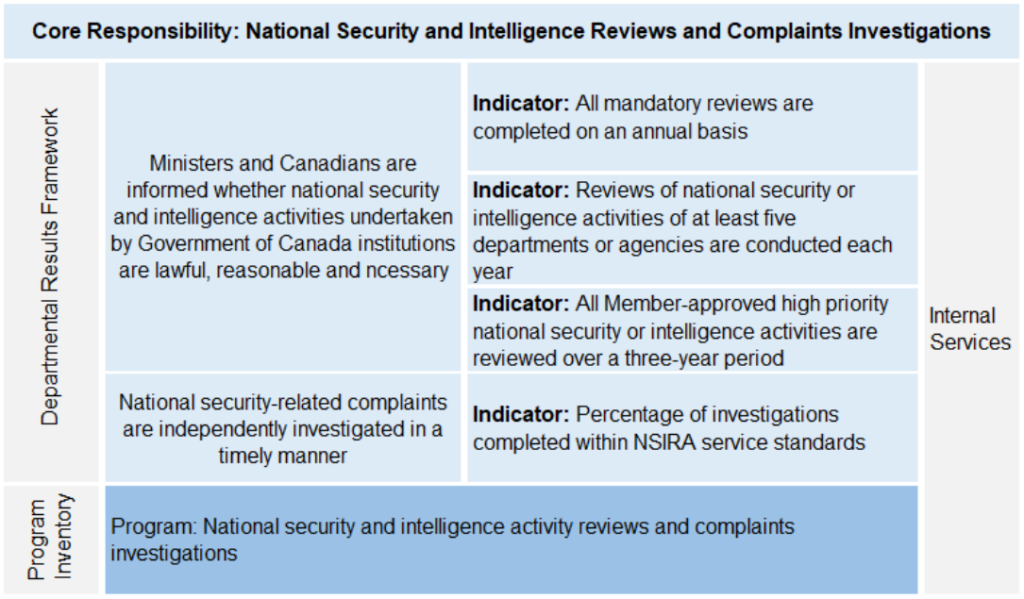
Ministers and Canadians are informed whether national security and intelligence activities undertaken by Government of Canada institutions are lawful, reasonable and necessary
Departmental results Target Date to achieve target Actual Results
All mandatory reviews are completed on an annual basis 100% completion of mandatory reviews 2021–22 2021–22: 100%
2022–23: 100%
2023–24: 100%
Reviews of national security or intelligence activities of at least five departments or agencies are conducted each year At least one national security or intelligence activity is reviewed in at least five departments or agencies annually 2021–22 2021–22: 100%
2022–23: 100%
2023–24: 100%
All high priority national security or intelligence activities, as approved by members, are reviewed over a three-year period 100% completion over three years; at least 33% completed each year 2021–22 2021–22: 33%
2022–23: 33%
2023–24: 33%
Departmental results Target Date to achieve target Actual Results
Percentage of investigations completed within NSIRA Secretariat service standards. 90% 2022–23 2021–22: N/A
2022–23: N/A
2023–24: 100%
Note: The NSIRA Secretariat was created on July 12, 2019. Actual results for 2020–21 are not available because the new Departmental Results Framework in the changeover from the Security Intelligence Review Committee to the NSIRA Secretariat was being developed. This new framework is for measuring and reporting on results achieved starting in 2021–22.

Additional information on the detailed results and performance information for the NSIRA Secretariat’s program inventory is available on GC InfoBase.

Details on results

The following section describes the results for National Security and Intelligence Reviews and Complaints Investigations in 2023–24 compared with the planned results set out in NSIRA Secretariat’s departmental plan for the year.

Ministers and Canadians are informed whether national security and intelligence activities undertaken by Government of Canada institutions are lawful, reasonable and necessary

NSIRA Secretariat staff supported NSIRA in the completion of 11 national security and intelligence reviews over the course of the 2023-24 fiscal year. A total of 13 Government of Canada organizations were subject to review and eight Ministers, plus the Prime Minister, went on to receive one or more of the NSIRA reports that were approved by members in the 2023-24 fiscal year.

  • 10 section 34 ministerial reports
  • 12 section 35 compliance reports
  • 1 section 39 report on disclosures under the Security of Canada Information Disclosure Act
  • NSIRA’s first ever section 40 special report to the Prime Minister, which was tabled in Parliament

Of the 11 reviews completed this year, three reviews included multiple Government of Canada organizations by design.  These three multi-organization reviews were:

  • The annual review of disclosures under the Security of Canada Information Disclosure Act (SCIDA)
  • The annual review of the implementation of directions issued under the Avoiding Complicity in Mistreatment by Foreign Entities Act (ACA)
  • Review of the dissemination of intelligence on People’s Republic of China political foreign interference, 2018-2024

All Departments/agencies covered in these multi-organizational reviews were:  Canada Border Services Agency (CBSA), Canada Revenue Agency (CRA), Communications Security Establishment (CSE), Canadian Security Intelligence Service (CSIS), Department of Fisheries and Oceans (DFO), Department of National Defence and Canadian Armed Forces (DND/CAF), Financial Transactions and Reports Analysis Centre of Canada (FINTRAC), Global Affairs Canada (GAC), Immigration, Refugees and Citizenship Canada (IRCC), Privy Council Office (PCO), Public Safety Canada (PS), Royal Canadian Mounted Police (RCMP), and Transport Canada (TC).

Of the 11 reviews completed this year, four reviews focused on a topic that involved one Government of Canada organization:

  • CSIS – two reviews
  • CBSA – one review
  • DND/CAF – one review

Of the 11 reviews completed reviews this year, four reviews focused on topics that spanned across two Government of Canada organizations:

  • CSE and CSIS – one review
  • CSE and Treasury Board Secretariat (TBS) – one review
  • CSE and Shared Services Canada (SSC) – one review
  • CSIS and PS – one review

Two departments were subject to NSIRA review for the first time: TBS and SSC.

During the reporting period, the Secretariat continued to refine its processes and methodology to assist the NSIRA review mandate, with the goal of promoting high-quality, impactful reviews. This maturation included the implementation of developed tracking and data collection with a view to using business intelligence to support data-informed decision-making and to optimize review operations.  NSIRA Secretariat staff promoted transparency and accountability by working with CBSA, CRA, CSE, CSIS, DFO, DND/CAF, FINTRAC, GAC, IRCC, PS, RCMP and TC to redact and proactively publish 7 reports on the NSIRA website.

National security related complaints are independently investigated in a timely manner

In 2023-24, the NSIRA Secretariat saw the continued maturation of the processes underpinning the fulfillment of its investigation mandate. The conduct of the investigative process has increased its emphasis on timeliness and efficiency, as well as transparency in order to enhance the relevance of the process for complainants.

The level of investigative activities remained high and included an increase in complaints against CSIS with respect to delays in security assessments related to immigration applications. 

During the past year, NSIRA Secretariat stabilized its investigative processes for complaints as a result of the implementation of procedures and practices that ensured that the conduct of investigations is fair, timely and transparent. With the normalization of the NSIRA Secretariat’s work environment as a result of the dissipation of the constraints related to the COVID-19 pandemic, NSIRA investigations have seen an increase in efficiency. NSIRA completed six formal investigations and issued final reports in those cases, and concluded seven complaint matters by way of informal resolutions.

As of April 1, 2023, the NSIRA Secretariat implemented service standards related to the investigation of complaints. The service standards set internal time limits for important investigative steps for each type of complaint, under normal circumstances. The service standards specify the circumstances under which those time limits do not apply. The development of the service standards includes tracking and data collection on whether the NSIRA Secretariat is meeting its own service standards in the investigation of complaints. In 2023-24, it reached a success rate of 100% in meeting them.

Finally, the NSIRA Secretariat completed the last phase of a study on the collection of race-based data and other demographic information jointly commissioned with the CRCC. The study undertook work to assess the viability of the collection of identity-based and demographic data as part of the Government of Canada’s ongoing anti-racism initiatives. Improved, more precise and more consistent tracking, collection and measurement of data is necessary to support anti-racism efforts in government. NSIRA continued its collaboration with the CRCC in determining an implementation strategy and this work will continue in 2024-25.

Outreach and collaboration

Engagement and collaboration with current and new partners as well as public outreach were a big part of the support provided to NSIRA by Secretariat staff this year. Secretariat staff engaged in regular interactions with their counterparts in domestic review bodies such as the Secretariat of the National Security and Intelligence Committee of Parliamentarians and the Civilian Review and Complaints Commission to coordinate activities in a way to avoid of duplication in review efforts. Secretariat staff also established new collaborative relationships with counterparts at the various Agents of Parliament. In Fall 2023, the Secretariat supported NSIRA in hosting the Five Eyes Intelligence Oversight and Review Council (FIORC) annual conference in Ottawa. The 3-day event brought together review representatives from Canada, the United States, Australia, New Zealand, and the United Kingdom. The event was hosted in partnership with the Office of the Intelligence Commissioner. Secretariat staff further engaged in regular working level interactions with FIORC partners for the exchange of best practices and for the development of training in a variety of areas. As a result of Secretariat engagement efforts, NSIRA was able to establish important new connections with European partners and participated in the European Intelligence Oversight Conference. NSIRA also secured observer status participation in the Intelligence Oversight Working Group which gathers European oversight and review bodies. Secretariat staff also supported NSIRA in the production of the NSIRA Public Annual Report; the main public report informing Canadians about NSIRA’s work. In addition, Secretariat staff implemented timelier regular publication of unclassified versions of NSIRA reports throughout the year to engage the Canadian public regularly about NSIRA’s work.

Key risks

Effective review requires timely and complete responses to NSIRA’s requests for information, open and candid briefings, and mutual respect. Despite NSIRA’s expansive access rights under the NSIRA Act, Secretariat staff continued to note some instances where Government of Canada organizations did not prioritize the work of review or were not fully responsive to access requests. Compounding these challenges were outdated information management systems and practices within many reviewed organizations, which slowed down responsiveness. While work remains to be done on this front, Secretariat staff have shown excellent resilience and persistance in pushing Government of Canada organizations that are subject to NSIRA review to meet NSIRA’s expectations of responsiveness as an independent review body.

With respect to the Secretariat’s service standards, one risk to the achievement of the planned results for this core responsibility is the procedural unpredictability of NSIRA’s investigations due to the quasi-judicial nature of the process and the institutional independence of NSIRA members in the conduct of their investigations. Procedural unpredictability may result in some investigations becoming more protracted than others depending on the complexity of the complaint that NSIRA must address. In order to mitigate such a risk, the Secretariat’s service standards for the key steps in the process require that all necessary information, including documentary and oral evidence, be before NSIRA for the steps in question to be completed. With the variances in the length of time required for this totality of information to be before NSIRA, the Secretariat’s risk of a service standard lapsing is mitigated.

Resources required to achieve results

Table 2: Snapshot of resources required for National Security and Intelligence Reviews and Complaints Investigations

Table 2 provides a summary of the planned and actual spending and full-time equivalents (FTEs) required to achieve results.

Resource Planned Actual
Spending $10,807,324 $7,307,710
Full-time equivalents 69 51

Complete financial and human resources information for the NSRIA Secretariat’s program inventory is available on GC InfoBase.

Gender-based analysis plus

In the fiscal year 2023-2024, the NSIRA Secretariat has continued to advance the Human Rights, Accessibility, Employment Equity, Diversity, and Inclusion (EEDI) Action Plan initiated on April 1, 2022. This includes incorporating a GBA+ lens into the design and implementation of policies and programs.

The Secretariat has continued to align its policies, programs, and practices with human rights, accessibility, and EE principles. The NSIRA Secretariat completed the final phase of a study on the collection of race-based and other demographic data, conducted in collaboration with the CRCC. This study evaluated the feasibility of collecting identity-based and demographic information to support the Government of Canada’s ongoing anti-racism initiatives. Enhanced, accurate, and consistent tracking, collection, and measurement of this data are essential for advancing anti-racism efforts within the government. NSIRA continued to work with the CRCC to develop an implementation strategy, with plans to further this initiative in 2024-25.

This year saw the publication of our Accessibility Plan – First Progress Report, which focused on increasing awareness and improving accessibility within the workforce and workplace. Through internal capacity building and new service agreements, NSIRA aims to address previously lagging areas and integrate accessibility sustainably across all operations.

In spring 2023, the Public Service Employee Survey (PSES) 2022 results were released to all staff, providing an opportunity to reflect on NSIRA employees’ views on the organization’s strengths and challenges regarding diversity and inclusion.

Additionally, the NSIRA Secretariat has initiated the development of a pay equity plan to ensure equitable compensation for all employees in compliance with the Pay Equity Act. These efforts reflect NSIRA’s ongoing commitment to fostering a more inclusive and equitable environment.

United Nations 2030 Agenda for Sustainable Development and the Sustainable Development Goals

More information on NSRIA Secretariat’s contributions to Canada’s Federal Implementation Plan on the 2030 Agenda and the Federal Sustainable Development Strategy can be found in our Departmental Sustainable Development Strategy.

Internal services

In this section

  • Description
  • Progress on results
  • Resources required to achieve results
  • Contracts awarded to Indigenous business

Description

Internal services are the services that are provided within a department so that it can meet its corporate obligations and deliver its programs. There are 8 categories of internal services:

  • management and oversight services
  • human resources management services
  • financial management services
  • information management services
  • information technology services
  • real property management services
  • materiel management services
  • acquisition management services

Progress on results

This section presents details on how the department performed to achieve results and meet targets for internal services.

During the reporting period, the NSIRA Secretariat continued to take steps to ensure resources were deployed in the most effective and efficient manner possible and its operations and administrative structures, tools and processes continued to focus on supporting the delivery of its priorities. Several tools to improve the ability for budget managers to plan and forecast were deployed and implemented in the forecasting cycle.

The Secretariat recognizes the need to be an inclusive, healthy, and flexible employer. Over the past year, we have encouraged flexible working arrangements, such as teleworking, to achieve work–life balance and meet performance expectations.

With the collaboration from PSPC, RCMP and CSE, the NSIRA Secretariat has completed a two-year construction project and has expanded its footprint with the addition of approx. 50 workstations with an occupancy target date of August 2024. The facilities team will continue the work associated with the Accessibility Canada Act management action plan, specifically the built environment.

The NSIRA Secretariat has explored various tools to assist with the material management program and will seek to implement the solution in the coming fiscal years once the tools and resources are in place.

The implementation of GCdocs within our organization is progressing significantly, reflecting our commitment to improving our information management. We have recently completed the configuration of the Protected B GCdocs environment, aligned with the updated organizational file plan. Additionally, we have initiated the document migration plan, marking a key milestone in our transition toward more efficient, secure, and compliant document handling. This advancement supports our goal of enhancing productivity, ensuring regulatory compliance, and improving collaboration across our organization.

Resources required to achieve results

Table 3: Resources required to achieve results for internal services this year

Table 3 provides a summary of the planned and actual spending and full-time equivalents (FTEs) required to achieve results.

Resource Planned Actual
Spending $12,201,901 $7,654,469
Full-time equivalents 31 24

The complete financial and human resources information for the NSIRA Secretariat’s program inventory is available on GC InfoBase.

Contracts awarded to Indigenous businesses

Government of Canada departments are to meet a target of awarding at least 5% of the total value of contracts to Indigenous businesses each year. This commitment is to be fully implemented by the end of 2024–25.

NSIRA Secretariat is a Phase 3 department and is aiming to achieve the minimum 5% target by the end of 2024–25. For the year 2023-24, the actual percentage was 1% which includes commodities from Economic Object Code 1172 – Offices and Stationary Supplies and Economic Code 0630 Repairs and Maintenance Office buildings.

Some of the measures the NSIRA secretariat is taking to achieve the 5% minimum target include the implementation of a strategy to create more opportunities for Indigenous businesses, implementing tools such as an addition to our internal checklist that requires that indigenous procurement options are considered and the possibility of initiating discussion around potential set asides or areas of focus for indigenous procurement.

The Secretariat continues to explore various ways to improve our implementation strategy to create more opportunities for Indigenous businesses by including a periodic review of results against target and potential system adjustments to allow for more accurate and efficient tracking.

Spending and human resources 

In this section

  • Spending
  • Funding
  • Financial statement highlights
  • Human resources

Spending

This section presents an overview of the department’s actual and planned expenditures from 2021–22 to 2026–27.

Budgetary performance summary

Table 4 Actual three-year spending on core responsibilities and internal services (dollars)

Table 4 presents how much money NSIRA Secretariat spent over the past three years to carry out its core responsibilities and for internal services.

Core responsibilities and internal services 2023–24 Main Estimates 2023–24 total authorities available for use Actual spending over three years (authorities used)
National Security and Intelligence Reviews and Complaints Investigations $10,807,324 $11,622,473 • 2021–22: $7,394,642
• 2022–23: $7,756,271
• 2023–24: $9,110,398
Internal services $12,201,901 $12,568,128 • 2021–22: $9,895,112
• 2022–23: $10,532,876
• 2023–24: $10,535,328
Total $23,009,225 $24,115,856
Analysis of the past three years of spending

More financial information from previous years is available on the Finances section of GC Infobase.

Table 5 Planned three-year spending on core responsibilities and internal services (dollars)

Table 5 presents how much money NSIRA Secretariat’s plans to spend over the next three years to carry out its core responsibilities and for internal services.

Core responsibilities and internal services 2024–25 planned spending 2025–26 planned spending 2026–27 planned spending
National Security and Intelligence Reviews and Complaints Investigations $10,852,987 $10,852,051 $10,852,051
Internal services $7,722,123 $7,758,034 $7,758,034
Total $18,575,110 $18,610,085 $18,610,085
Analysis of the next three years of spending

Spending over the next three years is anticipated to remain constant as the facilities fit-up and expansion is completed and the organization is nearing a steady state. No additional special projects are planned that would impact overall spending.

More detailed financial information from previous years is available on the Finances section of GC Infobase.

Funding

This section provides an overview of the department’s voted and statutory funding for its core responsibilities and for internal services. For further information on funding authorities, consult the Government of Canada budgets and expenditures.

Graph 1: Approved funding (statutory and voted) over a six-year period

Graph 1 summarizes the department’s approved voted and statutory funding from 2021-22 to 2026-27.
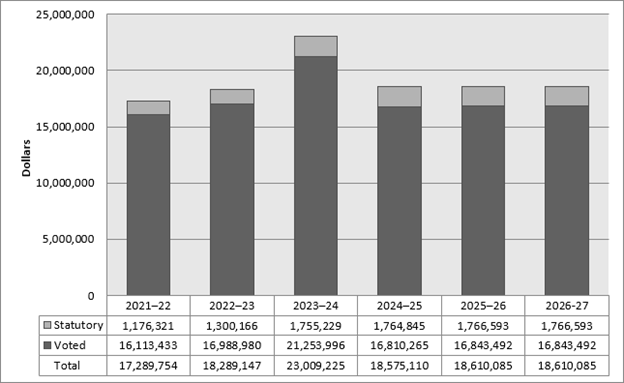
Bar graph that summarizes the department’s approved voted and statutory funding from 2021-22 to 2026-27
2021-22 2022-23 2023-24 2024-25 2025-26 2026-27
Statutory 1,176,321 1,300,166 1,755,229 1,764,845 1,766,593 1,766,593
Voted 16,113,433 16,988,980 21,253,996 16,810,265 16,843,492 16,843,492
Total 17,289,754 18,289,147 23,009,225 18,575,110 18,610,085 18,610,085
Analysis of statutory and voted funding over a six-year period

Funding over the next six years is anticipated to remain constant as the facilities fit-up and expansion is completed and the organization is nearing a steady state. No additional special projects are planned or anticipated that would necessitate additional funding.

For further information on NSIRA Secretariat’s departmental voted and statutory expenditures, consult the Public Accounts of Canada.

Financial statement highlights

NSIRA Secretariat’s complete financial statements (unaudited) for the year ended March 31, 2024, are available online.

Table 6 Condensed Statement of Operations (unaudited) for the year ended March 31, 2024 (dollars)

Table 6 summarizes the expenses and revenues for 2023–24 which net to the cost of operations before government funding and transfers.

Financial information 2023–24 actual results 2023–24 planned results Difference (actual results minus planned)
Total expenses $18,223 $23,009 -$4,786
Total revenues $0 $0 $0
Net cost of operations before government funding and transfers $18,223 $23,009 -$4,786

The 2023–24 planned results information is provided in NSIRA Secretariat’s Future-Oriented Statement of Operations and Notes 2023–24.

Table 7 summarizes actual expenses and revenues which net to the cost of operations before government funding and transfers.

Financial information 2023–24 actual results 2022–23 actual results Difference (2023-24 minus 2022-23)
Total expenses $18,223 $19,586 -$1,363
Total revenues $0 $0 $0
Net cost of operations before government funding and transfers $18,223 $19,586 -$1,363

Table 8 Condensed Statement of Financial Position (unaudited) as of March 31, 2024 (dollars) 

Table 8 provides a brief snapshot of the department’s liabilities (what it owes) and assets (what the department owns), which helps to indicate its ability to carry out programs and services.

Financial information Actual fiscal year (2023–24) Previous fiscal year (2022–23) Difference (2023–24 minus 2022–23)
Total net liabilities $2,374 $2,050 $324
Total net financial assets $1,779 $1,578 $201
Departmental net debt $595 $472 $123
Total non-financial assets $7,391 $2,240 $5,151
Departmental net financial position $6,796 $1,768 $5,028

Human resources

This section presents an overview of the department’s actual and planned human resources from 2021–22 to 2026–27. 

Table 9: Actual human resources for core responsibilities and internal services

Table 9 shows a summary of human resources, in full-time equivalents (FTEs), for NSIRA Secretariat’s core responsibilities and for its internal services for the previous three fiscal years.

Core responsibilities and internal services 2021–22 actual FTEs 2022–23 actual FTEs 2023–24 actual FTEs
National Security and Intelligence Reviews and Complaints Investigations 52 53 51
Internal services 22 25 24
Total 74 78 75
Analysis of human resources over the last three years

The increase in FTEs from 74 in 2021–22 to 78 in 2022–23 is primarily a result of the staffing of vacant positions. There have been no significant differences in the past two years. NSIRA Secretariat human resources is expected to remain constant. Minor fluctuations reflect normal staff turnover.

Table 10: Human resources planning summary for core responsibilities and internal services

Table 10 shows information on human resources, in full-time equivalents (FTEs), for each of NSIRA Secretariat’s core responsibilities and for its internal services planned for the next three years. Human resources for the current fiscal year are forecasted based on year to date. 

Core responsibilities and internal services 2024–25 planned FTEs 2025–26 planned FTEs 2026–27 planned FTEs
National Security and Intelligence Reviews and Complaints Investigations 69 69 69
Internal services 31 31 31
Total 100 100 100
Analysis of human resources for the next three years

FTE count to remain constant across the board.

Corporate information

Departmental profile

Appropriate minister(s): The Right Honourable Justin Trudeau, Prime Minister of Canada

Institutional head: Charles Fugère, Executive Director

Ministerial portfolio: Privy Council Office

Enabling instrument(s): National Security and Intelligence Review Agency Act

Year of incorporation / commencement: 2019

Departmental contact information

Mailing address:

National Security and Intelligence Review Agency Secretariat
P.O. Box 2430, Station B
Ottawa, Ontario
K1P 5W5

Email: info@nsira-ossnr.gc.ca

Website(s): https://nsira-ossnr.gc.ca/

Federal tax expenditures

The tax system can be used to achieve public policy objectives through the application of special measures such as low tax rates, exemptions, deductions, deferrals and credits. The Department of Finance Canada publishes cost estimates and projections for these measures each year in the Report on Federal Tax Expenditures. This report also provides detailed background information on tax expenditures, including descriptions, objectives, historical information and references to related federal spending programs as well as evaluations and GBA Plus of tax expenditures.

Definitions

appropriation (crédit)

Any authority of Parliament to pay money out of the Consolidated Revenue Fund.

budgetary expenditures (dépenses budgétaires)

Operating and capital expenditures; transfer payments to other levels of government, departments or individuals; and payments to Crown corporations.

core responsibility (responsabilité essentielle)

An enduring function or role performed by a department. The intentions of the department with respect to a core responsibility are reflected in one or more related departmental results that the department seeks to contribute to or influence.

Departmental Plan (plan ministériel)

A report on the plans and expected performance of an appropriated department over a 3year period. Departmental Plans are usually tabled in Parliament each spring.

departmental priority (priorité)

A plan or project that a department has chosen to focus and report on during the planning period. Priorities represent the things that are most important or what must be done first to support the achievement of the desired departmental results.

departmental result (résultat ministériel)

A consequence or outcome that a department seeks to achieve. A departmental result is often outside departments’ immediate control, but it should be influenced by program-level outcomes.

departmental result indicator (indicateur de résultat ministériel)

A quantitative measure of progress on a departmental result.

departmental results framework (cadre ministériel des résultats)

A framework that connects the department’s core responsibilities to its departmental results and departmental result indicators.

Departmental Results Report (rapport sur les résultats ministériels)

A report on a department’s actual accomplishments against the plans, priorities and expected results set out in the corresponding Departmental Plan.

Full-time equivalent (équivalent temps plein)

A measure of the extent to which an employee represents a full person-year charge against a departmental budget. For a particular position, the full-time equivalent figure is the ratio of number of hours the person actually works divided by the standard number of hours set out in the person’s collective agreement.

gender-based analysis plus (GBA Plus) (analyse comparative entre les sexes plus [ACS Plus])

An analytical tool used to assess support the development of responsive and inclusive how different groups of women, men and gender-diverse people experience policies, programs and policies, programs, and other initiatives. GBA Plus is a process for understanding who is impacted by the issue or opportunity being addressed by the initiative; identifying how the initiative could be tailored to meet diverse needs of the people most impacted; and anticipating and mitigating any barriers to accessing or benefitting from the initiative. GBA Plus is an intersectional analysis that goes beyond biological (sex) and socio-cultural (gender) differences to consider other factors, such as age, disability, education, ethnicity, economic status, geography (including rurality), language, race, religion, and sexual orientation.

government-wide priorities (priorités pangouvernementales)

For the purpose of the 2022–23 Departmental Results Report, government-wide priorities are the high-level themes outlining the government’s agenda in the November 23, 2021, Speech from the Throne: building a healthier today and tomorrow; growing a more resilient economy; bolder climate action; fight harder for safer communities; standing up for diversity and inclusion; moving faster on the path to reconciliation; and fighting for a secure, just and equitable world.

horizontal initiative (initiative horizontale)

An initiative where two or more federal departments are given funding to pursue a shared outcome, often linked to a government priority.

nonbudgetary expenditures (dépenses non budgétaires)

Net outlays and receipts related to loans, investments and advances, which change the composition of the financial assets of the Government of Canada.

performance (rendement)

What a department did with its resources to achieve its results, how well those results compare to what the department intended to achieve, and how well lessons learned have been identified.

performance indicator (indicateur de rendement)

A qualitative or quantitative means of measuring an output or outcome, with the intention of gauging the performance of an department, program, policy or initiative respecting expected results.

plan (plan)

The articulation of strategic choices, which provides information on how a department intends to achieve its priorities and associated results. Generally, a plan will explain the logic behind the strategies chosen and tend to focus on actions that lead to the expected result.

planned spending (dépenses prévues)

For Departmental Plans and Departmental Results Reports, planned spending refers to those amounts presented in Main Estimates.

A department is expected to be aware of the authorities that it has sought and received. The determination of planned spending is a departmental responsibility, and departments must be able to defend the expenditure and accrual numbers presented in their Departmental Plans and Departmental Results Reports.

program (programme)

Individual or groups of services, activities or combinations thereof that are managed together within the department and focus on a specific set of outputs, outcomes or service levels.

program inventory (répertoire des programmes)

Identifies all the department’s programs and describes how resources are organized to contribute to the department’s core responsibilities and results.

result (résultat)

A consequence attributed, in part, to an department, policy, program or initiative. Results are not within the control of a single department, policy, program or initiative; instead they are within the area of the department’s influence.

Indigenous business (entreprise autochtones)

For the purpose of the Directive on the Management of Procurement Appendix E: Mandatory Procedures for Contracts Awarded to Indigenous Businesses and the Government of Canada’s commitment that a mandatory minimum target of 5% of the total value of contracts is awarded to Indigenous businesses, a department that meets the definition and requirements as defined by the Indigenous Business Directory

statutory expenditures (dépenses législatives)

Expenditures that Parliament has approved through legislation other than appropriation acts. The legislation sets out the purpose of the expenditures and the terms and conditions under which they may be made.

target (cible)

A measurable performance or success level that a department, program or initiative plans to achieve within a specified time period. Targets can be either quantitative or qualitative.

voted expenditures (dépenses votées)

Expenditures that Parliament approves annually through an appropriation act. The vote wording becomes the governing conditions under which these expenditures may be made.
Share this page
Date Modified:

Quarterly Report: For the quarter ended June 30, 2024

Quarterly Report: For the quarter ended June 30, 2024


Date of Publishing:

Introduction

This quarterly report has been prepared by management as required by section 65.1 of the Financial Administration Act and in the form and manner prescribed by the Directive on Accounting Standards, GC 4400 Departmental Quarterly Financial Report. This quarterly financial report should be read in conjunction with the 2024–2025 Main Estimates.

This quarterly report has not been subject to an external audit or review.

Mandate

The National Security and Intelligence Review Agency (NSIRA) is an independent external review body that reports to Parliament. Established in July 2019, NSIRA is responsible for conducting reviews of the Government of Canada’s national security and intelligence activities to ensure that they are lawful, reasonable and necessary. NSIRA also hears public complaints regarding key national security agencies and their activities.

The NSIRA Secretariat supports the Agency in the delivery of its mandate. Independent scrutiny contributes to strengthening the accountability framework for national security and intelligence activities and to enhancing public confidence. Ministers and Canadians are informed whether national security and intelligence activities undertaken by Government of Canada institutions are lawful, reasonable, and necessary

A summary description NSIRA’s program activities can be found in Part II of the Main Estimates.  Information on NSIRA’s mandate can be found on its website.

Basis of presentation

This quarterly report has been prepared by management using an expenditure basis of accounting. The accompanying Statement of Authorities includes the agency’s spending authorities granted by Parliament and those used by the agency, consistent with the 2024–2025 Main Estimates. This quarterly report has been prepared using a special-purpose financial reporting framework (cash basis) designed to meet financial information needs with respect to the use of spending authorities.

The authority of Parliament is required before money can be spent by the government. Approvals are given in the form of annually approved limits through appropriation acts or through legislation in the form of statutory spending authorities for specific purposes.

Highlights of the fiscal quarter and fiscal year-to-date results

This section highlights the significant items that contributed to the net increase or decrease in authorities available for the year and actual expenditures for the quarter ended June 30, 2024.

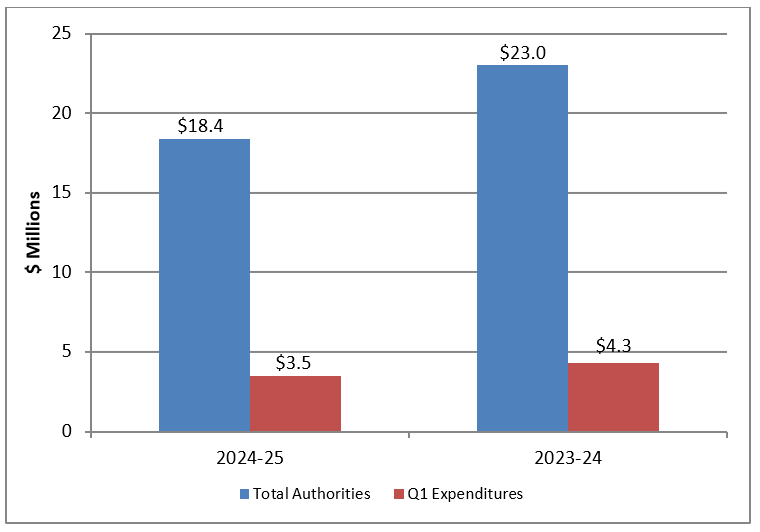
NSIRA Secretariat spent approximately 19% of its authorities by the end of the first quarter, compared with 19% in the same quarter of 2023–2024 (see graph 1).

Graph 1: Comparison of total authorities and total net budgetary expenditures, Q1 2024–25 and Q1 2023–24

Graph 1: Comparison of total authorities and total net budgetary expenditures, Q1 2024–25 and Q1 2023–24 - Text version to follow
Comparison of total authorities and total net budgetary expenditures, Q1 2024–25 and Q1 2023–24
  2024-25 2023-24
Total Authorities $18.4 $23.0
Q1 Expenditures $3.5 $4.3

Significant changes to authorities

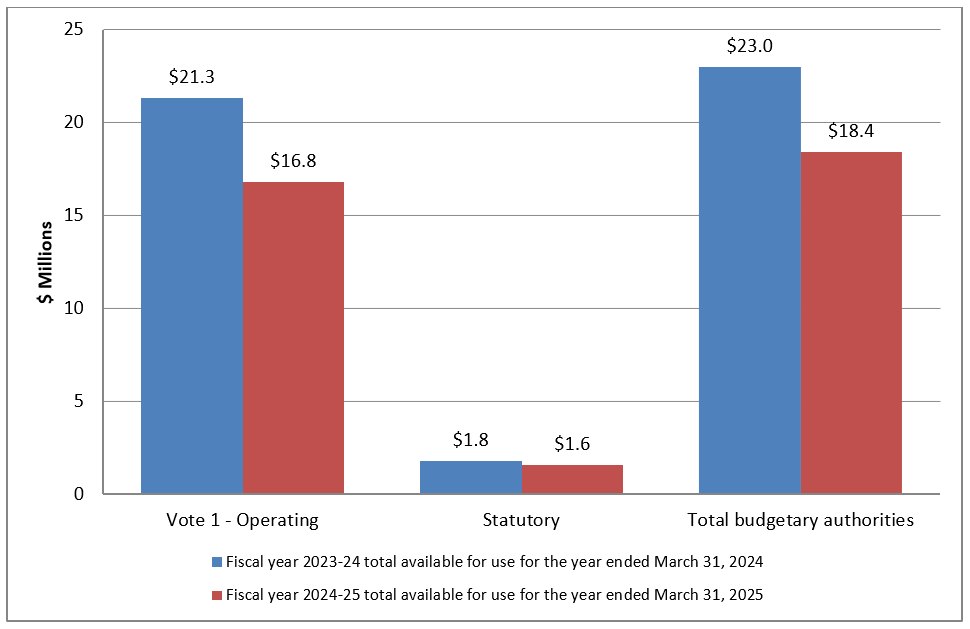
As of June 30, 2024, Parliament had approved $18.4 million in total authorities for use by NSIRA Secretariat for 2024–2025 compared with $23.0 million as of June 30, 2023, for a net decrease of $4.6 million or 20.0% (see graph 2).

Graph 2: Variance in authorities as at June 30, 2024

Graph 2: Variance in authorities as at June 30, 2024 - Text version to follow
Variance in authorities as at June 30, 2024 (in millions)
  Fiscal year 2023-24 total available for use for the year ended March 31, 2024 Fiscal year 2024-25 total available for use for the year ended March 31, 2025
Vote 1 – Operating 21.3 16.8.3
Statutory 1.8 1.6
Total budgetary authorities 23.0 18.4

*Details may not sum to totals due to rounding*

The decrease of $4.6 million in authorities is mostly explained by a reduction in capital funding for infrastructure projects.

Significant changes to quarter expenditures

The first quarter expenditures totalled $3.5 million for a decrease of $0.8 million when compared with $4.3 million spent during the same period in 2023–2024.  Table 1 presents budgetary expenditures by standard object.

Table 1

Variances in expenditures by standard object (in thousands of dollars) Fiscal year 2024–25: expended during the quarter ended June 30, 2024 Fiscal year 2023–24: expended during the quarter ended June 30, 2023 Variance $ Variance %
Personnel 3,008 2,886 122 4%
Transportation and communications 58 130 (72) (55%)
Information 6 0 6 100%
Professional and special services 269 1,165 (896) (77%)
Rentals 25 48 (23) (48%)
Repair and maintenance 3 24 (21) (88%)
Utilities, materials, and supplies 28 7 21 300%
Acquisition of machinery and equipment 12 48 (36) (75%)
Other subsidies and payments 79 4 75 1875%
Total gross budgetary expenditures 3,488 4,312 (824) (19%)

Transportation and communications

The decrease of $72,000 is explained by a change in the timing of invoicing for the internet connection.

Professional and special services

The decrease of $896,000 is mainly explained by a change in the timing of the billing for maintenance and services in support of our classified IT network infrastructure.

Rentals

The decrease of $23,000 is explained by a decrease in cost for the rent for temporary office space.

Repair and maintenance

The decrease of $21,000 is explained by a one-time maintenance contract purchased in fiscal year 2023-2024.

Utilities, materials, and supplies

The increase of $21,000 is explained by unreconciled acquisition card purchases.

Acquisition of machinery and equipment

The decrease of $36,000 is explained by a one-time purchase of a specialized laptop along with a wall mounted charging station and warranty in 2023-2024.

Other subsidies and payments

The increase of $75,000 is explained by an increase in salary overpayments.

Risks and uncertainties

There is a risk that the funding received to offset pay increases anticipated over the coming year will be insufficient to cover the costs of such increases and the year-over-year cost of services provided by other government departments/agencies is increasing significantly.

NSIRA Secretariat is closely monitoring pay transactions to identify and address over and under payments in a timely manner and continues to apply ongoing mitigating controls.

Mitigation measures for the risks outlined above have been identified and are factored into NSIRA Secretariat’s approach and timelines for the execution of its mandated activities.

Significant changes in relation to operations, personnel and programs

Mr. Charles Fugère was appointed by the Governor-in-Council to be Executive Director of the NSIRA Secretariat on an interim basis on June 3, 2024.

Mr. Marc-André Cloutier, NSIRA Secretariat’s Director General, Corporate Services and CFO since 2023, retired in Q4 of 2023-2024. He has been replaced by Mr. Martyn Turcotte.

Approved by senior officials:

Charles Fugère
Executive Director

Amanda Wark
A/Chief Financial Officer

Appendix

Statement of authorities (Unaudited)

(in thousands of dollars)

  Fiscal year 2024–25 Fiscal year 2023–24
  Total available for use for the year ending March 31, 2025 (note 1) Used during the quarter ended June 30, 2024 Year to date used at quarter-end Total available for use for the year ending March 31, 2024 (note 1) Used during the quarter ended June 30, 2023 Year to date used at quarter-end
Vote 1 – Net operating expenditures 16,810 3,088 3,088 21,254 3,873 3,873
Budgetary statutory authorities
Contributions to employee benefit plans 1,601 400 400 1,755 439 439
Total budgetary authorities (note 2) 18,411 3,488 3,488 23,009 4,312 4,312

Note 1: Includes only authorities available for use and granted by Parliament as at quarter-end.

Note 2: Details may not sum to totals due to rounding.

Departmental budgetary expenditures by standard object (unaudited)

(in thousands of dollars)

  Fiscal year 2024–25 Fiscal year 2023–24
  Planned expenditures for the year ending March 31, 2025 (note 1) Expended during the quarter ended June 30, 2024 Year to date used at quarter-end Planned expenditures for the year ending March 31, 2024 Expended during the quarter ended June 30, 2023 Year to date used at quarter-end
Expenditures
Personnel 13,205 3,088 3,088 13,303 2,886 2,886
Transportation and communications 685 58 58 650 130 130
Information 76 6 6 372 0 0
Professional and special services 3,577 269 269 3,596 1,165 1,165
Rentals 309 25 25 271 48 48
Repair and maintenance 436 3 3 4,580 24 24
Utilities, materials, and supplies 58 28 28 73 7 7
Acquisition of machinery and equipment 65 12 12 132 48 48
Other subsidies and payments 0 79 79 33 4 4
Total gross budgetary expenditures
(note 2)
18,411 3,488 3,488 23,009 4,312 4,312

Note 1: Includes only authorities available for use and granted by Parliament as at quarter-end.

Note 2: Details may not sum to totals due to rounding.

Share this page
Date Modified:

Financial Statements: NSIRA 2022–23

Financial Statements: NSIRA 2022–23


Date of Publishing:

Statement of Management Responsibility Including Internal Control over Financial Reporting

Responsibility for the integrity and objectivity of the accompanying financial statements for the year ended March 31, 2023, and all information contained in these financial statements rests with the management of the National Security and Intelligence Review Agency (NSIRA) Secretariat. These financial statements have been prepared by management using the Government of Canada’s accounting policies, which are based on Canadian public sector accounting standards.

Management is responsible for the integrity and objectivity of the information in these financial statements. Some of the information in the financial statements is based on management’s best estimates and judgment and gives due consideration to materiality. To fulfill its accounting and reporting responsibilities, management maintains a set of accounts that provides a centralized record of the NSIRA Secretariat’s financial transactions. Financial information submitted in the preparation of the Public Accounts of Canada, and included in the NSIRA Secretariat’s Departmental Results Report, is consistent with these financial statements.

Management is also responsible for maintaining an effective system of internal control over financial reporting (ICFR) designed to provide reasonable assurance that financial information is reliable, that assets are safeguarded and that transactions are properly authorized and recorded in accordance with the Financial Administration Act and other applicable legislation, regulations, authorities, and policies.

Management seeks to ensure the objectivity and integrity of data in its financial statements through careful selection, training and development of qualified staff; through organizational arrangements that provide appropriate divisions of responsibility; through communication programs aimed at ensuring that regulations, policies, standards, and managerial authorities are understood throughout the NSIRA Secretariat and through conducting an annual risk-based assessment of the effectiveness of the system of ICFR.

The system of ICFR is designed to mitigate risks to a reasonable level based on an ongoing process to identify key risks, to assess effectiveness of associated key controls, and to make any necessary adjustments.

The financial statements of the National Security and Intelligence Agency Secretariat have not been audited.

John Davies
Executive Director

Marc-André Cloutier
Chief Financial Officer

Ottawa, Canada
September 12, 2023

Statement of Financial Position (Unaudited)

As of March 31 (in thousands of dollars)

  2023 2022
Liabilities
Accounts payable and accrued liabilities (Note 4) 1,433 1,220
Vacation pay and compensatory leave 632 556
Employee future benefits (Note 5b) 229 228
Total liabilities 2,294 2,004
Financial assets
Due from Consolidated Revenue Fund 1,000 692
Accounts receivable and advances (Note 6) 518 637
Total net financial assets 1,518 1,329
Departmental net debt 776 675
Non-financial assets
Prepaid expenses 6 70
Tangible capital assets (Note 7) 4,824 4,734
Total non-financial assets 4,830 4,804
Departmental net financial position 4,054 4,129
Contractual obligations (Note 8)    

The accompanying notes form an integral part of these financial statements.

John Davies
Executive Director

Marc-André Cloutier
Chief Financial Officer

Ottawa, Canada
September 12, 2023

Statement of Operations and Departmental Net Financial Position (Unaudited)

For the Year Ended March 31 (in thousands of dollars)

  2023
Planned Results
2023 Actual 2022 Actual
Expenses
National Security and Intelligence Reviews and Complaints Investigations (Note 9) 10,757 8,359 8,360
Internal Services 17,494 11,227 7,805
Total expenses 28,251 19,586 16,165
Net cost from continuing operations 28,251 19,586 16,165
Net cost of operations before government funding and transfers 28,251 19,586 16,165
Government funding and transfers
Net cash provided by Government of Canada   17,929 17,553
Change in due from Consolidated Revenue Fund   308 (254)
Services provided without charge by other government departments (Note 10a)   1,265 1,242
Transfer of overpayments   9 (15)
Net cost of operations after government funding and transfers 75 (2,361)
Departmental net financial position – Beginning of year 4,129 1,768
Departmental net financial position – End of year 4,054 4,129

Segmented information (Note 11)

The accompanying notes form an integral part of these financial statements.

Statement of Change in Departmental Net Debt (Unaudited)

For the Year Ended March 31 (in thousands of dollars)

  2023 2022
Net cost of operations after government funding and transfers 75 (2,361)
Change due to tangible capital assets
Acquisition of tangible capital assets 755 3,114
Amortization of tangible capital assets (664) (528)
Total change due to tangible capital assets 91 2,586
Change due to prepaid expenses (65) (22)
Net increase (decrease) in departmental net debt 101 203
Departmental net debt – Beginning of year 675 472
Departmental net debt – End of year 776 675

The accompanying notes form an integral part of these financial statements.

Statement of Cash Flows (Unaudited)

For the Year Ended March 31 (in thousands of dollars)

  2023 2022
Operating activities
Net cost of operations before government funding and transfers 19,586 16,165
Non-cash items:
Amortization of tangible capital assets (664) (528)
Services provided without charge by other government departments (Note 9a) (1,265) (1,242)
Transfer of overpayments (9) (15)
Variations in Statement of Financial Position:
Increase (decrease) in accounts receivable and advances (119) 5
Increase (decrease) in prepaid expenses (65) (22)
Decrease (increase) in accounts payable and accrued liabilities (213) 299
Decrease (increase) in vacation pay and compensatory leave (76) (341)
Decrease (increase) in future employee benefits (1) 88
Cash used in operating activities 17,174 14,439
Capital investing activities
Acquisitions of tangible capital assets (Note 7) 755 3,114
Cash used in capital investing activities 755 3,114
Net cash provided by Government of Canada 17,929 17,553

Notes to the Financial Statements (Unaudited)

1. Authority and objectives

The agency was established, effective July 12, 2019 under the National Security and Intelligence Review Agency Act (NSIRA Act).

The agency is a division of the federal public administration as set out in column 1 of Schedule I.1 of the Financial Administration Act and reports to Parliament through the Prime Minister.

The mandate of the agency is to review all Government of Canada national security and intelligence activities to ensure that they are lawful, reasonable and necessary.  The agency also investigates public complaints regarding key national security agencies and activities.

To achieve its strategic outcome and deliver results for Canadians, NSIRA articulates its plans and priorities based on the core responsibility and program inventory included below:

National Security and Intelligence Reviews and Complaints Investigations

The National Security and Intelligence Review Agency reviews Government of Canada national security and intelligence activities to assess whether they are lawful, reasonable and necessary. It investigates complaints from members of the public regarding activities of CSIS, CSE or the national security activities of the RCMP, as well as certain other national security-related complaints.  This independent scrutiny contributes to the strengthening of the framework of accountability for national security and intelligence activities undertaken by Government of Canada institutions and supports public confidence in this regard.

Internal Services

Internal support services are groups of related activities and resources that are administered to support the needs of programs and other corporate obligations of an organization. These groups are: Management and Oversight Services; Communications Services; Legal Services; Human Resources Management Services; Financial Management Services; Information Management Services; Information Technology Services; Real Property Services; Materiel Services; Acquisition Services; and Other Administrative Services. Internal Services include only those activities and resources that apply across an organization and not to those provided specifically to a program.

2. Summary of significant accounting policies

These financial statements are prepared using NSIRA’s accounting policies stated below, which are based on Canadian public sector accounting standards. The presentation and results using the stated accounting policies do not result in any significant differences from Canadian public sector accounting standards.

Significant accounting policies are as follows:

(a) Parliamentary authorities

NSIRA is financed by the Government of Canada through Parliamentary authorities. Financial reporting of authorities provided to NSIRA do not parallel financial reporting according to generally accepted accounting principles since authorities are primarily based on cash flow requirements. Consequently, items recognized in the Statement of Operations and Departmental Net Financial Position and in the Statement of Financial Position are not necessarily the same as those provided through authorities from Parliament. Note 3 provides a reconciliation between the bases of reporting. The planned results amounts in the ”Expenses” and ”Revenues” sections of the Statement of Operations and Departmental Net Financial Position are the amounts reported in the Future-Oriented Statement of Operations included in the 2022-2023 Departmental Plan. The planned results amounts in the “Government funding and transfers” section of the Statement of Operations and Departmental Net Financial Position and in the Statement of Change in Departmental Net Debt were prepared for internal management purposes and have not been previously published.

(b) Net cash provided by Government of Canada

NSIRA operates within the Consolidated Revenue Fund (CRF), which is administered by the Receiver General for Canada. All cash received by NSIRA is deposited to the CRF, and all cash disbursements made by NSIRA are paid from the CRF. The net cash provided by Government is the difference between all cash receipts and all cash disbursements, including transactions between departments of the Government.

(c) Amounts due from or to the CRF

Amounts due from or to the CRF are the result of timing differences at year-end between when a transaction affects authorities and when it is processed through the CRF. Amounts due from the CRF represent the net amount of cash that NSIRA is entitled to draw from the CRF without further authorities to discharge its liabilities.

(d) Expenses

  • Vacation pay and compensatory leave are accrued as the benefits are earned by employees under their respective terms of employment.
  • Services provided without charge by other government departments for accommodation, employer contributions to the health and dental insurance plans and workers’ compensation are recorded as operating expenses at their carrying value.

(e) Employee future benefits

  • Pension benefits: Eligible employees participate in the Public Service Pension Plan, a pension plan administered by the Government. NSIRA’s contributions to the Plan are charged to expenses in the year incurred and represent the total departmental obligation to the Plan. NSIRA’s responsibility with regard to the Plan is limited to its contributions. Actuarial surpluses or deficiencies are recognized in the financial statements of the Government of Canada, as the Plan’s sponsor.
  • Severance benefits: The accumulation of severance benefits for voluntary departures ceased for applicable employee groups. The remaining obligation for employees who did not withdraw benefits is calculated using information derived from the results of the actuarially determined liability for employee severance benefits for the Government as a whole.

(f) Non-financial assets

All tangible capital assets having an initial cost of $10,000 or more are recorded at their acquisition cost. Tangible capital assets do not include immovable assets located on reserves as defined in the Indian Act, works of art, museum collection and Crown land to which no acquisition cost is attributable; and intangible assets.

Inventories are valued at cost and are comprised of spare parts and supplies held for future program delivery and are not primarily intended for resale. Inventories that no longer have service potential are valued at the lower of cost or net realizable value.

(g) Measurement uncertainty

The preparation of these financial statements requires management to make estimates and assumptions that affect the reported and disclosed amounts of assets, liabilities, revenues and expenses reported in the financial statements and accompanying notes at March 31. The estimates are based on facts and circumstances, historical experience, general economic conditions and reflect the Government’s best estimate of the related amount at the end of the reporting period. The most significant items where estimates are used are contingent liabilities, the liability for employee future benefits and the useful life of tangible capital assets. Actual results could significantly differ from those estimated. Management’s estimates are reviewed periodically and, as adjustments become necessary, they are recorded in the financial statements in the year they become known.

Related party transactions, other than inter-entity transactions, are recorded at the exchange amount.

Inter-entity transactions are transactions between commonly controlled entities. Inter-entity transactions, other than restructuring transactions, are recorded on a gross basis and are measured at the carrying amount, except for the following:

  • Services provided on a recovery basis are recognized as revenues and expenses on a gross basis and measured at the exchange amount.
  • Certain services received on a without charge basis are recorded for departmental financial statement purposes at the carrying amount.

3. Parliamentary authorities

NSIRA receives most of its funding through annual Parliamentary authorities. Items recognized in the Statement of Operations and Departmental Net Financial Position and the Statement of Financial Position in one year may be funded through Parliamentary authorities in prior, current or future years. Accordingly, NSIRA has different net results of operations for the year on a government funding basis than on an accrual accounting basis. The differences are reconciled in the following tables:

(a) Reconciliation of net cost of operations to current year authorities used

(in thousands of dollars)

  2023 2022
Net cost of operations before government funding and transfers 19,586 16,165
Adjustments for items affecting net cost of operations but not affecting authorities:
Amortization of tangible capital assets (664) (528)
Services provided without charge by other government departments (1,265) (1,242)
Increase / (decrease) in vacation pay and compensatory leave (76) (341)
Increase / (decrease) in employee future benefits (1) 88
Refund of prior years’ expenditures 6 41
Total items affecting net cost of operations but not affecting authorities (2,000) (1,982)
Adjustments for items not affecting net cost of operations but affecting authorities
Acquisition of tangible capital assets 755 3,114
Increase / (decrease) in prepaid expenses (65) (22)
Accounts receivable and advances 13 15
Total items not affecting net cost of operations but affecting authorities 703 3,107
Current year authorities used 18,289 17,290

(b) Authorities provided and used

(in thousands of dollars)

  2023 2022
Authorities provided:
Vote 1 – Operating expenditures 28,074 30,851
Statutory amounts 1,300 1,176
Less:
Lapsed: Operating (11,085) (14,737)
Current year authorities used 18,289 17,290

4. Accounts payable and accrued liabilities

The following table presents details of NSIRA’s accounts payable and accrued liabilities.

(in thousands of dollars)

  2023 2022
Accounts payable – Other government departments and agencies 425 436
Accounts payable – External parties 1,008 784
Total accounts payable 1,433 1,220
Total accounts payable and accrued liabilities 1,433 1,220

5. Employee future benefits

(a) Pension benefits

NSIRA’s employees participate in the Public Service Pension Plan (the ”Plan”), which is sponsored and administered by the Government of Canada. Pension benefits accrue up to a maximum period of 35 years at a rate of two percent per year of pensionable service, times the average of the best five consecutive years of earnings. The benefits are integrated with Canada/Québec Pension Plan benefits and they are indexed to inflation.

Both the employees and the Agency contribute to the cost of the Plan. Due to the amendment of the Public Service Superannuation Act following the implementation of provisions related to Economic Action Plan 2012, employee contributors have been divided into two groups – Group 1 related to existing plan members as of December 31, 2012 and Group 2 relates to members joining the Plan as of January 1, 2013. Each group has a distinct contribution rate.

The 2022-23 expense amounts to $1,178,731 ($1,072,922 in 2021-22). For Group 1 members, the expense represents approximately 1.02 times (1.01 times in 2021-22) the employee contributions and, for Group 2 members, approximately 1.00 times (1.00 times in 2021-22) the employee contributions.

NSIRA’s responsibility with regard to the Plan is limited to its contributions. Actuarial surpluses or deficiencies are recognized in the Consolidated Financial Statements of the Government of Canada, as the Plan’s sponsor.

(b) Severance benefits

Severance benefits provided to NSIRA’s employees were previously based on an employee’s eligibility, years of service and salary at termination of employment. However, since 2011 the accumulation of severance benefits for voluntary departures progressively ceased for substantially all employees. Employees subject to these changes were given the option to be paid the full or partial value of benefits earned to date or collect the full or remaining value of benefits upon departure from the public service. By March 31, 2018, substantially all settlements for immediate cash out were completed. Severance benefits are unfunded and, consequently, the outstanding obligation will be paid from future authorities.

The changes in the obligations during the year were as follows:

(in thousands of dollars)

  2023 2022
Accrued benefit obligation – Beginning of year 228 316
Expense for the year 1 (7)
Benefits paid during the year (81)
Accrued benefit obligation – End of year 229 228

6. Accounts receivable and advances

The following table presents details of NSIRA’s accounts receivable and advances balances:

  2023 2022
Receivables – Other government departments and agencies 454 546
Receivables – External parties 40 60
Employee advances 24 31
Net accounts receivable 518 637

7. Tangible capital assets

Amortization of tangible capital assets is done on a straight-line basis over the estimated useful life of the asset as follows:

Asset Class Amortization Period
Informatics hardware 3 to 10 years
Other equipment 3 to 30 years
Leasehold improvements Over the useful life of the improvement or the lease term, whichever is shorter
Assets under construction once in service, in accordance with asset type

(in thousands of dollars)

  Cost Accumulated Amortization Net Book Value
(1) Adjustments include assets under construction that were transferred to the other categories upon completion of the assets.
Capital Asset Class Opening Balance Acquisitions Adjustments (1) Disposal and Write- Offs Closing Balance Opening Balance Amortization Adjustments (1) Disposals and Write- Offs Closing Balance 2022 2021
Restated (Note 11)
Informatics hardware 335 335 267 40 307 28 68
Other equipment 1,124 1,124 422 121 543 581 703
Leasehold improvements 1,005 1,005 335 503 838 167 670
Assets under construction 3,293 755 4,048 4,048 3,293
Total 5,757 755 6,512 1,024 664 1,688 4,824 4,734

8. Contractual obligations

The nature of the NSIRA’s activities may result in some large multi-year contracts and obligations whereby NSRIA will be obligated to make future payments in order to carry out its programs or when the services/goods are received. Significant contractual obligations that can be reasonably estimated are summarized as follows:

  2024 2025 2026 2027 2028 2029 and subsequent Total
Acquisition of goods and services 4,725 45 45 45 45 4,905
Total 4,725 45 45 45 45 4,905

NSIRA is related as a result of common ownership to all government departments, agencies, and Crown corporations. Related parties also include individuals who are members of key management personnel or close family members of those individuals, and entities controlled by, or under shared control of, a member of key management personnel or a close family member of that individual.

NSIRA enters into transactions with these entities in the normal course of business and on normal trade terms.

During the year, NSIRA received common services which were obtained without charge for other government departments as disclosed below.

(a) Common services provided without charge by other government departments

During the year, the NSIRA received services without charge from certain common service organizations, related to accommodation and the employer’s contribution to the health and dental insurance plans. These services provided without charge have been recorded at the carrying value in NSIRA’s Statement of Operations and Departmental Net Financial Position as follows:

(in thousands of dollars)

  2023 2022
Accommodation 500 486
Employer’s contribution to the health and dental insurance plans 765 756
Total 1,265 1,242

The Government has centralized some of its administrative activities for efficiency, cost-effectiveness purposes and economic delivery of programs to the public. As a result, the Government uses central agencies and common service organizations so that one department performs services for all other departments and agencies without charge. The costs of these services, such as the payroll and cheque issuance services provided by Public Services and Procurement Canada and audit services provided by the Office of the Auditor General are not included in the Department’s Statement of Operations and Departmental Net Financial Position.

(b) Other transactions with other government departments and agencies

  2023 2022
Expenses 7,324 6,844

10. Segmented information

Presentation by segment is based on the Department’s core responsibility. The presentation by segment is based on the same accounting policies as described in the Summary of significant accounting policies in Note 2. The following table presents the expenses incurred and revenues generated for the main core responsibilities, by major object of expense and by major type of revenue. The segment results for the period are as follows:

  National Security and Intelligence Reviews and Complaints Investigations Internal Services 2023 2022
Expenses
Salaries and employee benefits 7,817 3,200 11,017 10,282
Professional and special services 250 3,422 3,672 3,470
Accommodation 519 519 505
Transportation and communications 226 138 364 213
Information 4 13 17 69
Acquisition of machinery and equipment 47 47 354
Repair and maintenance 3,643 3,643 3,091
Amortization of tangible capital assets 664 664 528
Rental 215 215 130
Utilities, materials and supplies 2 37 39 30
Other 60 (671) (611) (2,507)
Total expenses 8,359 11,227 19,586 16,165
Net cost from continuing operations 8,359 11,227 19,586 16,165

Annex to the Statement of Management Responsibility Including Internal Control over Financial Reporting for Fiscal Year 2021-22 (unaudited)

1. Introduction

This document provides summary information on measures taken by the National Security Intelligence Review Agency (NSIRA) to maintain an effective system of internal control over financial reporting (ICFR) including information on internal control management, assessment results and related action plans.

Detailed information on NSIRA authority, mandate, and programs can be found in our Departmental Plan for the 2022 to 2023 fiscal year and our Departmental Results Report for the 2022 to 2023 fiscal year.

2. Departmental system of internal control over financial reporting

In support of an effective system of internal control, NSIRA conducted self-assessments of key control areas that were identified to be assessed in the 2022 to 2023 fiscal year. A summary of the assessment results and action plan is provided in subsection B.2. 

NSIRA completed the assessment of key control areas as indicated in the following table. A summary of the results, action plans, and additional details are also provided.

2.1  Service Arrangements relevant to financial statements

NSIRA relies on other organizations for the processing of certain transactions that are recorded in its financial statements, and relies on these service providers to ensure an adequate system of ICFR is maintained over services provided to NSIRA.

Common Arrangements:
  • Public Services and Procurement Canada, which administers the payment of salaries and the procurement of goods and services, and provides accommodation services
  • Shared Services Canada, which provides IT infrastructure services
  • Treasury Board of Canada Secretariat, which provides information on public service insurance and centrally administers payment of the employer’s share of contributions toward statutory employee benefit plans

Readers of this annex may refer to the annexes of the above-noted departments for a greater understanding of the systems of internal control over financial reporting related to these specific services.

Specific Arrangements:
  • Prior to fiscal 2021-22, in accordance to a Memorandum of Understanding (MOU) between the two organizations, NSIRA relied on the Privy Council Office (PCO) for the performance of financial services, including relevant control measures.  Effective, April 1, 2021, NSIRA entered into a new MOU with PCO, which reflected a shift whereby NSIRA would work towards financial services self-sufficiency, by fiscal 2022-23 (including a transition period over fiscal 2021-22).
  • Treasury Board of Canada Secretariat provides the agency with a SAP financial system platform to capture and report all financial transactions and a PeopleSoft human resources system platform to manage pay and leave transactions

2.2  Assessment results for the 2022 to 2023 fiscal year

NSIRA completed the assessment of key control areas as indicated in the following table. A summary of the results, action plans, and additional details are also provided.

Key Control Areas Remediation required Summary results and action plan
Delegation Yes Internal controls are functioning as intended, no action plan required.
Transfer Payments N/A Not applicable

With respect to the key control areas of the delegation of spending and financial authorities, controls related to spending and financial authorities were functioning well and form an adequate basis for the department’s system of internal control.

3. Departmental action plan

Assessment Plan

NSIRA will assess the performance of its system of internal control by focusing on key control areas over    a cycle of years as shown in the following table.

Key Control Areas 2022-23 2023-24 2024-25 2025-2026 2026-2027
Delegation No No No No No
Transfer Payments Yes No No No No
Contracting No Yes No No No
Year-end Payables No Yes No No No
Receivables No Yes

No

No No
Pay Administration No No Yes No No
Travel No No Yes No No
Financial Management Governance No No Yes No No
Hospitality No No No Yes No
Fleet Management No No No Yes No
Accountable Advances No No No Yes No
Acquisition cards No No No No Yes
Leave No No No No Yes
Special Financial Authorities No No No No Yes
Share this page
Date Modified:

Communications Security Establishment’s Governance of Active and Defensive Cyber Operations: Government Responses

Communications Security Establishment’s Governance of Active and Defensive Cyber Operations


Government Responses

Date of Publishing:

Executive Summary

This was NSIRA’s first review of CSE’s governance of Active and Defensive Cyber Operations (ACO/DCOs). The review assessed the governance framework that guides the conduct of ACO/DCOs and whether CSE appropriately considers its legal obligations and the foreign policy impacts of operations.

CSE’s authority to conduct ACO/DCOs was introduced in 2019 through the Communications Security Establishment Act. These powers did not exist prior to the introduction of that legislation and are important new capabilities for the Government of Canada. The current global environment is clarifying the relevance of these capabilities and authorities for Canada. 

 In keeping with its commitment to lawfulness, CSE has worked diligently and methodically to operationalize these new authorities. As CSE continues to develop this capability, it is proceeding cautiously to ensure all activities are carried out in accordance with the CSE Act, and in line with Canada’s international obligations, in particular those highlighted in Canada’s recently published statement on the application of International Law in cyberspace.

CSE acknowledges the crucial role that review bodies play in the national security and intelligence community and CSE welcomes reviews by and recommendations from these review bodies. NSIRA’s recommendations from its review of CSE’s ACO/DCO governance framework will help guide the development of CSE’s capabilities so that CSE can continue to ensure lawfulness as well as effectiveness, efficiency and responsiveness.

As a crucial partner in the ACO/DCO governance framework, NSIRA engaged GAC in this review and made recommendations in relation to both GAC and CSE. CSE and GAC are pleased to provide the following response to NSIRA’s recommendations.


Recommendation no.1:

CSE should more precisely define the classes of activities, associated techniques, and intended target sets to be undertaken for Active and Defensive Cyber Operations as well as their underlying rationale and objectives, both in its Applications and associated Ministerial Authorizations for these activities.

CSE’s response:

CSE agrees with this recommendation.

While CSE agrees with this recommendation, CSE notes that the Minister is always provided with a sufficient amount of information and detail necessary to assess the application and grant an authorization.

CSE agrees that, where operationally appropriate, combining the information contained in briefings and presentations into the written application and authorisation will provide a more comprehensive written record. CSE has begun refining the information included in Active Cyber Operations (ACO) and Defensive Cyber Operations (DCO) applications and authorisations.


Recommendation no.2:

GAC should include a mechanism to assess all relevant foreign policy risk parameters of Active and Defensive Cyber Operations within the associated Ministerial Authorizations.

GAC’s response:

GAC agrees with this recommendation.

GAC already includes a consideration of a wide variety of factors in its Foreign Policy Risk Assessment, as identifiable in the Foreign Policy Risk Assessment template.

CSE has also in the past provided separate operational/technical risk assessments in its mission plans. This has included additional information about the targets and their activities on the GII, the technologies they use, or the complex technical systems CSE develops and deploys to conduct these operations.


Recommendation no.3:

CSE and GAC should establish a framework to consult key stakeholders, such as the National Security and Intelligence Advisor to the Prime Minister and other federal departments whose mandates intersect with proposed Active Cyber Operations to ensure that they align with broader Government of Canada strategic priorities and that the requirements of the CSE Act are satisfied.

Joint CSE and GAC response:

In principle, CSE and GAC agree with this recommendation.

All relevant Government of Canada stakeholders whose mandates may intersect with a planned ACO are consulted. We agree with the importance of ensuring alignment with broad Government of Canada strategic priorities and believe there are a number of avenues already in place through which updates can be shared and consultations can be undertaken with the broader security and intelligence community as and when needed. Examples of this include the Assistant Deputy Minister (ADM) and Deputy Minister (DM) level security and intelligence committee infrastructure (e.g. ADM National Security Operations Committee, DM Operations Committee) and the geographic-specific committee infrastructure. Additionally, there is a community-wide intelligence priority process that provides a framework and guidance for intelligence-related activities such as cyber operations.

We appreciate that as the types of ACOs considered and undertaken broaden, the current model for consulting government departments and agencies may need to evolve. CSE and GAC will work together to evolve an appropriate consultation framework over time as needed.


Recommendation no.4:

CSE and GAC should develop a threshold that discerns between an Active Cyber Operation and a pre-emptive Defensive Cyber Operation, and this threshold should be described to the Minister of National Defence within the applicable Ministerial Authorizations.

Joint CSE and GAC response:

CSE and GAC disagree with this recommendation.

CSE and GAC cannot agree with this recommendation as it refers to an activity (pre-emptive Defensive Cyber Operation) that is not provided for in the Communications Security Establishment Act (CSE Act) and that CSE does not conduct.

Under the DCO aspect of CSE’s mandate in section 18 of the CSE Act, CSE is authorized to carry out activities on or through the global information infrastructure to help protect federal institutions’ electronic information and information infrastructures and electronic information and information infrastructures designated under the CSE Act as being of importance to the Government of Canada (relevant infrastructure). The threat does not need to have compromised the information or infrastructure before a DCO is initiated, but it must present a credible threat to the designated information infrastructure(s). (U) In circumstances where CSE is aware a cyber threat exists but this threat has not manifested as a threat to the designated infrastructure(s), CSE can consider conducting an ACO. CSE can only conduct an ACO if it can satisfy the Minister that any intended activities would degrade, disrupt, influence, respond to or interfere with the capabilities, intentions or activities of a foreign individual, state or organisation or terrorist group as they relate to international affairs, defence or security.

If NSIRA believes that CSE and GAC need to more clearly define the threshold between an ACO and a DCO, then CSE and GAC also disagree with this recommendation on the basis that the CSE Act clearly sets out the conditions that CSE must satisfy before undertaking cyber security activities, DCOs or ACOs. There is no need for any other threshold to be created.


Recommendation no. 5:

In its applications to the Minister of National Defence, CSE should accurately describe the potential for collection activities to occur under separate authorizations while engaging in Active and Defensive Cyber Operations.

CSE’s response:

CSE agrees with this recommendation.

CSE already accurately describes the potential for collection activities, and the authority for such activities, in its applications to the Minister of National Defence.  CSE has taken steps to ensure that applications for and authorizations of ACOs and DCOs clearly reference the authorizations under which any acquisition of information required to achieve the intended outcome of the ACO or DCO is conducted.

Importantly, CSE is not permitted to acquire information under an ACO or DCO authorization. The acquisition of the information relied on to conduct ACO and DCO activities is authorised under CSE’s foreign intelligence authorization, cybersecurity authorization or an emergency authorization. The use of this information in support of ACO and DCO purposes is outlined in CSE’s foreign intelligence and cybersecurity authorizations. These authorizations are reviewed by the Intelligence Commissioner who assesses the reasonableness and proportionality of the acquisition and use of information for ACO and DCO purposes.


Recommendation no. 6:

CSE should include all pertinent information, including targeting and contextual information, within all operational plans in place for a cyber operation, and in materials it presents to GAC.

CSE’s response:

CSE disagrees with this recommendation.

GAC requires sufficient and pertinent information upon which to base its analysis related to foreign risk and international law. CSE has worked with GAC to share the appropriate level of operational detail that GAC has requested to conduct their work.  This need is reflected in the CSE-GAC Governance Framework whereby GAC is provided with an operation-specific Mission Plan to inform its Foreign Policy Risk Assessment. GAC is satisfied with the information provided by CSE. When GAC has required additional information to conduct its Foreign Policy Risk Assessment or international law assessment, CSE has provided the supplemental information requested.


Recommendation no. 7:

CSE should provide a structured training program to its employees involved in the execution of Active and Defensive Cyber Operations (ACO/DCOs), to ensure that they have the requisite knowledge of CSE’s legal authorities, requirements, and prohibitions, as required by the associated Ministerial Authorizations.

CSE’s response:

CSE agrees with this recommendation.

To supplement the existing mandatory annual training and testing that covers CSE’s legal authorities, requirements and prohibitions, CSE will consider developing a tailored training program for employees involved in the planning and execution of ACOs and DCOs.


Recommendation no. 8:

CSE and GAC should provide an assessment of the international legal regime applicable to the conduct of Active and Defensive Cyber Operations. Additionally, CSE should require that GAC conduct and document a thorough legal assessment of each operation’s compliance with international law.

Joint CSE and GAC response:

CSE and GAC partially agree with this recommendation.

In the time since this review concluded, GAC and CSE have continued to develop the process for assessing the international legal implications of cyber operations, with GAC’s Legal Bureau documenting a thorough legal assessment of each operation’s compliance with international law.

Procedurally, CSE submits a Mission Plan to GAC requesting a Foreign Policy Risk Assessment. Once received, GAC’s Legal Bureau leads a consultation process with Department of Justice (DOJ) counsel from both CSE’s and GAC’s Department of Legal Services (DLS), and in some cases, with DOJ counsel from the Constitutional, Administrative and International Law Section (CAILS), to discuss the international law implications of the planned operation as described in the Mission Plan. (U) These discussions are summarised in a written legal assessment recorded in the Foreign Policy Risk Assessment and are grounded in the international law analysis the GAC Legal Bureau has been developing over many years, including in the Government of Canada’s comments on the draft chapter of Tallinn Manual 2.0 in 2016, the development of the Draft Desk Book coordinated by GAC’s Legal Bureau and produced in August 2019, and the extensive legal analysis done in advance of the original ACO and DCO MAs.

GAC notes that it would be unusual to produce a comprehensive legal assessment of applicable law with respect to a range of potential or hypothetical operations that might be conducted by Canada, its allies and its adversaries in any field, cyber or otherwise. Rather it is GAC’s practice, like that of States generally, to produce legal assessments in relation to specific proposed activities or operations or court cases or other potential disputes.

GAC has consolidated its international legal analysis into a public statement on international law applicable to cyberspace. This public statement was developed and completed through extensive interdepartmental consultations among legal and policy experts, as well as an analysis of other national statements and leading publications and processes, including Tallinn Manual 2.0, the Swiss-led Expert Dialogue on International Law and Cyber, the Dutch-led Hague process, the Swiss-led Informal Consultations on International Humanitarian Law and Cyber Operations, the Oxford Process, and the US Cyber Command annual Legal Conference. Canada has joined like-minded and other nations in producing a public statement, in part to advance ongoing multilateral processes at the United Nations and elsewhere, to further develop common understandings and a broader consensus on how international law applies in cyberspace.


Recommendation no. 9:

CSE and GAC should communicate to one another all relevant information and any new developments relevant to assessing risks associated with a cyber operation, both in the planning phases and during its execution.

Joint CSE and GAC response:

CSE and GAC agree with this recommendation.

In the time since this review concluded, CSE and GAC have increased the frequency of working-level exchanges. Under the GAC-CSE Foreign Cyber Operations Governance Framework, GAC and CSE will bolster the existing points of contact and develop standard operating procedures for CSE and GAC to mutually provide any new information or developments relevant to a cyber operation.

Share this page
Date Modified:

Departmental Plan: 2024-2025

Departmental Plan: 2024-2025


Plans at a glance

A departmental plan describes a department’s priorities, plans and associated costs for the upcoming three fiscal years.

  • Vision, mission, raison d’etre and operating context
  • Minister’s mandate letter

Key priorities

In 2024–25, the NSIRA Secretariat’s top priorities are to

  • support NSIRA Members in undertaking professional, independent reviews of Canada’s national security and intelligence activities;
  • support NSIRA Members in conducting independent investigations of national security and intelligence public complaints;
  • provide transparency about our work; and
  • continue to strengthen our domestic and international partnerships.

Refocusing Government Spending

In Budget 2023, the government committed to reducing spending by $14.1 billion over the next five years, starting in 2023–24, and by $4.1 billion annually after that.

While not officially part of the government spending reduction exercise, the NSIRA Secretariat will respect the spirit of this exercise by

  • critically considering the need for contractors, and
  • identifying work that can be done in-house or deferred, if required.

NSIRA remains committed to managing spending with prudence and probity and that resources are used effectively, and efficiently to achieve organizational objectives. 

Highlights

A Departmental Results Framework consists of an organization’s core responsibilities, the results it plans to achieve, and the performance indicators that measure progress toward these results.

National security and intelligence reviews and complaints investigations

Departmental results:

NSIRA reviews Government of Canada national security and intelligence activities to assess whether they are lawful, reasonable, and necessary. The Agency also investigates complaints from members of the public on the activities of the Canadian Security Intelligence Service (CSIS), the Communications Security Establishment (CSE), the Royal Canadian Mounted Police (RCMP), as well as certain other national security-related complaints, independently and in a timely manner.

The NSIRA Secretariat supports the Agency in the delivery of its mandate. Independent scrutiny contributes to strengthening the accountability framework for national security and intelligence activities and to enhancing public confidence. Ministers and Canadians are informed whether national security and intelligence activities undertaken by Government of Canada institutions are lawful, reasonable, and necessary.

See GC InfoBase for the full framework and program inventory.

Planned spending: $10,852,987

Planned human resources: 69

Support to national security and intelligence reviews and complaints investigations: The NSIRA Secretariat will support the Agency as it ensures institutions’ accountability and enhances public confidence. This will involve conducting transparent and timely investigations into complaints related to national security or intelligence activities and the denial of security clearances.

Throughout 2024–25, the NSIRA Secretariat will support and conduct the Agency’s current reviews and initiate new reviews as per its Forward Review Plan. It will also conduct the Agency’s mandated annual reviews under the National Security and Intelligence Review Agency Act and annual reviews of CSIS and CSE activities.

For more information on the NSIRA Secretariat’s plans, see the “Plans to deliver” section of this plan.

More information about National security and intelligence reviews and complaints investigations can be found in the full departmental plan.

Date of Publishing:

From the Executive Director

This Departmental Plan describes the priorities and goals for the National Security and Intelligence Review Agency (NSIRA) Secretariat in 2024–25. Our work is fundamentally anchored by our role in supporting the Agency’s mandate to undertake independent, expert review and investigation of the Government of Canada’s national security and intelligence activities.

Since the Agency’s inception in 2019, the NSIRA Secretariat has worked to establish a professional workforce and the supporting infrastructure, processes, and policies needed to carry out its mandate. Our approaches have matured as we have taken time for deep internal reflection and to consult with our domestic and international partners. Combined with the growing willingness of the national security community to genuinely accept and adjust to our mandate, we are now well positioned to leverage what we have learned and confidently advance our work as a world-recognized review body. In so doing, we will continue to work towards NSIRA’s vision of an accountable, transparent, and effective national security and intelligence community that upholds the rule of law.

In 2024–25, the Secretariat will continue to improve the quality of our working environment to attract and retain an exceptional workforce. We recognize that prioritizing the physical and mental well-being of our employees, and continuing to advance diversity and inclusion, are important aspects of becoming an employer of choice. We have taken steps to implement meaningful action in the coming year. NSIRA is well positioned to take on new and exciting challenges in the year ahead. I would like to thank both Secretariat staff and NSIRA Members, whose ongoing professionalism and dedication to our important work continues to be the force behind our past and future success.

John Davies
Executive Director
National Security and Intelligence Review Agency Secretariat

Plans to deliver on core responsibilities and internal services

Core responsibilities and internal services:

  • National security and intelligence reviews and complaints investigations
  • Internal services

National security and intelligence reviews and complaints investigations

Description

NSIRA reviews Government of Canada national security and intelligence activities to assess whether they are lawful, reasonable, and necessary. The Agency investigates complaints from members of the public regarding activities of CSIS, CSE, and the national security activities of the RCMP, as well as certain other national security-related complaints.

The NSIRA Secretariat supports the Agency in the delivery of this mandate. The resulting independent scrutiny contributes to the strengthening of the framework of accountability for national security and intelligence activities undertaken by Government of Canada institutions and enhancing public confidence.

Quality of life impacts

NSIRA’s core responsibility relates most closely to the indicator ‘confidence in institutions’, within the ‘democracy and institutions’ sub domain and under the overarching domain of ‘good governance’.

Results and targets

The following tables show, for each departmental result related to national security and intelligence reviews and complaints investigations, the indicators, the results from the three most recently reported fiscal years, the targets and target dates approved in 2024–25.

Table 1: Indicators, results and targets for departmental result “Ministers and Canadians are informed whether national security and intelligence activities undertaken by Government of Canada institutions are lawful, reasonable, and necessary”

Indicator 2020–21 result 2021–22 result 2022–23 result Target Date to achieve
All mandatory reviews are completed on an annual basis N/A 100% 100% 100% completion of mandatory reviews  December 2022
Reviews of national security or intelligence activities of at least five departments or agencies are conducted each year N/A 100% 100% At least one national security or intelligence activity is reviewed in at least five departments or agencies annually December 2022
All Member-approved high priority national security or intelligence activities are reviewed over a three- year period N/A 33% 33% 100% completion over three years; at least 33% completed each year December 2022

Table 2: Indicators, results, and targets for departmental result “National security-related complaints are independently investigated in a timely manner”

Indicator 2020–21 result 2021–22 result 2022–23 result Target Date to achieve
Note: NSIRA was created on July 12, 2019. Actual results for 2020–21 are not available because the new Departmental Results Framework was being developed during the transition of the Security Intelligence Review Committee into the establishment of NSIRA. The new framework is for measuring and reporting on results achieved starting in 2021–22; in 2022–23, NSIRA finalized service standards on the time required to complete its investigations (effective April 1, 2023). The results will be included in the next Departmental Results Report.
Percentage of investigations completed within NSIRA service standards N/A N/A N/A 90% – 100% March 2024

The financial, human resources and performance information for NSIRA’s program inventory is available on GC InfoBase.

Plans to achieve results

Support to NSIRA reviews

The NSIRA Secretariat will continue to support the Agency’s current, ongoing reviews and new reviews from the Forward Review Plan throughout 2024–25. This will include supporting the annual reviews of CSIS and CSE activities, to provide responsible Ministers and the Canadian public with an assessment of these institutions’ activities, including their lawfulness, reasonableness, and necessity.

In 2024–25, the NSIRA Secretariat will continue to be informed and guided by the knowledge acquired through reviews of departments and agencies (reviewees) to date. As it becomes increasingly familiar with reviewees’ organizational structures, networks, policies, and activities, and able to apply such information to subsequent reviews, it will leverage this knowledge to ensure these institutions’ national security and intelligence activities are reviewed from a strongly informed position of independence. The NSIRA Secretariat will also continue to support reviews focused on crosscutting, horizontal issues that span multiple reviewees, with a goal of fully leveraging NSIRA’s authority in this regard.

In addition to conducting its mandated annual reviews in 2024-25, the NSIRA Secretariat will lead the development of a new review plan that is timely, topical, and responsive. The Forward Review Plan involves evaluating proposals for new reviews against an established matrix of criteria. The criteria represent the considerations or aspects that NSIRA deems to be the most important and relevant to the issues and topics it addresses through its discretionary reviews. The outcome will be a prioritized list of new reviews that will be undertaken once the existing reviews are completed. In this way, the NSIRA Secretariat will continue to support NSIRA Members in executing their responsibilities and exercising their authority under the NSIRA Act.

Support to NSIRA complaints investigations

In 2024–25, the NSIRA Secretariat will support the Agency in ensuring institutions’ accountability and enhancing public confidence by conducting transparent and timely investigations into complaints related to national security and the denial of security clearances. NSIRA’s independent investigation of complaints plays a critical role in maintaining public access to justice.

In the coming year, the NSIRA Secretariat will apply its rules of procedure, which were first implemented in 2021, to promote accessibility, timeliness, and efficiency in the Agency’s investigation of complaints. This includes an informal resolution process that has proven successful in resolving complaints that do not need to proceed e to formal investigation process.

The NSIRA Secretariat will further implement the Agency’s new service standards for the investigation of complaints, which were created in 2022–23 and effective as of April 1, 2023.

Transparency

The NSIRA Secretariat will continue to proactively publish unclassified versions of all Agency review reports. It will engage reviewees in a timelier manner on release approvals and aim to publish redacted reports on the NSIRA website shortly after these reports are provided to reviewees and their respective Ministers, leveraging processes developed during the previous year.

Partnerships

Participation

In 2024–25, the NSIRA Secretariat will build on its ongoing partnership efforts from the previous year. It will continue its participation in the Five Eyes Intelligence Oversight and Review Council, which brings together review agency representatives from Canada, the United States, Australia, New Zealand, and the United Kingdom.

Engagement

The NSIRA Secretariat will also continue to support multilateral and bilateral engagement with other like-minded European and international partners. Such participation and engagement will include ongoing working-level visits and exchanges. This work will support NSIRA’s interest in benefiting from, and contributing to, the sharing of best practices with the broader review and oversight community. The NSIRA Secretariat will also continue to build on recent efforts to foster collaborative relationships with other domestic review bodies and civil society groups.

Key risks

The NSIRA Secretariat has made progress on accessing the information required to conduct reviews; however, there continues to be risks associated with reviewees’ ability to respond to, and prioritize, information requests, hindering NSIRA’s ability to deliver its review plan in a timely way. The NSIRA Secretariat will continue to mitigate this risk by providing clear communication related to information requests, tracking their timely completion within communicated timelines, and escalating issues when appropriate.

Snapshot of planned resources in 2024–25
  • Planned spending: $18,575,110
  • Planned full-time resources: 100

In 2024–25, the NSIRA Secretariat will continue to implement its three-year action plan on human rights, accessibility, employment equity, diversity, and inclusion. It first put this plan into effect during fiscal year 2022–23, following a maturity assessment of its policies, programs, and practices, and the Call to Action from the Clerk of the Privy Council. It includes, among many components, incorporating a gender-based analysis plus lens into the design and implementation of the NSIRA Secretariat’s policies and programs.

Employee self-identification data, which was first collected by the NSIRA Secretariat in 2023–2024 (further to the establishment of a special program under the Canadian Human Rights Act), will continue to inform the NSIRA Secretariat’s activities in the year ahead and better position it to:

  • prevent, eliminate, or reduce disadvantages and barriers that are experienced by any group of individuals based on, or related to, prohibited grounds of discrimination;
  • identify gaps in representation, to implement recruitment and retention measures aimed at not only achieving but retaining a diverse workforce and maintaining an inclusive work environment;
  • leverage the value of diverse peoples and perspectives in its work; and
  • identify meaningful opportunities for employee engagement in keeping with its overall commitment to human rights, accessibility, employment equity, diversity, and inclusion.

NSIRA’s Forward Looking Review Plan continues to be informed by considerations related to anti-racism, equity, and inclusion. These considerations apply to the process of selecting reviews to be undertaken, as well as to the analysis that takes place during individual reviews. NSIRA reviews routinely take into account the potential for national security or intelligence activities to result in disparate outcomes for various communities, and will continue to do so in the year ahead.

In 2024–25, in the context of complaint investigations, the NSIRA Secretariat will continue to support the Agency as it works with the Civilian Review and Complaints Commission (CRCC) to develop strategies for the collection, analysis, and use of identity-based data. Following the completion of a joint study, it will focus on assessing how some recommendations can be implemented for the collection, analysis, and use of identity-based data in relation to the NSIRA and CRCC mandates.

The NSIRA Secretariat will also continue to implement its Accessibility Plan, which outlines the steps that will be taken to increase accessibility within the organization and for all Canadians over the next two years. In addition, its Diversity, Inclusion, and Employment Equity Advisory Committee will continue to work with management and staff to build a more equitable, diverse, and inclusive workplace and workforce. This will include organizing discussions and learning events with all staff and providing advice on policy and program design.

In the year ahead, the NSIRA Secretariat will also develop and implement a pay equity plan, as required by the Pay Equity Act. Closing any identified gender pay gap is essential to advancing gender equality and fostering a workplace driven by inclusivity and fairness.

Program inventory

National security and intelligence reviews and complaints investigations are supported by the following program in the program inventory:

  • National security and intelligence activity reviews and complaints investigations.

Supporting information on planned expenditures, human resources, and results related to NSIRA’s program inventory is available on GC Infobase.

Internal services

Description

Internal services are the services that are provided within a department so that it can meet its corporate obligations and deliver its programs. There are 10 categories of internal services:

  • management and oversight services
  • communications services
  • human resources management services
  • financial management services
  • information management services
  • information technology services
  • real property management services
  • materiel management services
  • acquisition management services

Plans to achieve results

In 2024–25, the NSIRA Secretariat will continue to take steps to ensure resources are deployed in the most effective and efficient manner possible, and its operations and administrative structures, tools, and processes continue to focus on supporting the delivery of its priorities.

The NSIRA Secretariat recognizes the need to be an inclusive, healthy, and flexible employer. Over the coming year, it will continue to encourage flexible working arrangements, such as teleworking, to achieve work–life balance and meet performance expectations.

In the coming year, the NSIRA Secretariat’s office footprint, with modern and flexible workstations in the classified and non-classified realm, is expected to be completed. The project has been pushed back to a summer 2024 delivery date due to its complexity, supply chain challenges, and compliance requirements.

The NSIRA Secretariat also continues to implement security controls and keeps its Security Plan and Business Impact Analysis evergreen, to ensure resiliency over time. In addition, based on the NSIRA Secretariat’s Information Management plans and strategies developed last fiscal year, it has identified the tools and resources required to execute the plans and strategies over the coming years.

Snapshot of planned resources in 2024-25
  • Planned spending: $7,722,123
  • Planned full-time resources: 31
Planning for contracts awarded to Indigenous businesses

The NSIRA Secretariat is among the final wave of departments and agencies that are to achieve the mandatory minimum target of contract awards to Indigenous businesses by 2024–25. Efforts are already well underway in support of the Government of Canada’s commitment which requires that an annual, mandatory minimum target of five percent of the total value of contracts be awarded to Indigenous businesses.

In 2021-22, the NSIRA Secretariat exceeded its plan to reach two percent of total contract values awarded to Indigenous business, and achieved three percent, as shown in Table 3. Measures undertaken by the NSIRA Secretariat to facilitate the achievement of the mandatory minimum target by 2024–25 include a commitment to process an increasing minimum number of contracts in each of the following three fiscal years, as set-asides under the Procurement Strategy for Indigenous Business.

Table 3: Progress toward target for contracts with Indigenous businesses

5% reporting field description 2021–22 actual % achieved 2022–23 actual % achieved 2023–24 planned % target 2024–25 planned % target
Total percentage of contracts with Indigenous businesses 3% 3% 3% 5%

Planned spending and human resources

This section provides an overview of NSIRA’s planned spending and human resources for the next three fiscal years and compares planned spending for 2024–25 with actual spending from previous years.

Spending

Table 4: Actual spending summary for core responsibilities and internal services ($ dollars)

The following table shows information on spending for each of NSIRA’s core responsibilities and for its internal services for the previous three fiscal years. Amounts for the current fiscal year are forecasted based on spending to date.

Core responsibilities and Internal Services 2020–21 actual expenditures 2021–22 actual expenditures 2022–23 forecast spending
National Security and Intelligence Reviews and Complaints Investigations 7,394,642 7,756,271 9,516,920
Subtotal 7,394,642 7,756,271 9,516,920
Internal Services 9,895,112 10,532,876 10,799,513
Total 17,289,754 18,289,147 20,316,433

Table 5: Budgetary planning summary for core responsibilities and internal services (dollars)

The following table shows information on spending for each of NSIRA’s core responsibilities and for its internal services for the upcoming three fiscal years.

Core responsibilities and Internal Services 2024–25 budgetary spending (as indicated in Main Estimates) 2024–25 planned spending 2025–26 planned spending 2026–27 planned spending
National Security and Intelligence Reviews and Complaints Investigations 10,852,987 10,852,987 10,852,051 10,852,051
Subtotal 10,852,987 10,852,987 10,852,051 10,852,051
Internal Services 7,722,123 7,722,123 7,758,034 7,758,034
Total 18,575,110 18,575,110 18,610,085 18,610,085

Funding

Figure 1: Departmental spending 2021–22 to 2026–27

The following graph presents planned spending (voted and statutory expenditures) over time.

Departmental spending trend graph
  2021–22 2022–23 2023–24 2024–25 2025–26 2026–27
Statutory 1,176,321 1,300,166 1,513,580 1,764,845 1,766,593 1,766,593
Voted 16,113,433 16,988,981 18,802,853 16,810,265 16,843,492 16,843,492
Total 17,289,754 18,289,147 20,316,433 18,575,110 18,610,085 18,610,085

Peak spending was reached in 2023–24 with the inclusion of the majority of construction project expenditures. The NSIRA Secretariat will move to steadier state of spending in 2024–25.

Estimates by vote

Information on NSIRA’s organizational appropriations is available in the 2024–25 Main Estimates.

Future-oriented condensed statement of operations

The future-oriented condensed statement of operations provides an overview of NSIRA’s operations for 2023–24 to 2024–25.

The forecast and planned amounts in this statement of operations were prepared on an accrual basis. The forecast and planned amounts presented in other sections of the Departmental Plan were prepared on an expenditure basis. Amounts may therefore differ.

A more detailed future-oriented statement of operations and associated notes, including a reconciliation of the net cost of operations with the requested authorities, are available at NSIRA’s website.

Table 6: Future-oriented condensed statement of operations for the year ending March 31, 2025 (dollars)

Financial information 2023–24 Forecast results 2024–25 Planned results Difference (2024–25 planned results minus 2023–24 Forecast results)
Total expenses 18,786,869 20,400,691 1,613,823
Total revenues 0 0 0
Net cost of operations before government funding and transfers 18,786,869 20,400,691 1,613,823

Human resources

Table 7: Actual human resources for core responsibilities and internal services

The following table shows a summary of human resources, in full-time equivalents (FTEs), for NSIRA’s core responsibilities and for its internal services for the previous three fiscal years. Human resources for the current fiscal year are forecasted based on year to date. 

Core responsibilities and Internal Services 2021–22 actual full time equivalents 2022–23 actual full time equivalents 2023–24 forecast full time equivalents
National Security and Intelligence Reviews and Complaints Investigations 52 53 69
Subtotal 52 53 69
Internal Services 22 25 31
Total 74 78 100

Given the NSIRA secretariat continues to be a growing organization, the increase of 4 FTEs is reasonable year over year. The organization plans to continue to grow towards 100 FTEs through various recruitment and retention programs.

Table 8: Human resources planning summary for core responsibilities and internal services

The following table shows information on human resources, in full-time equivalents (FTEs), for each of NSIRA’s core responsibilities and for its internal services planned for 2024–25 and future years.

Core responsibilities and Internal Services 2024–25 planned full time equivalents 2025–26 planned full time equivalents 2026–27 planned full time equivalents
National Security and Intelligence Reviews and Complaints Investigations 69 69 69
Subtotal 69 69 69
Internal Services 31 31 31
Total 100 100 100

With a tight labour market and the requirement for a significant portion of employees to work primarily from secure office space, recruitment continues to prove challenging. New recruitment and retention programs will help the NSIRA secretariat in its ongoing efforts to be fully staffed.

Corporate Information

Organizational profile

Appropriate minister: The Right Honourable Justin Trudeau, Prime Minister of Canada
Institutional head: John Davies, Executive Director
Ministerial portfolio: Privy Council Office
Enabling instrument: National Security and Intelligence Review Agency Act
Year of incorporation / commencement: 2019

Organizational contact information

National Security and Intelligence Review Agency
P.O. Box 2430, Station “D” Ottawa, Ontario
K1P 5W5

Telephone: The phone number is temporarily disabled
Fax: The fax number is temporarily disabled.
Emailinfo@nsira-ossnr.gc.ca
Websitewww.nsira-ossnr.gc.ca

Supplementary information tables

Information on NSIRA’s departmental sustainable development strategy can be found on NSIRA’s website

Federal tax expenditures

NSIRA’s Departmental Plan does not include information on tax expenditures.

Tax expenditures are the responsibility of the Minister of Finance. The Department of Finance Canada publishes cost estimates and projections for government wide tax expenditures each year in the Report on Federal Tax Expenditures.

This report provides detailed information on tax expenditures, including objectives, historical background and references to related federal spending programs, as well as evaluations, research papers and gender-based analysis plus.

Appendix: definitions

appropriation (crédit)

Any authority of Parliament to pay money out of the Consolidated Revenue Fund.

budgetary expenditures (dépenses budgétaires)

Operating and capital expenditures; transfer payments to other levels of government, organizations or individuals; and payments to Crown corporations.

core responsibility (responsabilité essentielle)

An enduring function or role performed by a department. The intentions of the department with respect to a core responsibility are reflected in one or more related departmental results that the department seeks to contribute to or influence.

Departmental Plan (plan ministériel)

A report on the plans and expected performance of an appropriated department over a 3‑year period. Departmental Plans are usually tabled in Parliament each spring.

departmental priority (priorité)

A plan or project that a department has chosen to focus and report on during the planning period. Priorities represent the things that are most important or what must be done first to support the achievement of the desired departmental results.

departmental result (résultat ministériel)

A consequence or outcome that a department seeks to achieve. A departmental result is often outside departments’ immediate control, but it should be influenced by program-level outcomes.

departmental result indicator (indicateur de résultat ministériel)

A quantitative measure of progress on a departmental result.

departmental results framework (cadre ministériel des résultats)

A framework that connects the department’s core responsibilities to its departmental results and departmental result indicators.

Departmental Results Report (rapport sur les résultats ministériels)

A report on a department’s actual accomplishments against the plans, priorities and expected results set out in the corresponding Departmental Plan.

experimentation (expérimentation)

The conducting of activities that seek to first explore, then test and compare the effects and impacts of policies and interventions in order to inform evidence-based decision-making, and improve outcomes for Canadians, by learning what works, for whom and in what circumstances. Experimentation is related to, but distinct from innovation (the trying of new things), because it involves a rigorous comparison of results. For example, using a new website to communicate with Canadians can be an innovation; systematically testing the new website against existing outreach tools or an old website to see which one leads to more engagement, is experimentation.

full‑time equivalent (équivalent temps plein)

A measure of the extent to which an employee represents a full person‑year charge against a departmental budget. For a particular position, the full‑time equivalent figure is the ratio of number of hours the person actually works divided by the standard number of hours set out in the person’s collective agreement.

gender-based analysis plus (GBA Plus) (analyse comparative entre les sexes plus [ACS Plus])

An analytical process used to assess how diverse groups of women, men and gender-diverse people experience policies, programs and services based on multiple factors including race ethnicity, religion, age, and mental or physical disability.

government-wide priorities (priorités pangouvernementales)

For the purpose of the 2020–21 Departmental Results Report, those high-level themes outlining the government’s agenda in the 2019 Speech from the Throne, namely: Fighting climate change; Strengthening the Middle Class; Walking the road of reconciliation; Keeping Canadians safe and healthy; and Positioning Canada for success in an uncertain world.

horizontal initiative (initiative horizontale)

An initiative where two or more federal organizations are given funding to pursue a shared outcome, often linked to a government priority.

non‑budgetary expenditures (dépenses non budgétaires)

Net outlays and receipts related to loans, investments and advances, which change the composition of the financial assets of the Government of Canada.

performance (rendement)

What an organization did with its resources to achieve its results, how well those results compare to what the organization intended to achieve, and how well lessons learned have been identified.

performance indicator (indicateur de rendement)

A qualitative or quantitative means of measuring an output or outcome, with the intention of gauging the performance of an organization, program, policy or initiative respecting expected results.

performance reporting (production de rapports sur le rendement)

The process of communicating evidence‑based performance information. Performance reporting supports decision making, accountability and transparency.

plan (plan)

The articulation of strategic choices, which provides information on how an organization intends to achieve its priorities and associated results. Generally, a plan will explain the logic behind the strategies chosen and tend to focus on actions that lead to the expected result.

planned spending (dépenses prévues)

For Departmental Plans and Departmental Results Reports, planned spending refers to those amounts presented in Main Estimates.

A department is expected to be aware of the authorities that it has sought and received. The determination of planned spending is a departmental responsibility, and departments must be able to defend the expenditure and accrual numbers presented in their Departmental Plans and Departmental Results Reports.

program (programme)

Individual or groups of services, activities or combinations thereof that are managed together within the department and focus on a specific set of outputs, outcomes or service levels.

program inventory (répertoire des programmes)

Identifies all the department’s programs and describes how resources are organized to contribute to the department’s core responsibilities and results.

result (résultat)

A consequence attributed, in part, to an organization, policy, program or initiative. Results are not within the control of a single organization, policy, program or initiative; instead they are within the area of the organization’s influence.

statutory expenditures (dépenses législatives)

Expenditures that Parliament has approved through legislation other than appropriation acts. The legislation sets out the purpose of the expenditures and the terms and conditions under which they may be made.

target (cible)

A measurable performance or success level that an organization, program or initiative plans to achieve within a specified time period. Targets can be either quantitative or qualitative.

voted expenditures (dépenses votées)

Expenditures that Parliament approves annually through an appropriation act. The vote wording becomes the governing conditions under which these expenditures may be made.

Share this page
Date Modified:

Quarterly Report: For the quarter ended December 31, 2024

Quarterly Report: For the quarter ended December 31, 2024


Date of Publishing:

Introduction

This quarterly report has been prepared by management as required by section 65.1 of the Financial Administration Act and in the form and manner prescribed by the Directive on Accounting Standards, GC 4400 Departmental Quarterly Financial Report. This quarterly financial report should be read in conjunction with the 2024–25 Main Estimates.

This quarterly report has not been subject to an external audit or review.

The National Security and Intelligence Review Agency (NSIRA) is an independent external review body that reports to Parliament. Established in July 2019, NSIRA reviews Government of Canada national security and intelligence activities to assess whether they are lawful, reasonable, and necessary. The Agency also investigates complaints from members of the public on the activities of the Canadian Security Intelligence Service (CSIS), the Communications Security Establishment (CSE), the Royal Canadian Mounted Police (RCMP), as well as certain other national security-related complaints, independently and in a timely manner.

The NSIRA Secretariat supports the Agency in the delivery of its mandate. Independent scrutiny contributes to strengthening the accountability framework for national security and intelligence activities and to enhancing public confidence. Ministers and Canadians are informed whether national security and intelligence activities undertaken by Government of Canada institutions are lawful, reasonable, and necessary

A summary description NSIRA’s program activities can be found in Part II of the Main Estimates.  Information on NSIRA’s mandate can be found on its website.

Basis of presentation

This quarterly report has been prepared by management using an expenditure basis of accounting. The accompanying Statement of Authorities includes the secretariat’s spending authorities granted by Parliament and those used by the secretariat, consistent with the 2024–2025 Main Estimates. This quarterly report has been prepared using a special-purpose financial reporting framework (cash basis) designed to meet financial information needs with respect to the use of spending authorities.

The authority of Parliament is required before money can be spent by the government. Approvals are given in the form of annually approved limits through appropriation acts or through legislation in the form of statutory spending authorities for specific purposes.

The Secretariat uses the full accrual method of accounting to prepare and present its annual departmental financial statements that are part of the departmental results reporting process. However, the spending authorities voted by Parliament remain on an expenditure basis.

Highlights of the fiscal quarter and fiscal year-to-date results

This section highlights the significant items that contributed to the net increase or decrease in authorities available for the year and actual expenditures for the quarter ended December 31, 2024.

NSIRA Secretariat spent approximately 63% of its authorities by the end of the third quarter, compared with 52% in the same quarter of 2023–2024 (see graph 1).

Graph 1: Comparison of total authorities and total net budgetary expenditures, Q3 2024–2025 and Q3 2023–2024

Graph 1: Comparison of total authorities and total net budgetary expenditures, Q3 2024–25 and Q3 2023–24 - Text version to follow
Comparison of total authorities and total net budgetary expenditures, Q3 2024–25 and Q3 2023–24
  2024-25 2023-24
Total Authorities $20.5 $24.4
Q3 Expenditures $4.2 $4.8
Year-to-Date Expenditures $13.0 $12.8

Significant changes to authorities

As of December 31, 2024, Parliament had approved $20.5 million in total authorities for use by NSIRA Secretariat for 2024–2025 compared with $24.4 million as of December 31, 2023, for a net decrease of $3.9 million or 16.1% (see graph 2).

Graph 2: Variance in authorities as at December 31, 2024 (in millions of dollars)

Graph 2: Variance in authorities as of December 31, 2024 - Text version to follow
Variance in authorities as at December 31, 2024 (in millions)
  Fiscal year 2023-24 total available for use for the year ended March 31, 2024 Fiscal year 2024-25 total available for use for the year ended March 31, 2025
Vote 1 – Operating 22.6 18.9
Statutory 1.8 1.6
Total budgetary authorities 24.4 20.5

The decrease of $3.9 million in authorities is mostly due to the end of several infrastructure projects that had required substantial funding in 2023-2024. No equivalent projects have been planned for 2024-2025, leading to a natural decrease in the authorizations allocated to this expenditure.

Significant changes to quarter expenditures

The third quarter expenditures totalled $4.2 million for a decrease of $0.6 million compared to $4.8 million spent during the same period in 2023–2024. Table 1 presents budgetary expenditures by standard object.

Table 1: Departmental budgetary expenditures by Standard Object (unaudited)

Variances in expenditures by standard object (in thousands of dollars) Fiscal year 2024–25: expended during the quarter ended December 31, 2024 Fiscal year 2023–24: expended during the quarter ended December 31, 2023 Variance $ Variance %
Personnel 3,584 2,866 718 25%
Transportation and communications 131 110 21 19%
Information 15 1 14 1400%
Professional and special services 437 486 (49) (10%)
Rentals 40 78 (38) (49%)
Repair and maintenance 27 1,161 (1,134) (98%)
Utilities, materials and supplies (11) (1) (10) 1000%
Acquisition of machinery and equipment 0 83 (83) (100%)
Other subsidies and payments 15 (33) 48 (145%)
Total gross budgetary expenditures 4,238 4,751 (513) (11%)

*Details may not sum to totals due to rounding*

Personnel

The increase of $718,000 is attributable to the addition of FTEs to meet increased demand, and to higher average salaries as a result of collective bargaining increases.

Information

The increase of $14,000 is explained by a one-time purchase of name plates and the hiring of a communications consultant.

Rentals

The decrease of $38,000 is explained by a decrease in software maintenance fees.

Repair and maintenance

The decrease of $1,134,000 is due to invoices related to a capital infrastructure project that was completed in 2023-24.

Acquisition of machinery and equipment

The decrease of $83,000 is explained by one-time purchases of application software and device lockers in 2023-24.

Other subsidies and payments

The increase of $48,000 is explained by a change in the timing of salary overpayment recoveries.

Significant changes to year-to-date expenditures

The year-to-date expenditures totalled $13.0 million for an increase of $0.2 million (1%) compared to $12.8 million spent during the same period in 2023- 2024. Table 2 presents budgetary expenditures by standard object.

Table 2: Departmental budgetary expenditures by Standard Object (unaudited) (continued)

Variances in expenditures by standard object (in thousands of dollars) Fiscal year 2024–25: year-to-date expenditures as of December 31, 2024 Fiscal year 2023–24: year-to-date expenditures as of December 31, 2023 Variance $ Variance %
Personnel 10,448 8,766 1,682 19%
Transportation and communications 266 302 (36) (12%)
Information 28 5 23 460%
Professional and special services 2,026 2,155 (129) (6%)
Rentals 82 151 (69) (46%)
Repair and maintenance 67 1,188 (1,121) (94%)
Utilities, materials and supplies 29 56 (27) (48%)
Acquisition of machinery and equipment 20 135 (115) (85%)
Other subsidies and payments 56 89 (33) (37%)
Total gross budgetary expenditures 13,022 12,847 175 1%

*Details may not sum to totals due to rounding*

Personnel

The increase of $1,682,000 reflects management’s decision to increase FTEs to enhance operational capacity in response to greater demand for output. It is also a result of an increase in average salary due to alignment with increases approved as part of collective bargaining.

Information

The increase of $23,000 is due to increased use of a communications consultant and printing services.

Rentals

The decrease of $69,000 is due to a 3-year pre-paid software licence in 2023-24 and the timing of invoicing for the maintenance fees associated to the financial system.

Repair and maintenance

The decrease of $1,121,000 is due to invoicing for a capital infrastructure project that was completed in 2023-24.

Utilities, materials and supplies

The decrease of $27,000 is due to a decrease in unreconciled acquisition card payments.

Acquisition of machinery and equipment

The decrease of $115,000 is mainly explained by one-time purchases of application software in 2023-24.

Other subsidies and payments

The decrease of $33,000 is explained by a change in the timing of salary overpayment recoveries.

Risks and uncertainties

There is a risk that the funds received to compensate for salary increases will be insufficient to cover the costs, and that the annual cost of services provided by other government departments and agencies will increase significantly. To mitigate these risks, the NSIRA Secretariat forecasts personnel and operating expenses over a period of three fiscal years, and identifies critical functions.

The NSIRA Secretariat closely monitors payroll transactions to identify and quickly correct any shortfalls or overruns. It continues to apply ongoing mitigating controls such as participation in PSPC’s Reconciliation Tool (RT) initiative. Mitigation measures for the risks described above have been defined, and are reflected in the NSIRA Secretariat’s approach and timetable for carrying out its mandated activities.

Significant changes in relation to operations, personnel and programs

There have been no changes to the NSIRA Secretariat Program.

Approved by senior officials:

Charles Fugère
Executive Director

Martyn Turcotte
Chief Financial Officer

Appendix

Statement of authorities (Unaudited)

(in thousands of dollars)

  Fiscal year 2024–25 Fiscal year 2023–24
  Total available for use for the year ending March 31, 2025 (note 1) Used during the quarter ended December 31, 2024 Year to date used at quarter-end Total available for use for the year ending March 31, 2024 (note 1) Used during the quarter ended December 31, 2023 Year to date used at quarter-end
Vote 1 – Net operating expenditures 18,856 3,838 11,821 22,633 4,313 11,531
Budgetary statutory authorities
Contributions to employee benefit plans 1,601 400 1,201 1,755 438 1,316
Total budgetary authorities (note 2) 20,457 4,238 13,022 24,388 4,751 12,847

*Details may not sum to totals due to rounding*

Note 1: Includes only authorities available for use and granted by Parliament as at quarter-end.

Departmental budgetary expenditures by standard object (unaudited)

(in thousands of dollars)

  Fiscal year 2024–25 Fiscal year 2023–24
  Planned expenditures for the year ending March 31, 2025 (note 1) Expended during the quarter ended December 31, 2024 Year-to-date used at quarter-end Planned expenditures for the year ending March 31, 2024 (note 1) Expended during the quarter ended December 31, 2023 Year-to-date used at quarter-end
Expenditures
Personnel 14,211 3,584 10,448 13,372 2,866 8,766
Transportation and communications 685 131 266 650 110 302
Information 76 15 28 371 1 5
Professional and special services 4,617 437 2,026 4,906 486 2,155
Rentals 309 40 82 271 78 151
Repair and maintenance 436 27 67 4,580 1,161 1,188
Utilities, materials and supplies 58 (11) 29 73 (1) 56
Acquisition of machinery and equipment 65 0 20 132 83 135
Other subsidies and payments 0 15 56 33 (33) 89
Total gross budgetary expenditures
(note 2)
20,457 4,238 13,022 24,388 4,751 12,847

*Details may not sum to totals due to rounding*

Share this page
Date Modified:

Review of Information Sharing Across Aspects of Communications Security Establishment’s Mandate: CSE Responses

Review of Information Sharing Across Aspects of Communications Security Establishment’s Mandate


CSE Responses

Recommendation CSE Response

NSIRA Recommendation 1: CSE should obtain additional legal advice on its internal sharing of information between the foreign intelligence and cybersecurity aspects of the mandate, explicitly in relation to compliance with the Privacy Act. which thoroughly addresses the following two issues:

  • Whether the internal sharing of information between the foreign intelligence and cybersecurity aspects of the mandate is a use or a disclosure of information for the purposes of the Privacy Act: and
  • Whether uses and disclosures a re done in accordance with sections 7 and 8 of the Privacy Act.
CSE Response: Disagree. CSE does not accept recommendation 1. CSE has already received comprehensive and clear legal advice on this matter from the Department of Justice and has relied on that advice in the conductof its activities (which NSIRA has found lawful).
NSIRA Recommendation 2: All foreign intelligence and cyber security applications from the Chief of CSE should appropriately inform the Minister of National Defence that retained information might be used to support a different aspect. CSE Response:CSE has already implemented the recommended action. CSE notes that it had and continues to inform the Minister a bout the use of information for other aspects of its mandate. Applications for all foreign intelligence and cybersecurity Ministerial Authorizations in 2021-2022 included wording to clearly reflect that information collected under one aspect of CSE’s mandate could be used to support a different aspect.

Share this page
Date Modified:

Accessibility Plan – First Progress Report

Accessibility Plan – First Progress Report


Meta data information

National Security and Intelligence Review Agency, Accessibility Plan – First Progress Report, December 2023
Title in French: Office de surveillance des activités en matière de sécurité nationale et de renseignement, Plan sur l’accessibilité – Premier rapport d’étape, Décembre 2023
Also available online: https://nsira-ossnr.gc.ca/publications/secretariat-operations/accessibility-plan-first-progress-report/
ISSN: 2818-5927
Key title: Accessibility Plan – First Progress Report (National Security and Intelligence Review Agency (Canada))
© His Majesty the King in Right of Canada, 2023

Date of Publishing:

From the Executive Director

In accordance with the Accessible Canada Act, I am pleased to table the National Security and Intelligence Review Agency’s (NSIRA) first progress report to its Accessibility Plan 2022 – 2025. This progress report describes the work that has been done to implement activities over the course of 2023.

As noted in our inaugural plan, accessibility is a work in progress. The Review Agency and the NSIRA Secretariat have made advances on several fronts, however there is more work to be done. Despite the best of intentions, it is apparent that some of the timelines were optimistic given the organization’s small size and the need to wait for work to be completed by other departments or agencies.

Most of the activities identified for completion in the first year were focused on increasing awareness and improving accessibility for the workforce and in the workplace. Consequently, for this first progress report consultations were limited to engaging with members of the NSIRA Secretariat’s workforce who offered their insights as persons with disabilities. The information provided by employees reinforced the importance of seeking input from persons with disabilities to identify and resolve barriers.

Through the combined efforts of growing internal capacity and new service level agreements with other public service organizations, NSIRA hopes to be better positioned to address areas that fell behind in 2023. We are optimistic that the coming year will provide an opportunity to double down on efforts to ensure that accessibility is integrated in an effective and sustainable manner in all aspects of the Review Agency’s and the NSIRA Secretariat’s work.

John Davies

Executive Director, NSIRA Secretariat

General

The Executive Director of the NSIRA Secretariat, who is the deputy head and employer, leads the Secretariat that supports the Review Agency in the fulfillment of its mandate under the National Security and Intelligence Review Agency Act. The Secretariat is responsible for monitoring feedback to evaluate progress and to determine its future accessibility plans.

In compliance with the requirements of the Accessible Canada Act (“ACA”) and the Accessible Canada Regulations, this progress report is available on NSIRA’s website, which is used to communicate with the public.

To request a copy of this report, the accessibility plan, or a description of the feedback process in an alternate format or to provide feedback about NSIRA’s progress report, the accessibility plan and any barriers encountered in dealing with NSIRA, please contact the undersigned by mail, telephone, or email.

Chief of Staff, Executive Director’s Office
National Security and Intelligence Review Agency Secretariat
P.O. Box 2430, Station “B”
Ottawa, Ontario, K1P 5W5


Telephone: 1-833-890-0293
Email: info@nsira-ossnr.gc.ca

Introduction

The National Security and Intelligence Review Agency published its Accessibility Plan 2022 – 2025 in December 2022. This first progress report describes the work that has been done to implement activities between January 1 and December 31, 2023.

The Accessibility Plan 2022 – 2025 set out three priority areas to improve accessibility:

  1. Increasing staff awareness about accessibility and the barriers that limit access for Canadians with disabilities.
  2. Ensuring Canadians have access to NSIRA’s publications and services.
  3. Continuing to advance a culture of respect and inclusion by integrating accessibility in all aspects of the organization’s work.

Through the efforts of the Senior Advisor, Wellness Initiatives, the NSIRA Secretariat can monitor progress, identify areas for improvement, and ensure overall coherence across the activities outlined in the accessibility plan.

Progress with respect to the priority areas and the accessibility plan is set out on the following pages. It is organized according to the seven key areas outlined in the Accessible Canada Act namely: employment; built environment; information and communication technologies (ICT); communication other than ICT; procurement of goods, services, and facilities; design and delivery of programs and services; and transportation.

The Review Agency and the NSIRA Secretariat were able to make advances on several fronts, however delays in staffing, stringent security requirements, and the organization’s small size meant activities did not progress as quickly as initially anticipated. The NSIRA Secretariat does not have ultimate control over certain fundamental aspects related to the built environment, technology, or security and must, therefore, adjust its pace to align with the direction given by the responsible policy centres.

Progress vis-à-vis accessibility plan

Employment

While developing the accessibility plan, the NSIRA Secretariat identified gaps with respect to employment. There was no written accommodation process for persons with disabilities employed in the NSIRA Secretariat. Furthermore, there was limited information available about accessibility requirements, resources, and information.

Status: On track

The NSIRA Secretariat was able to make advances in relation to many of the priorities with respect to employment. The Manager, Human Resources Services was joined by the Senior Advisor, Wellness Initiatives, midway through the year. Together they worked on 14 specific cases in 2023 to ensure that employees received the accommodations they requested to enable them to participate fully in all aspects of their work experience. Additionally, the following progress was made:

  • Duty to accommodate training was developed and delivered to all human resources staff and managers in February 2023.
  • Work is underway to make available a series of “how to” guides and a calendar of events for HR advisors, managers, and employees early in 2024.
  • The NSIRA Secretariat launched a new SelfID questionnaire in 2023, which was completed by all term and indeterminate employees. The data shows that the representation of persons with disabilities currently stands at 19.5%.
  • Performance measures and indicators relative to employment are under development, which will enable the NSIRA Secretariat to review selection practices to identify and prevent or mitigate barriers.
  • All recruitment and staffing material and communications with candidates at all stages of hiring processes include information about accommodations and accessibility. For example, invitations to interviews or to written exams clearly indicate that accommodations are available upon request.
  • A new feedback questionnaire was developed and launched in November 2023, to systematically seek feedback from candidates about the effectiveness of accommodation measures in selection processes.
  • A second feedback questionnaire was developed and launched in October 2023 to seek feedback from NSIRA Secretariat employees about barriers, gaps, appropriateness, and timeliness of workplace accommodations. (See the section entitled “Feedback” for more information.)
  • Employees and managers received training on the Government of Canada Workplace Accessibility Passport (GCWAP) in February and May 2023. Managers and employees are routinely encouraged to use GCWAP.
  • The Senior Advisor, Wellness Initiatives, introduced a standard operating practice to consult with other organizations to increase awareness of accessibility and to develop accommodation strategies for NSIRA Secretariat employees. Additionally, the Senior Advisor coordinates with the Communication Security Establishment (CSE), Privy Council Office (PCO), RCMP, and ergonomic firms as needed to develop individualized approaches.
  • Electronics must undergo specialized screening before they can be brought into the workplace. This type of security screening falls outside the control of the NSIRA Secretariat, which has requested expedited screening of electronics intended as an accommodation measure. The NSIRA Secretariat has set up a small inventory of screened equipment to further accelerate the process.
  • A new workshop entitled Accommodations at NSIRA was developed and delivered in May 2023. It will continue to be offered at least annually during National Accessibility Week. Accessibility awareness is routinely discussed at various occupational health and safety committee meetings.
  • Accessibility awareness and accommodation measures are now featured in training offered to HR staff and managers, as well as new employee orientation and on-boarding. Every letter of offer includes a point of contact with whom employees may confidentially discuss their accommodation needs.

Built Environment

The accessibility plan reported barriers in the built environment including heavy doors without automatic door openers; airlocks between doors; tripping hazards; narrow corridors; lack of accessible signage; restrictions with respect to assistive devices and job aids; an emergency alert system that flashes lights but does not emit an audible alarm; lack of control over lighting or temperature within the office space; and an outdated building emergency evacuation plan. Some of the barriers were tied to requirements of the Treasury Board Policy on Government Security and other policies that apply to the NSIRA Secretariat, but for which it is not the author.

Status: Ongoing

The NSIRA Secretariat made some inroads incorporating accessibility requirements into the built environment, but progress was slow. Delays can be attributed to two main reasons. First, NSIRA’s built environment is subject to standards established by Public Services and Procurement Canada (PSPC) and the CSE. Second, there was a lot of staff movement, which was compounded by delays in staffing. The following provides additional detail about progress in respect of the built environment:

  • The NSIRA Secretariat identified the need for updated standards to PSPC and CSE and will continue to emphasize the importance of accessibility assessments in the built environment in its ongoing discussions with PSPC and CSE.
  • Efforts to develop an action plan to remove and/or mitigate barriers, such as text to voice platforms, audible and visual alerts, signage, etc., have advanced slowly because of delays staffing.
  • In partnership with CSE and PCO, work is underway to develop and document a process to procure and enable the use of medical/assistive devices and adaptive technology in the workplace. This work is being done in consultation with the Senior Advisor, Wellness Initiatives.
  • Alternate arrangements were established on a case-by-case basis to address accessibility issues prior to individuals attending a site or office. This involved working in partnership with managers and corporate services. Delays in staffing may affect the extent to which alternative arrangements are delivered on a consistent and timely basis.
  • The NSIRA Secretariat created a process to identify employees who need assistance in a building emergency and evacuation, which was deployed for a drill in the fall 2023. The NSIRA Secretariat is continuing to work with the building senior managers of the Courts Administration Service and the Department of Natural Resources Canada, who are responsible for establishing the Building Emergency Procedures at NSIRA’s two worksites.
  • The security component of new employee on-boarding has been reviewed to identify barriers or gaps for persons with disabilities. Revisions are underway and the updated content will be launched early in 2024.

Information and Communication Technologies

The accessibility plan identified barriers with respect to information and communication technologies (ICT), notably that neither the intranet website, nor the internet website were fully accessible. Documents on both websites were not designed with accessibility in mind. Individuals bringing a complaint did not have the option to bring a complaint through any means other than by completing a templated form and persons with a hearing impairment had limited options for engaging with the Registrar.

Status: Ongoing

The NSIRA Secretariat’s Information Management (IM) and Information Technology (IT) team had several important priorities to tackle in 2023, one of which was a well-functioning internet website that adheres to accessibility standards and is compliant to Web Content Accessibility Guidelines (WCAG). This was accomplished in November 2023. The IM and IT team is understaffed and therefore has not been able to undertake all the activities identified in the accessibility plan. The team has still made some small progress in the following areas:

  • Work planning to review and modify accessibility of previously published documents, including fillable forms to ensure they are WCAG 2.0 compliant has been initiated and will continue.
  • Preliminary and informal discussions have been initiated drawing on the experiences of NSIRA’s existing workforce to better understand the types of barriers encountered as persons with disabilities and the challenges associated with accommodating their needs.
  • The NSIRA IT providers are the PCO and the CSE and both deliver their IT services with their own service model. There is a Memorandum of Understanding (MOU) between the CSE and the NSIRA as well as a MOU between the PCO and the NSIRA for the respective IT services. The NSIRA relies on these two different IT providers, which own their respective IT network and which the NSIRA Secretariat uses to communicate and collaborate; these IT providers control, monitor, manage and maintain the IT equipment on their respective networks. The NSIRA has no control over the hardware or the software that can be used on any of the networks to which it has access. Both service models are perceived not to be designed to be flexible and adaptable to meet the specific accessibility requirements of the NSIRA. In this context, the NSIRA Secretariat has already informally engaged these two partners to address accessibility in the interim. The NSIRA Secretariat will formally engage both partners to discuss tangible and sustainable solutions or means regarding accessibility in IT service delivery going forward.
  • Training for all staff about creating accessible documents and using other accessibility features available through ICT has been delayed due to a lack of resources. The Corporate Services team will inform NSIRA Secretariat employees early in the new year about training, information sessions, and online tools offered by other Government of Canada departments.
  • The NSIRA Secretariat’s Webmaster completed some training in which some concepts of WCAG 2.1 were taught. Training for other employees who draft reports, publications, and other publicly available material will begin in the second year of the Accessibility Plan 2022–2025. In the interim, the Webmaster will continue to ensure that material posted online is WCAG 2.0 compliant.
  • The work to incorporate digital tools to enhance accessibility with respect to the complaints process is delayed. As opposed to simply adapting existing forms, the NSIRA Secretariat has determined that a new complaints portal must be developed. Accessibility will be incorporated into the design and development of the new portal.

Communication other than ICT

The accessibility plan aimed to address several barriers with respect to communication for staff and members of the public including the absence of a process to provide alternate formats and communication support upon request. Other barriers included technical or sector-specific language in public facing documents and reports, as well as lack of guidance or established procedures for use of closed captioning, sign language interpretation, or TTY for persons with a hearing disability.

Status: Ongoing

In 2023 the NSIRA Secretariat engaged the services of a communications expert, a partner of the Five Eyes Intelligence Oversight and Review Council (FIORC), to develop a new communication strategy, which reviewed internal and external communications, as well as stakeholder engagement practices. The strategy identified key priorities for improving NSIRA’s output, engagement, and reputation, including recommendations for a new public-facing website. The NSIRA Secretariat is in the process of recruiting a Communications Manager, whose responsibilities will include implementing the communication strategy and leading on the communications activities identified in the Accessibility Plan 2022 – 2025. Progress was achieved on the following in 2023:

  • The NSIRA Secretariat’s Review Report Style Guide ensures that all review reports are written in accordance with accessibility guidelines published by Employment and Social Development Canada.
  • The Review Report Style Guide is an evergreen document. Additional changes are underway, which will be more explicit about what to include/consider from an accessibility perspective.
  • The NSIRA reports published in 2023 were available in HTML and PDF and included alt text for all graphics and images. Alt text was also included for posts on X (formerly known as Twitter).

Procurement of Goods, Services and Facilities

Although no barriers were identified with respect to the procurement of goods, services and facilities, the accessibility plan nevertheless noted that improvements could be made to ensure “accessibility by design” in procurement practices.

Status: Delayed

Due to a lack of staff, the NSIRA Secretariat was unable to carry out its planned activities for incorporating accessibility by design in its procurement practices. The NSIRA Secretariat recently negotiated a service level agreement with another public service organization and will explore integrating accessibility into the services offered in the new year.

Design and Delivery of Programs and Services

An important part of NSIRA’s mandate is to investigate complaints related to activities carried out by the Canadian Security Intelligence Service and the CSE, as well as complaints related to the denial or revocation of security clearances, and other matters under its purview. Ensuring that Canadians with disabilities can participate in these processes is integral to the investigations, however the Rules of Procedure do not provide accessibility options to accommodate the needs of persons with disabilities, while also complying with the necessary security requirements.

Status: Ongoing

As the work began to address the barriers identified with respect to NSIRA’s investigative function, it became clear that accessibility is contingent primarily on the built environment. The accessibility plan reported barriers such as heavy doors without automatic door openers. This includes the hearing room where investigative proceedings are held. Tripping hazards and restrictions with respect to assistive devices were also noted, among other concerns.

Similarly, progress around programs and services is inextricably linked to the barriers with respect to information and communication technologies. For the complaint investigation process, this included the internet website, which was not fully accessible, and limited options for persons with a hearing impairment to engage with the Registrar.

The new internet website includes a more user-friendly interface that meets WCAG standards. Complainants can more easily navigate to the information and forms they need to bring a complaint. The complaint forms themselves have been redesigned to be more accessible. Additionally, the following activities are underway:

  • A new section of the Rules of Procedure is being drafted to reflect the Review Agency’s commitment to ensuring accessibility. Progress is significantly dependent on the NSIRA Secretariat’s progress in incorporating accessibility requirements into the built environment.
  • In addition, the amendments to the Rules of Procedure will reflect an investigation participant’s ability to access alternate arrangements on a case-by-case basis to address their accessibility needs prior to their attendance on the premises for investigative proceedings.
  • The Rules of Procedure will also provide that the Registrar is to be notified of barriers and/or accessibility requirements for the Review Agency to accommodate those needs.
  • Finally, the Rules will provide that an individual wishing to bring a complaint must be provided procedural assistance by the Registrar in the event assistance is needed to address any barriers. This will enable access to persons with a variety of disabilities, including an individual with a cognitive disability who may require assistance articulating their complaint or allegations.

Transportation

The NSIRA Secretariat did not identify any barriers or develop an action plan with respect to this element.

Status: On track

Although specific actions were not identified, it is worth noting that NSIRA’s offices are in Ottawa, where employees and members of the public may use various modes of transportation to reach the work sites. Accessible transportation services are provided by OC Transpo in Ottawa and by the Société de Transport de l’Outaouais in Gatineau. Individuals who use their personal vehicles may park in designated spots available at nearby lots. Information is provided to new hires about designated parking spaces.

Consultations

The Accessible Canada Act requires consultations with persons with disabilities in preparing progress reports. The activities outlined in the accessibility plan for completion or launch in the first year aimed to improve accessibility for the workforce and in the workplace. This, combined with NSIRA’s specific mandate, greatly influenced the focus of consultations for this first progress report.

Thanks to the introduction of a self-identification (SelfID) questionnaire, employees who identified as a person with a disability were specifically invited to provide insight into barriers in the workplace and how to resolve, remove or mitigate them. Additionally, all staff were offered an opportunity to participate in the consultation process whether they had self-identified as a person with a disability or not. In this manner the NSIRA Secretariat benefited from a range of perspectives and first-hand experiences about barriers and the actions needed to become a more inclusive and accessible organization.

Feedback

Feedback from the NSIRA Secretariat’s employees included suggestions to improve security scanning of assistive devices and other required technology. Suggestions were also made with respect to knowledge transfer among staff responsible for facilities (i.e., the built environment) to ensure a smooth transition and avoid potential delays for employees who await assistive or adaptive devices or equipment.

Other employees identified barriers with respect to wheelchair accessibility at one location, which had not been previously noted. Concerns also included the height of some equipment, which was out of reach for a person using a wheelchair.

Since the pandemic, meetings often include employees working on-site and from home. The feedback from employees revealed that the sound system does not pick up voices consistently from all areas of the boardrooms. Consequently, parts of presentations or discussions in the boardroom are not being captured and employees participating from home cannot hear what is being said. It was therefore recommended that this be addressed in the context of the built environment.

No feedback was received from members of the public about the accessibility plan during the year under review. The NSIRA Secretariat will continue to welcome feedback in the coming year.

Share this page
Date Modified:

Quarterly Report: For the quarter ended September 30, 2023

Quarterly Report: For the quarter ended September 30, 2023


Date of Publishing:

Introduction

This quarterly report has been prepared by management as required by section 65.1 of the Financial Administration Act and in the form and manner prescribed by the Directive on Accounting Standards, GC 4400 Departmental Quarterly Financial Report. This quarterly financial report should be read in conjunction with the 2023–24 Main Estimates.

This quarterly report has not been subject to an external audit or review.

Mandate

The National Security and Intelligence Review Agency (NSIRA) is an independent external review body that reports to Parliament. Established in July 2019, NSIRA is responsible for conducting reviews of the Government of Canada’s national security and intelligence activities to ensure that they are lawful, reasonable and necessary. NSIRA also hears public complaints regarding key national security agencies and their activities.

A summary description NSIRA’s program activities can be found in Part II of the Main Estimates.  Information on NSIRA’s mandate can be found on its website.

Basis of presentation

This quarterly report has been prepared by management using an expenditure basis of accounting. The accompanying Statement of Authorities includes the agency’s spending authorities granted by Parliament and those used by the agency, consistent with the 2023–24 Main Estimates. This quarterly report has been prepared using a special-purpose financial reporting framework (cash basis) designed to meet financial information needs with respect to the use of spending authorities.

The authority of Parliament is required before money can be spent by the government. Approvals are given in the form of annually approved limits through appropriation acts or through legislation in the form of statutory spending authorities for specific purposes.

Highlights of the fiscal quarter and fiscal year-to-date results

This section highlights the significant items that contributed to the net increase or decrease in authorities available for the year and actual expenditures for the quarter ended September 30, 2023.

NSIRA Secretariat spent approximately 33% of its authorities by the end of the second quarter, compared with 23% in the same quarter of 2022–23 (see graph 1).

Graph 1: Comparison of total authorities and total net budgetary expenditures, Q2 2023–24 and Q2 2022–23

Graph: Comparison of total authorities and total net budgetary expenditures - Text version follows
Comparison of total authorities and total net budgetary expenditures, Q2 2023–24 and Q2 2022–23
  2023-24 2022-23
Total Authorities $24.3 $29.7
Q2 Expenditures $3.8 $3.6
Year-to-Date Expenditures $8.1 $6.9

Significant changes to authorities

As at September 30, 2023, Parliament had approved $24.3 million in total authorities for use by NSIRA Secretariat for 2023–24 compared with $29.7 million as of September 30th, 2022, for a net decrease of $5.4 million or 18.2% (see graph 2).

Graph 2: Variance in authorities as at September 30, 2023

Graph: Variance in authorities as at September 30, 2023 - Text version follows
Variance in authorities as at June 30, 2023 (in millions)
  Fiscal year 2022-23 total available for use for the year ended March 31, 2023 Fiscal year 2023-24 total available for use for the year ended March 31, 2024
Vote 1 – Operating 28.0 22.6
Statutory 1.7 1.7
Total budgetary authorities 29.7 24.3

*Details may not sum to totals due to rounding*

The decrease of $5.4 million in authorities is mostly explained by a gradual reduction in NSIRA Secretariat’s ongoing operating funding due to an ongoing construction project nearing completion.

Significant changes to quarter expenditures

The second quarter expenditures totalled $3.8 million for an increase of $0.2 million when compared with $3.6 million spent during the same period in 2022–2023.  Table 1 presents budgetary expenditures by standard object.

Table 1

Variances in expenditures by standard object(in thousands of dollars) Fiscal year 2023–24: expended during the quarter ended September 30, 2023 Fiscal year 2022–23: expended during the quarter ended September 30, 2022 Variance $ Variance %
Personnel 3,014 2,903 111 4%
Transportation and communications 62 70 (8) (11%)
Information 4 0 4 100%
Professional and special services 504 578 (74) (13%)
Rentals 25 39 (14) (36%)
Repair and maintenance 3 33 (30) (91%)
Utilities, materials and supplies 50 12 38 317%
Acquisition of machinery and equipment 4 4 0 0%
Other subsidies and payment 118 3 115 3833%
Total gross budgetary expenditures 3,784 3,642 142 4%

Repair and maintenance

The decrease of $30,000 is due to the timing of invoicing for an ongoing capital project.

Utilities, materials and supplies

The increase of $38,000 is due to a temporarily unreconciled suspense account.

Other subsidies and payments

The increase of $115,000 is explained by an increase in payroll system overpayments which were subsequently resolved.

Significant changes to year-to-date expenditures

The year-to-date expenditures totalled $8.1 million for an increase of $1.1 million (17%) when compared with $6.9 million spent during the same period in 2022–23. Table 2 presents budgetary expenditures by standard object.

Table 2

Variances in expenditures by standard object(in thousands of dollars) Fiscal year 2023–24: year-to-date expenditures as of September 30, 2023 Fiscal year 2022–23: year-to-date expenditures as of September 30, 2022 Variance $ Variance %
Personnel 5,900 5,248 652 12%
Transportation and communications 192 114 78 68%
Information 4 5 (1) (20%)
Professional and special services 1,669 1,424 245 17%
Rentals 73 49 24 49%
Repair and maintenance 27 64 (37) (58%)
Utilities, materials and supplies 57 28 29 104%
Acquisition of machinery and equipment 52 13 39 300%
Other subsidies and payment 122 1 121 12100%
Total gross budgetary expenditures 8,096 6,946 1,150 17%

Personnel

The increase of $652,000 relates to an increase in average salary and an increase in full time equivalent (FTE) positions.

Transportation and communications

The increase of $78,000 is due to the timing of invoicing for the organization’s internet connections.

Professional and special services

The increase of $245,000 is explained by an increase in IT support costs and guard services associated to a capital construction project.

Repair and maintenance

The decrease of $37,000 is due to the timing of invoicing for an ongoing capital project.

Utilities, materials and supplies

The increase of $29,000 is due to a temporarily unreconciled suspense account.

Acquisition of machinery and equipment

The increase of $39,000 is mainly explained by the one-time purchase of a specialized laptop.

Other subsidies and payments

The increase of $121,000 is explained by an increase in payroll system overpayments which were subsequently resolved.

Risks and uncertainties

The Secretariat assisted NSIRA in its work with the departments and agencies subjected to reviews to ensure a timely and unfettered access to all the information necessary for the conduct of reviews. While work remains to be done on this front, we acknowledge the improvements in cooperation and support to the independent review process demonstrated by some reviewees.

There is a risk that the funding received to offset pay increases anticipated over the coming year will be insufficient to cover the costs of such increases and the year-over-year cost of services provided by other government departments/agencies is increasing significantly.

NSIRA Secretariat is closely monitoring pay transactions to identify and address over and under payments in a timely manner and continues to apply ongoing mitigating controls.

Mitigation measures for the risks outlined above have been identified and are factored into NSIRA Secretariat’s approach and timelines for the execution of its mandated activities.

Significant changes in relation to operations, personnel and programs

There have been two new Governor-in-Council appointments during the Second quarter, Ms. Colleen Swords and Mr. Jim Chu. 

There have been no changes to the NSIRA Secretariat Program.

Approved by senior officials:

John Davies
Deputy Head

Marc-André Cloutier
Director General, Corporate Services, Chief Financial Officer

Appendix

Statement of authorities (Unaudited)

(in thousands of dollars)

  Fiscal year 2023–24 Fiscal year 2022–23
  Total available for use for the year ending March 31, 2024 (note 1) Used during the quarter ended September 30, 2023 Year to date used at quarter-end Total available for use for the year ending March 31, 2023 (note 1) Used during the quarter ended September 30, 2022 Year to date used at quarter-end
Vote 1 – Net operating expenditures 22,564 3,345 7,218 27,931 3,210 6,082
Budgetary statutory authorities
Contributions to employee benefit plans 1,755 439 878 1,728 432 864
Total budgetary authorities (note 2) 24,319 3,784 8,096 29,659 3,642 6,946

Note 1: Includes only authorities available for use and granted by Parliament as at quarter-end.

Note 2: Details may not sum to totals due to rounding.

Departmental budgetary expenditures by standard object (unaudited)

(in thousands of dollars)

  Fiscal year 2023–24 Fiscal year 2022–23
  Planned expenditures for the year ending March 31, 2024 (note 1) Expended during the quarter ended September 30, 2023 Year to date used at quarter-end Planned expenditures for the year ending March 31, 2023 Expended during the quarter ended September 30, 2022 Year to date used at quarter-end
Expenditures
Personnel 13,303 3,014 5,900 13,245 2,903 5,248
Transportation and communications 650 62 192 597 70 114
Information 371 4 4 372 0 5
Professional and special services 4,906 504 1,669 4,914 578 1,424
Rentals 271 25 73 271 39 49
Repair and maintenance 4,580 24 27 9,722 33 64
Utilities, materials and supplies 73 50 57 173 12 28
Acquisition of machinery and equipment 132 4 52 232 4 13
Other subsidies and payments 33 118 122 133 3 1
Total gross budgetary expenditures
(note 2)
24,319 3,784 8,096 29,659 3,642 6,946

Note 1: Includes only authorities available for use and granted by Parliament as at quarter-end.

Note 2: Details may not sum to totals due to rounding.

Share this page
Date Modified:

Departmental Results Report: 2022-23

Departmental Results Report: 2022-23


Meta data information

Cat. Number: PS106-8E-PDF
ISSN: 2563-5174

© His Majesty the King in Right of Canada, 2023

Date of Publishing:

From the Executive Director

I am pleased to present the National Security and Intelligence Review Agency (NSIRA) Secretariat’s Departmental Results Report for 2022-23. Throughout the reporting period, the Secretariat has continued to execute its mission to support NSIRA in its focus on conducting highquality, impactful reviews and fair and efficient complaint investigations. We also worked to expand our capacity and expertise across all business lines, building on the work of previous years.

In 2022-23, NSIRA’s review work continued to expand to new areas within Canada’s national security and intelligence community and NSIRA continued to collaborate and de-conflict with like-minded accountability bodies in Canada with similar mandates. NSIRA’s work on complaint investigations was extensive and included the completion of a significant volume of referrals from the Canadian Human Rights Commission. The NSIRA Secretariat was an integral part of all of these developments which required us to remain agile, diverse and to explore all avenues of our productivity in the support of NSIRA.

Internally, we undertook a number of ambitious initiatives related to training and development, with a focus on attracting and retaining highly professional staff and offering career progression options. We continued to refine our business processes to enhance the quality of our output and strengthened our relationship with our various domestic and international counterparts to exchange on best practices in the field of national security and intelligence accountability.

I would like to thank all NSIRA Secretariat staff for their continued dedication to fulfilling our important mandate, and for ensuring that our work is held to the highest standards.

John Davies
Executive Director
National Security and Intelligence Review Agency

Results at a glance

In 2022-23, the National Security and Intelligence Review Agency (NSIRA) Secretariat continued to execute its mandate of assisting NSIRA in its Reviews and Investigations with the goal of improving national security and intelligence accountability and transparency in Canada. This related not only to the activities of the Canadian Security Intelligence Service (CSIS) and the Communications Security Establishment (CSE), but also other federal departments and agencies engaged in such activities, including:

  • the Department of National Defence (DND) and the Canadian Armed Forces (CAF);
  • the Canada Border Services Agency (CBSA); and,
  • all departments and agencies engaging in national security and intelligence activities in the context of NSIRA’s yearly reviews of the Security of Canada Information Disclosure Act and the Avoiding Complicity in Mistreatment by Foreign Entities Act.

The NSIRA Secretariat’s total spending in 2022-23 amounted to $18,289,147 and its total actual full-time equivalents were 78.

Review

NSIRA’s review of national security and intelligence activities undertaken by Government of Canada institutions ensures that ministers and Canadians are informed about whether these activities were lawful, reasonable and necessary.

During 2022–23, the Secretariat assisted NSIRA in completing 7 reviews, including reviews of activities that were never previously subject to independent scrutiny. We also refined our methodology, emphasizing a stronger role for NSIRA Members in working with staff to shape reviews throughout their lifecycle.

Complaint investigations

In 2022-23 the Secretariat assisted NSIRA in the continuation of maturation and modernization of the processes underpinning the fulfillment of its investigation mandate. The jurisdiction assessment phase was regularized, incorporating a verification protocol for the three agencies for which NSIRA has complaints jurisdiction. The administration and conduct of the investigative process has increased emphasis on investigative interviews in order to enhance the relevance of the process for complainants.

COVID-19 remained a lingering feature of the investigative landscape in the first half of the year which caused continued constraints with respect to the progress of investigations, requiring inperson meetings in compliance with security protocols. The new processes reduced delays in the conduct of investigations. It is anticipated that this will continue on a forward basis as we emerge from the pandemic.

The level of investigation activities last year remained high and included the completion of a significant referral from the Canadian Human Rights Commission (CHRC). A number of initiatives were commenced relating to data management and service standards which are expected to enhance file management in the coming year.

For more information, see the “Results: what we achieved” section of this report.

Results: what we achieved

Core responsibility

Assisting NSIRA in National Security and Intelligence Reviews and Complaints Investigations

Description:

The National Security and Intelligence Review Agency reviews Government of Canada national security and intelligence activities to assess whether they are lawful, reasonable and necessary. It investigates complaints from members of the public regarding activities of CSIS, CSE or the national security activities of the RCMP, as well as certain other national security-related complaints. This independent scrutiny contributes to the strengthening of the framework of accountability for national security and intelligence activities undertaken by Government of Canada institutions and supports public confidence in this regard. The NSIRA Secretariat’s function is to assist NSIRA in the conduct of this important work.

Results:

The NSIRA Secretariat assisted NSIRA in the completion of 7 national security and intelligence reviews over the course of 2022–23. Five reviews focused mainly on an individual department or agency, while two reviews were interdepartmental by design. Organizations whose activities were the subject of specific reviews included:

  • Canadian Security Intelligence Service — one review
  • Communications Security Establishment — two reviews
  • Department of National Defence and the Canadian Armed Forces — one review
  • Canada Border Services Agency – one review

The two interdepartmental reviews by design were:

  • The annual review of disclosures under the Security of Canada Information Disclosure Act (SCIDA)
  • The annual review of the implementation of directions issued under the Avoiding Complicity in Mistreatment by Foreign Entities Act (ACA)

During the reporting period, the Secretariat continued to refine its processes and methodology to assist the NSIRA review mandate, with the goal of promoting high-quality, impactful reviews.

NSIRA Members worked closely with Secretariat staff in designing and executing individual reviews. The Secretariat supported NSIRA in the development and implementation of a “Considerations Matrix” which uses objective criteria to identify review topics in accordance with NSIRA’s core mandate and mission. In addition, the Secretariat implemented an updated process at the staff level for its Quality Assurance of review work, incorporating peer review at key stages.

NSIRA continued to place emphasis on the review of the use of technology by reviewed entities. The Secretariat’s Technology Directorate supported NSIRA’s ongoing first technology-focused review of the lifecycle of CSIS information collected by technical capabilities pursuant to a Federal Court warrant.

Investigation of national security and intelligence–related complaints

During the past year, the Secretariat continued to assist NSIRA efforts in reforming the investigative process for complaints and developing procedures and practices to ensure that the conduct of investigations is fair, timely and transparent. This included work on a streamlined jurisdictional assessment phase and increased use of investigative interviews as the principal means of fact finding. These developments enabled the Secretariat to successfully assist NSIRA in dealing with a significant volume of complaints over this reporting period.

During 2022-23, under instructions from NSIRA leadership, the Secretariat began developing service standards related to the investigation of complaints. The service standards will set internal time limits for certain investigative steps for each type of complaint, under normal circumstances. The service standards will specify the circumstances under which those time limits do not apply. The Secretariat will finalize and publish its service standards in 2023.

The Secretariat assisted NSIRA in completing sixty-seven complaint investigations during the 2022-23 reporting period, which included 58 referrals from the CHRC and 9 other complaints. Additionally, the Secretariat began the last phase of a study on race-based data and the collection of demographic information jointly commissioned with the Civilian Review and Complaints Commission for the RCMP (CRCC). The study will assess the viability of the collection of identity-based and demographic data as part of the CRCC’s ongoing anti-racism initiatives. Improved, more precise and more consistent tracking, collection and measurement of data is necessary to support anti-racism efforts in government.

Gender-based analysis plus

In 2022–23, the NSIRA Secretariat’s Diversity, Inclusion and Employment Equity Advisory Committee examined and provided recommendations to senior management on ways it can improve its internal policies, programs and procedures, as well as its external service delivery model to increase inclusion, diversity and equity.

We continue to work closely with partners to develop strategies for the collection, analysis and use of race-based and demographic data in the context of the complaints process. Improving awareness and understanding of NSIRA’s investigation process remains a core objective to ensure justice is accessible to all.

The potential for national security and intelligence activities to result in disparate outcomes for minority groups is taken into account when the Secretariat assists NSIRA to plan and conduct its reviews. Diversity is one of the elements on NSIRA’s Review Considerations Matrix, which uses objective criteria to identify review topics in accordance with NSIRA’s core mandate and mission. While NSIRA’s reviews are focused on the compliance, reasonableness, necessity and efficacy of activities, particular consideration is given to the impacts of these activities on diverse communities.

In 2022-23, the NSIRA Secretariat worked to establish a framework for the collection of employee self-identification data, in order to understand the makeup of its workforce and how it compares with the broader Canadian population. Understanding where there are gaps in representation of equity-deserving groups will help to determine where changes are needed to correct historical disadvantages and achieve equality in the workplace. This initiative will be implemented in 2023-24.

The NSIRA Secretariat also published its first accessibility plan in accordance with the Accessible Canada Act: National Security and Intelligence Review Agency Accessibility Plan 2022 – 2025. The plan was developed further to both internal and external consultations which included individuals whose lived experience as persons with a disability provided invaluable insight into barriers, potential gaps, and important considerations with respect to mitigation strategies. This inaugural plan outlines the steps that will be taken to increase accessibility within the organization and for Canadians more generally over the next three years.

Innovation

Given the Secretariat’s mandate to assist NSIRA’s functions and responsibilities, the Secretariat did not engage in any program-related innovation activities.

Key risks

During the reporting period, the Secretariat assisted NSIRA in its work with the departments and agencies subject to review, to ensure timely and unfettered access to all the information necessary for the conduct of reviews. While work remains to be done on this front, we acknowledge the improvements in cooperation and support to the independent review process demonstrated by some reviewees. Secretariat staff generally increased its level of occupancy within the departments’ offices and its access to information systems.

Physical distancing precautions established by the COVID-19 pandemic were, for the most part, lifted in 2022–23. However, the Secretariat remains ready to implement such measures if they are deemed necessary in the future. We see investments made in virtual meeting technology as beneficial for the organization as they have allowed us to gain flexibility.

Results achieved

The following table shows, for the assistance in completing National Security and Intelligence Reviews and Complaints Investigations, the results achieved, the performance indicators, the targets and the target dates for 2022–23, and the actual results for the three most recent fiscal years for which actual results are available.

Departmental results Performance indicators Target Date to achieve target 2020-21 actual results 2021-22 actual results 2022-23 actual results
Ministers and Canadians are informed whether national security and intelligence activities undertaken by Government of Canada institutions are lawful, reasonable and necessary All mandatory reviews are completed on an annual basis 100% completion of mandatory reviews 2021-22 Not applicable (N/A) 100% 100%
Reviews of national security or intelligence activities of at least five departments or agencies are conducted each year At least one national security or intelligence activity is reviewed in at least five departments or agencies annually 2021-22 N/A 100% 100%
All Member-approved high priority national security or intelligence activities are reviewed over a three- year period 100% completion over three years; at least 33% completed each year 2021-22 N/A 33% 33%
National security-related complaints are independently investigated in a timely manner Percentage of investigations completed within NSIRA service standards 90% 2022-23 N/A N/A

Note: The NSIRA Secretariat was created on July 12, 2019. Actual results for 2020–21 are not available because the new Departmental Results Framework in the changeover from the Security Intelligence Review Committee to the NSIRA Secretariat was being developed. This new framework is for measuring and reporting on results achieved starting in 2021–22. In 2022–23, the Secretariat will finalize the development of service standards for how long it takes to complete its investigations; the results will be included in the next Departmental Results Report.

Financial, human resources and performance information for NSIRA’s Program Inventory is available in GC InfoBase.

Budgetary financial resources (dollars)

The following table shows, for internal services, budgetary spending for 2022–23, as well as actual spending for that year.

2022–23 Main Estimates 2022–23 Planned spending 2022–23 Total authorities available for use 2022–23 Actual spending (authorities used) 2022–23 Difference (Actual spending minus Planned spending)
$10,756,818 $10,756,818 $11,541,004 $7,756,271 $(3,000,547)

Financial, human resources and performance information for NSIRA Secretariat’s Program Inventory is available in GC InfoBase.

Human resources (full-time equivalents)

The following table shows, in full-time equivalents, the human resources the NSIRA Secretariat’s needed to fulfill this core responsibility for 2022–23.

2022–23 Planned full-time equivalents 2022–23 Actual full-time equivalents 2022–23 Difference (Actual full-time equivalents minus Planned full-time equivalents)
69 53 (16)

Financial, human resources and performance information for NSIRA Secretariat’s Program Inventory is available in GC InfoBase.

Internal Services

Description

Internal services are those groups of related activities and resources that the federal government considers to be services in support of programs and/or required to meet corporate obligations of an organization. Internal services refers to the activities and resources of the 10 distinct service categories that support program delivery in the organization, regardless of the internal services delivery model in a department. The 10 service categories are:

  • Acquisition Management Services
  • Communication Services
  • Financial Management Services
  • Human Resources Management Services
  • Information Management Services
  • Information Technology Services
  • Legal Services
  • Material Management Services
  • Management and Oversight Services
  • Real Property Management Services

Results

During the reporting period, the NSIRA Secretariat continued to take steps to ensure resources were deployed in the most effective and efficient manner possible and its operations and administrative structures, tools and processes continued to focus on supporting the delivery of its priorities.

The Secretariat recognizes the need to be an inclusive, healthy, and flexible employer. Over the past year, we have encouraged flexible working arrangements, such as teleworking, to achieve work–life balance and meet performance expectations.

The Secretariat initiated a project associated with the accreditation of its current space for use of classified material. Various testing, inspections and supported documents were issued to the Lead Security Agency issuing the authority to operate within the required timelines.

Work on increasing the Secretariat’s footprint with modern and flexible workstations within the classified and non-classified realm commenced in the summer of 2022. The project has, due to its complexity, supply chain challenges, and compliancy requirements, seen the delivery date pushed back to summer of 2024.

The Secretariat also completed work on refreshing two of its multifunctional meeting rooms. The Secretariat continues to implement security controls and keeps its Security Plan and the Business Impact Analysis evergreen, in order to ensure resiliency.

The Secretariat has successfully implemented an ergonomic and accessibility program. This program is a joint venture between the human resources and property management teams. In addition to this, based on the Information Management plans and strategies developed last fiscal year, the Secretariat identified the tools and resources required to execute the plans/strategies over the coming years.

Contracts awarded to Indigenous businesses

The Government of Canada is committed to reconciliation with Indigenous peoples and to improving socio-economic outcomes by increasing opportunities for First Nations, Inuit and Métis businesses through the federal procurement process.

Under the Directive on the Management of Procurement, which came into effect on May 13, 2021, departments must ensure that a minimum of 5% of the total value of the contracts they award are held by Indigenous businesses. This requirement is being phased in over three years, and full implementation is expected by 2024.

Indigenous Services Canada has set the implementation schedule:

  • Phase 1 departments: April 1, 2022, to March 31, 2023
  • Phase 2 departments: April 1, 2023, to March 31, 2024
  • Phase 3 departments: April 1, 2024, to March 31, 2025

The NSIRA Secretariat is a Phase 3 organization and is aiming to achieve the minimum 5% target by the end of 2025.

In order to achieve this target, the Secretariat plans to implement a strategy to create more opportunities for Indigenous businesses. Tools will be added to ensure Indigenous considerations for every contract and consideration will be given to amending internal policies.

In addition, all staff will be required to complete the mandatory course Indigenous Considerations in Procurement (COR409) from the Canada School of Public Service as well as Procurement in the Nunavut Settlement Area (COR410) from the Canada School of Public Service.

Budgetary financial resources (dollars)

The following table shows, for internal services, budgetary spending for 2021–22, as well as spending for that year.

2022–23 Main Estimates 2022–23 Planned spending 2022–23 Total authorities available for use 2022–23 Actual spending (authorities used) 2022–23 Difference (Actual spending minus Planned spending)
$17,493,858 $17,493,858 $17,822,513 $10,532,876 ($6,960,982)

The difference of $6.9 million between planned and actual spending is mostly due to the lingering impacts of the pandemic on the Secretariat’s ability to progress with its facilities fit-up and expansion plans, as well as on its planned spending on internal services infrastructure and systems.

Human resources (full-time equivalents)

The following table shows, in full-time equivalents, the human resources the department needed to carry out its internal services for 2022–23.

2022–23 Planned full-time equivalents 2022–23 Actual full-time equivalents 2022–23 Difference (Actual full-time equivalents minus Planned full-time equivalents)
31 25 (6)

Spending

Spending 2020–21 to 2025–26

The following graph presents planned (voted and statutory spending) over time.

Graph: Departmental spending trend - Text version follows
Departmental spending trend graph
2020-21 2021-22 2022-23 2023-24 2024-25 2025-26
Statutory 962,186 1,176,321 1,300,166 1,755,229 1,755,229 1,756,977
Voted 11,289,189 16,113,433 16,988,980 21,253,996 16,753,702 16,786,929
Total 12,251,375 17,289,754 18,289,147 23,009,225 18,508,931 18,543,906

The graph illustrates the Secretariat’s spending trends over a six-year period from 2020-21 to 2025–26. Fiscal years 2020–21 to 2022–23 reflect actual expenditures as reported in the Public Accounts. Fiscal years 2023–24 to 2025–26 represent planned spending.

The increased spending in 2023-24 is due to the expectation that the facilities fit-up and expansion is planned to be completed in this fiscal year.

The levelling of authorities in 2024–25 and 2025-26 is due to the sunsetting of funding earmarked for the completion of facilities fit-up and expansion.

Budgetary performance summary for core responsibilities and internal services (dollars)

The “Budgetary performance summary for core responsibilities and internal services” table presents the budgetary financial resources allocated for the NSIRA Secretariat’s core responsibilities and for internal services.

Core responsibilities and Internal Services 2022-23 Main Estimates 2022-23 Planned spending 2023-24 Planned spending 2024-25 Planned spending 2022-23 Total authorities available for use 2020-21 Actual spending (authorities used) 2021-22 Actual spending (authorities used) 2022-23 Actual spending (authorities used)
National Security and Intelligence Reviews and Complaints Investigations 10,756,818 10,756,818 10,757,687 10,757,687 11,541,004 3,009,066 7,394,642 7,756,271
Subtotal 10,756,818 10,756,818 10,757,687 10,757,687 11,541,004 3,009,066 7,394,642 7,756,271
Internal Services 17,493,858 17,493,858 7,701,336 7,701,042 17,822,513 6,643,579 9,895,112 10,532,876
Total 28,250,676 28,250,676 18,459,023 18,458,729 29,363,517 9,652,645 17,289,754 18,289,147

Human resources

The “Human resources summary for core responsibilities and internal services” table presents the full-time equivalents (FTEs) allocated to each of the Secretariat’s core responsibilities and to internal services.

Human resources summary for core responsibilities and internal services

Core responsibilities and Internal Services 2020-21 Actual full-time equivalents 2021-22 Actual full-time equivalents 2022-23 Planned full-time equivalents 2022-23 Actual full-time equivalents 2023-24 Planned full-time equivalents 2024-25 Planned full-time equivalents
National Security and Intelligence Reviews and Complaints Investigations 38 52 69 53 69 69
Subtotal 38 52 69 53 69 69
Internal Services 22 22 31 25 31 31
Total 29 60 100 78 100 100

Expenditures by vote

For information on the Secretariat’s organizational voted and statutory expenditures, consult the Public Accounts of Canada.

Government of Canada spending and activities

Information on the alignment of the Secretariat’s spending with Government of Canada’s spending and activities is available in GC InfoBase.

Financial statements and financial statements highlights

Financial statements

NSIRA’s financial statements (unaudited) for the year ended March 31, 2023, are available on the departmental website.

Financial statement highlights

Condensed Statement of Operations (unaudited) for the year ended March 31, 2023 (dollars)
Financial information 2022-23 Planned results 2022-23 Actual results 2021-22 Actual results Difference (2022-23 Actual results minus 2022-23 Planned results) Difference (2022-23 Actual results minus 2021-22 Actual results)
Total expenses $28,250,676 $19,585,699 $16,164,825 ($8,664,977) $3,420,874
Total revenues 0 0 0 0 0
Net cost of operations before government funding and transfers $28,250,676 $19,585,699 $16,164,825 ($8,664,977) $3,420,874

The 2022–23 planned results information is provided in the Secretariat’s Future-Oriented Statement of Operations and Notes 2022–23. Future-Oriented Statement of Operations and Notes 2022–23

Condensed Statement of Financial Position (unaudited) as of March 31, 2023 (dollars)
Financial information 2022-23 2021-22 Difference (2022-23 minus 2021-22)
Total net liabilities $2,293,538 $2,050,302 $243,236
Total net financial assets $1,518,277 $1,577,964 ($59,687)
Departmental net debt $775,261 $$472,338 $302,923
Total non-financial assets $4,829,722 $2,240,138 $2,589,584
Departmental net financial position $4,054,461 $1,767,800 $2,286,661

The 2022–23 planned results information is provided in the Secretariat’s Future-Oriented Statement of Operations and Notes 2022–23.

Corporate Information

Organizational profile

Appropriate minister: The Right Honourable Justin Trudeau, Prime Minister of Canada
Institutional head: John Davies, Executive Director
Ministerial portfolio: Privy Council Office
Enabling instrument: National Security and Intelligence Review Agency Act
Year of incorporation / commencement: 2019

Raison d’être, mandate and role: who we are and what we do

“Raison d’être, mandate and role: who we are and what we do” is available on NSIRA‘s website.

Operating context

Information on the operating context is available on NSIRA’s website.

Reporting framework

NSIRA’s Departmental Results Framework, with accompanying results and indicators, were under development in 2020–21. Additional information on key performance measures are included in the 2021–22 Departmental Plan.

Core Responsibility: National Security and Intelligence Reviews and Complaints Investigations
Departmental Results Framework Ministers and Canadians are informed whether national security and intelligence activities undertaken by Government of Canada institutions are lawful, reasonable and necessary Indicator: All mandatory reviews are completed on an annual basis Internal Services
Indicator: Reviews of national security or intelligence activities of at least five departments or agencies are conducted each year
Indicator: All Member-approved high priority national security or intelligence activities are reviewed over a three-year period
National security-related complaints are independently investigated in a timely manner Indicator: Percentage of investigations completed within NSIRA service standards
Program Inventory Program: National security and intelligence activity reviews and complaints investigations

Supporting information on the program inventory

Financial, human resources and performance information for NSIRA’s Program Inventory is available in GC InfoBase.

Supplementary information tables

The following supplementary information table is available on NSIRA’s website:

  • Gender-based analysis plus

Federal tax expenditures

The tax system can be used to achieve public policy objectives through the application of special measures such as low tax rates, exemptions, deductions, deferrals and credits. The Department of Finance Canada publishes cost estimates and projections for these measures each year in the Report on Federal Tax Expenditures. This report also provides detailed background information on tax expenditures, including descriptions, objectives, historical information and references to related federal spending programs. The tax measures presented in this report are the responsibility of the Minister of Finance.

Organizational contact information

National Security and Intelligence Review Agency
P.O. Box 2430, Station “D”
Ottawa, Ontario
K1P 5W5

Appendix: definitions

appropriation (crédit)

Any authority of Parliament to pay money out of the Consolidated Revenue Fund.

budgetary expenditures (dépenses budgétaires)

Operating and capital expenditures; transfer payments to other levels of government, organizations or individuals; and payments to Crown corporations.

core responsibility (responsabilité essentielle)

An enduring function or role performed by a department. The intentions of the department with respect to a core responsibility are reflected in one or more related departmental results that the department seeks to contribute to or influence.

Departmental Plan (plan ministériel)

A report on the plans and expected performance of an appropriated department over a 3‑year period. Departmental Plans are usually tabled in Parliament each spring.

departmental priority (priorité)

A plan or project that a department has chosen to focus and report on during the planning period. Priorities represent the things that are most important or what must be done first to support the achievement of the desired departmental results.

departmental result (résultat ministériel)

A consequence or outcome that a department seeks to achieve. A departmental result is often outside departments’ immediate control, but it should be influenced by program-level outcomes.

departmental result indicator (indicateur de résultat ministériel)

A quantitative measure of progress on a departmental result.

departmental results framework (cadre ministériel des résultats)

A framework that connects the department’s core responsibilities to its departmental results and departmental result indicators.

Departmental Results Report (rapport sur les résultats ministériels)

A report on a department’s actual accomplishments against the plans, priorities and expected results set out in the corresponding Departmental Plan.

experimentation (expérimentation)

The conducting of activities that seek to first explore, then test and compare the effects and impacts of policies and interventions in order to inform evidence-based decision-making, and improve outcomes for Canadians, by learning what works, for whom and in what circumstances. Experimentation is related to, but distinct from innovation (the trying of new things), because it involves a rigorous comparison of results. For example, using a new website to communicate with Canadians can be an innovation; systematically testing the new website against existing outreach tools or an old website to see which one leads to more engagement, is experimentation.

full‑time equivalent (équivalent temps plein)

A measure of the extent to which an employee represents a full person‑year charge against a departmental budget. For a particular position, the full‑time equivalent figure is the ratio of number of hours the person actually works divided by the standard number of hours set out in the person’s collective agreement.

gender-based analysis plus (GBA Plus) (analyse comparative entre les sexes plus [ACS Plus])

An analytical process used to assess how diverse groups of women, men and gender-diverse people experience policies, programs and services based on multiple factors including race ethnicity, religion, age, and mental or physical disability.

government-wide priorities (priorités pangouvernementales)

For the purpose of the 2022–23 Departmental Results Report, government-wide priorities are the high-level themes outlining the government’s agenda in the November 23, 2021, Speech from the Throne: building a healthier today and tomorrow; growing a more resilient economy; bolder climate action; fighter harder for safer communities; standing up for diversity and inclusion; moving faster on the path to reconciliation; and fighting for a secure, just and equitable world.

horizontal initiative (initiative horizontale)

An initiative where two or more federal organizations are given funding to pursue a shared outcome, often linked to a government priority.

non‑budgetary expenditures (dépenses non budgétaires)

Net outlays and receipts related to loans, investments and advances, which change the composition of the financial assets of the Government of Canada.

performance (rendement)

What an organization did with its resources to achieve its results, how well those results compare to what the organization intended to achieve, and how well lessons learned have been identified.

performance indicator (indicateur de rendement)

A qualitative or quantitative means of measuring an output or outcome, with the intention of gauging the performance of an organization, program, policy or initiative respecting expected results.

performance reporting (production de rapports sur le rendement)

The process of communicating evidence‑based performance information. Performance reporting supports decision making, accountability and transparency.

plan (plan)

The articulation of strategic choices, which provides information on how an organization intends to achieve its priorities and associated results. Generally, a plan will explain the logic behind the strategies chosen and tend to focus on actions that lead to the expected result.

planned spending (dépenses prévues)

For Departmental Plans and Departmental Results Reports, planned spending refers to those amounts presented in Main Estimates.

A department is expected to be aware of the authorities that it has sought and received. The determination of planned spending is a departmental responsibility, and departments must be able to defend the expenditure and accrual numbers presented in their Departmental Plans and Departmental Results Reports.

program (programme)

Individual or groups of services, activities or combinations thereof that are managed together within the department and focus on a specific set of outputs, outcomes or service levels.

program inventory (répertoire des programmes)

Identifies all the department’s programs and describes how resources are organized to contribute to the department’s core responsibilities and results.

result (résultat)

A consequence attributed, in part, to an organization, policy, program or initiative. Results are not within the control of a single organization, policy, program or initiative; instead they are within the area of the organization’s influence.

statutory expenditures (dépenses législatives)

Expenditures that Parliament has approved through legislation other than appropriation acts. The legislation sets out the purpose of the expenditures and the terms and conditions under which they may be made.

target (cible)

A measurable performance or success level that an organization, program or initiative plans to achieve within a specified time period. Targets can be either quantitative or qualitative.

voted expenditures (dépenses votées)

Expenditures that Parliament approves annually through an appropriation act. The vote wording becomes the governing conditions under which these expenditures may be made.
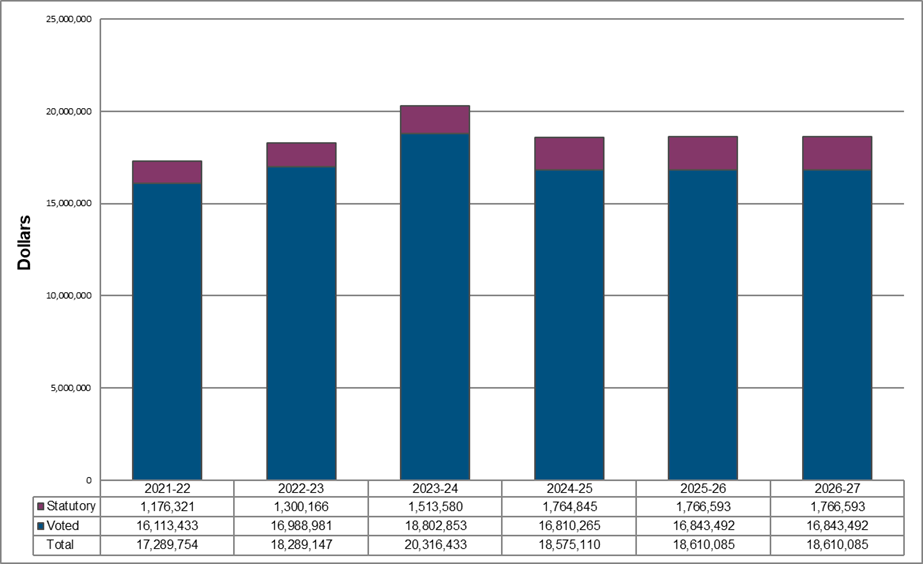
Share this page
Date Modified: